Freedom251 › Decentralized Storage Services

Peergos
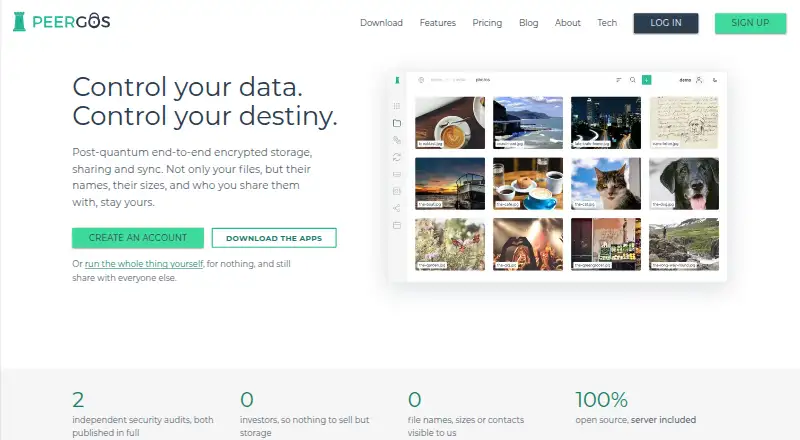
What Peergos is
Peergos is a storage, sharing, and sync service that describes its approach as post-quantum end-to-end encryption. Files are encrypted on the user's device, and the maker says account keys stay there; it also says the server cannot see file names, sizes, folder structure, modification times, file types, contacts, or sharing relationships. Folder sync works in both directions and transfers changed chunks, with an option to prevent deletions from spreading so synced folders can act as backup. Secret links can expire, require a password, restrict use counts, or allow recipients to write back. Peergos includes calendar, document and spreadsheet editors, PDF viewing and editing, media playback, an image gallery, a task board, a Markdown browser, and a wiki. Desktop integrations include WebDAV and CalDAV/CardDAV; Android can sync calendars and contacts with phone apps. Drive mounting is available on Windows, Linux, and Android, but not macOS. The maker says the software, including its server, is open source and offers reproducible builds. Users can self-host it for free. Paid plans list storage from 200 GB to 3000 GB.
Who it suits
Peergos may suit people seeking encrypted file storage, sharing, and cross-device sync, including those who want to host the software themselves. Its built-in editors and calendar, plus desktop integrations, may also suit users seeking more than file storage.
What it does well
- Files are encrypted on the user's device.
- Sync can be configured not to spread deletions.
- Sharing links can expire or require passwords.
- Self-hosting is available for free.
- The maker says the server is open source.
What to know first
- Drive mounting is unavailable on macOS.
- The Free plan is listed as unavailable.
- Paid plans list monthly prices from £43 a month.
Limits
The free self-host plan uses your own disk and requires you to run the server yourself. Paid tiers list 200 GB for Pro, 1,000 GB for Visionary and 3,000 GB for Pioneer; all list unlimited devices and no maximum file size.
Plans
| Plan | Billed and limits | Price |
|---|---|---|
| Self-host | for ever · Your disk · same software · run the server yourself | Free |
| Pro | Monthly £4 per month; yearly £3 per month · 200 GB · unlimited devices · no maximum file size | On request |
| Visionary | Monthly £10 per month; yearly £8 per month · 1000 GB · unlimited devices · no maximum file size | On request |
| Pioneer | Monthly £25 per month; yearly £20 per month · 3000 GB · unlimited devices · no maximum file size | On request |
As peergos.org lists them, read 30 Sept 2026. The maker's own page has the final word.
Getting started
- Visit https://peergos.org/
- Choose the self-host plan or a paid subscription
- Install or access Peergos on Android, Linux, macOS, Windows or the web
- For self-hosting, run the server yourself
- Set up folder sync across devices and choose whether deletions propagate
- Create secret links with the expiry, password, use limit or write-back options you need
Overview
Peergos brings encrypted file storage, sync and sharing together with a suite of built-in apps. It suits privacy-conscious individuals and technically confident users who value self-hosting; it is less suitable for macOS users who need a mounted drive. Its strongest case is the combination of metadata privacy and flexible sharing, while storage beyond a self-hosted disk comes at a substantial listed monthly price.
Key features
Privacy and security
Peergos describes its service as post-quantum end-to-end encrypted. Files are encrypted on the user’s device, and the maker says account keys never leave it. The server is also said to be unable to see file names, sizes, folder structure, modification times, file types, contacts or sharing relationships. That scope makes Peergos a strong fit for users who want to limit what a storage provider can learn from their files and activity.
Account protection includes authenticator apps, WebAuthn and CTAP2 security keys, Windows Hello and single-use backup codes. The maker says Radically Open Security and Cure53 audited Peergos and that both full reports are published. Its server and clients are open source, with reproducible builds. These are meaningful transparency measures for users prepared to assess or rely on them, not a substitute for protecting account credentials.
Sync, sharing and apps
Two-way folder sync sends changed chunks between devices. A setting can prevent deletions from propagating, so a synced folder can retain files removed elsewhere rather than simply mirroring every change. Secret sharing links can expire, require a password, have a fixed use count or allow recipients to write back. Those controls suit sharing with a defined audience or for a limited period.
The desktop app supports WebDAV for tools such as rclone and CalDAV/CardDAV for apps such as Thunderbird; Android can sync calendars and contacts with the phone’s apps. Built-in tools cover calendars, document and spreadsheet editing, PDF viewing and editing, media playback, image browsing, task boards, Markdown and wikis. This breadth can reduce the need to move among separate apps, though users should choose Peergos for its privacy and storage model rather than assume every built-in tool will replace a specialist app.
Pricing
Peergos is freemium in its pricing model, but its plans do not include a hosted free tier. Self-host costs nothing, billed for ever: it includes the same software, with storage limited to the user’s own disk and the user running the server. The maker says self-hosters can still share with other Peergos users. This is the lowest-cost route for people able to manage their own infrastructure; it gives up provider-hosted storage.
Pro is £43 a month and includes 200 GB, unlimited devices and no maximum file size. Visionary is £108 a month for 1000 GB, and Pioneer is £2,520 a month for 3000 GB; both also include unlimited devices and no maximum file size. The plan details give monthly and yearly rates of £4 per month and £3 per month for Pro, £10 per month and £8 per month for Visionary, and £25 per month and £20 per month for Pioneer. The larger tiers add capacity, not a different device or file-size allowance. Pro is the smallest hosted tier; Visionary and Pioneer are for users who need substantially more storage and can justify the higher monthly charge.
Platforms
Peergos supports Android, Linux, macOS, Windows, web and self-hosted use, with desktop and mobile apps. Drive mounting works in Windows, Linux and Android file managers, but is not available on macOS. Mac users can still use the service, but should not choose it expecting a mounted Peergos drive.
Who it's for
Peergos is best for people who want private file sync and sharing together with built-in productivity tools, or who want to run the server themselves. Its metadata protections and configurable secret links also suit users who need tighter control over what a server sees and how recipients access shared files. Those seeking a hosted free plan, or macOS drive mounting, should look elsewhere.
Pros and cons
- Pros: Client-side encryption and broad metadata privacy, as described by the maker, limit server visibility into files and relationships.
- Pros: Deletion controls make two-way sync usable as a backup as well as a mirror.
- Pros: Expiring, password-protected, use-limited and write-back links provide practical sharing controls.
- Pros: Self-hosting costs nothing and retains the ability to share with Peergos users.
- Cons: No hosted free plan is offered, so a hosted account starts with the paid storage tiers.
- Cons: Drive mounting is not available on macOS, despite macOS being supported.
- Cons: The listed Pro and larger tiers carry steep monthly prices, particularly for users who do not need their storage quotas.
Alternatives
Decentralized Storage Services is a broader category to compare when Peergos’s combination of sync, apps and self-hosting is not the right fit.
Sia is worth considering for readers who want an open-source decentralized storage project with a free plan and a wider listed platform range, including iOS and API access.
Carbide Network may suit readers comparing storage offers with per-GB billing and a home-provider option; its listed platforms include Android, iOS, API, macOS and Windows.
Aleph Cloud (formerly Aleph.im) is an alternative for readers focused on API or web-accessible cloud services, with a free static website hosting tier and IPFS distribution.
Walrus may appeal to readers looking for a free launch-period tier, with usage limits and pricing that may evolve over time.
Datum Storage offers a different storage proposition: one free terabyte for the first year, with additional storage priced per terabyte per month.
4EVERLAND is a web-based option with a free monthly tier that includes stated IPFS, Arweave, build-time, bandwidth and RPC allowances.
BNB Greenfield is a paid alternative for readers who prefer storage and download quotas billed in BNB; its free quota varies by selected storage provider.
Filebase may suit readers wanting API or web access and a free tier with 5 GB shared storage, 500 pinned files, 10 GB IPFS egress, free object egress and one bucket.
Verdict
Choose Peergos if you want encrypted sync and sharing with unusually broad metadata protections, useful built-in apps and the option to self-host. Its main drawback is the cost of hosted storage, alongside the missing macOS drive mount. For users who can run their own server or need its particular privacy and sharing controls, it is a compelling choice; otherwise, a less costly hosted option may fit better.
Verdict
Peergos combines encrypted storage and sync with built-in apps, flexible sharing links, and self-hosting. Drive mounting does not extend to macOS, and the listed paid tiers start at £43 a month.
Questions
Is Peergos free?
The listing says there is no free plan, while the Self-host plan is listed as free forever and uses your own disk with the same software.
What do the paid plans cost?
Pro is listed at £4 per month with yearly billing at £3 per month; Visionary at £10 monthly or £8 yearly; and Pioneer at £25 monthly or £20 yearly.
Which platforms does Peergos support?
The listed platforms are Android, Linux, macOS, self-hosted, web and Windows. Drive mounting is available on Windows, Linux and Android, but not macOS.
Is Peergos open source?
Yes. The maker says it is fully open source, including the server, and offers reproducible builds.
Can I self-host Peergos?
Yes. The maker says users can run the whole software themselves for free and still share with other Peergos users.
What storage do the paid plans include?
Pro lists 200 GB, Visionary 1,000 GB and Pioneer 3,000 GB. Each lists unlimited devices and no maximum file size.
Facts from Peergos's own pages
- Built-in apps
- Peergos includes calendar, document and spreadsheet editors, PDF viewing and editing, media playback, an image gallery, task board, Markdown browser and wiki. · peergos.org, 30 Sept 2026
- Company
- Peergos says it is a non-profit funded through user subscriptions, donations and grants, with no investors, debt or advertising. · peergos.org, 30 Sept 2026
- Drive mounting
- A Peergos drive can mount in the file manager on Windows, Linux and Android, but mounting is not yet available on macOS. · peergos.org, 30 Sept 2026
- Encryption
- Files are encrypted on the user's device, and the maker says account keys never leave it. · peergos.org, 30 Sept 2026
- Folder sync
- Folder sync works in both directions across devices, uploads changed chunks, and can be configured to stop propagating deletions so sync acts as backup. · peergos.org, 30 Sept 2026
- Integrations
- The desktop app supports WebDAV for tools such as rclone and CalDAV/CardDAV for apps such as Thunderbird; Android syncs calendars and contacts with the phone's apps. · peergos.org, 30 Sept 2026
- Metadata privacy
- The maker says file names, sizes, folder structure, modification times, file types, contacts and sharing relationships are hidden from the server. · peergos.org, 30 Sept 2026
- Open source
- The maker says Peergos is fully open source, including its server, and offers reproducible builds. · peergos.org, 30 Sept 2026
- Pricing model
- Hosted plans differ by storage, while the maker says every plan includes the same features and there is no free tier on its server. · peergos.org, 30 Sept 2026
- Product
- Peergos describes itself as post-quantum end-to-end encrypted storage, sharing and sync. · peergos.org, 30 Sept 2026
- Security audits
- The maker says Peergos has been audited by Radically Open Security and Cure53, with both reports published in full. · peergos.org, 30 Sept 2026
- Security controls
- Peergos supports authenticator apps, WebAuthn and CTAP2 security keys, Windows Hello, and single-use backup codes. · peergos.org, 30 Sept 2026
- Self-hosting
- The maker says users can run the whole software themselves for free and still share with other Peergos users. · peergos.org, 30 Sept 2026
- Sharing
- Secret links can be set to expire, require a password, allow a fixed number of uses, or permit writing back. · peergos.org, 30 Sept 2026
Where Peergos stands on Freedom251
- Decentralized Storage Services#18 of 25