Freedom251 › Decentralized Storage Services

Arweave
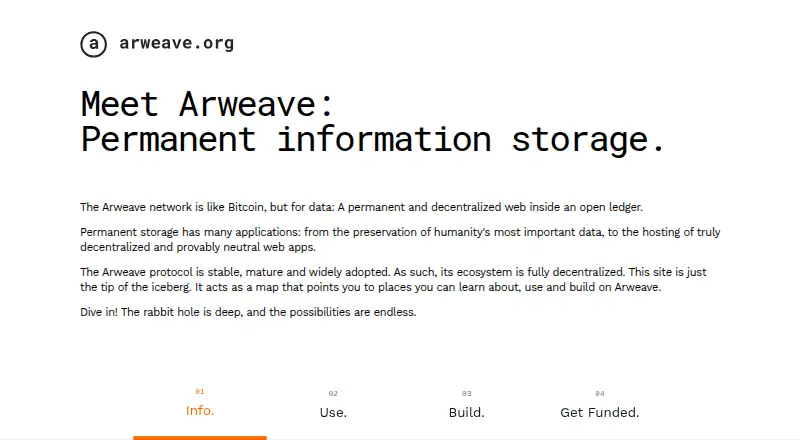
What Arweave is
Arweave is a blockchain network for permanent, decentralized information storage in an open ledger. Its stated uses include preserving important data and hosting decentralized web apps. People can upload files or create a homepage on the permaweb. The network sets transaction fees dynamically, and its documentation recommends checking the price endpoint near the time of submission. The protocol uses HTTP, so developers can access it with existing clients such as Axios, Fetch, and Guzzle. Listed client integrations cover Go, PHP, Scala, Java, C#, JavaScript, TypeScript, and NodeJS. Node software can be installed from pre-built binaries or built from source. The developer guide describes node roles for solo, coordinated, and pool mining, as well as VDF servers and validator nodes. Arweave describes stored content as timestamped and tamper-proof through the blockweave; integrity checks use transaction data in block hashes and recall blocks. Storage has a lasting consequence: once miners store data, there is no guaranteed way to remove it. The policy advises against storing cleartext personal or confidential information. Wallets hold private keys and let dApps request approval to sign transactions and data; wallet providers cannot recover lost key files. Arweave.app is an open-source web wallet and browser add-on, while Wander offers a mobile wallet and Chromium extension.
Who it suits
Arweave suits people seeking decentralized storage for important data or a home for a decentralized web app, and developers who want to work through HTTP clients or listed language integrations. Its storage model also suits users who understand that stored content may not be deletable and that lost wallet key files cannot be recovered by wallet providers.
What it does well
- Supports file uploads and permaweb homepages.
- HTTP access works with existing clients.
- Client integrations cover eight listed languages.
- Node software is available as binaries or source.
- Open-source Arweave.app wallet supports web and browser use.
What to know first
- Transaction fees vary dynamically with the network.
- Stored data has no guaranteed deletion method.
- Lost wallet key files cannot be recovered by wallet providers.
Limits
Transaction fees are determined dynamically, so the price endpoint should be checked near submission. Once one or more miners store data, there is no guaranteed way to delete it; lost wallet key files cannot be recovered by wallet providers.
Getting started
- Visit the Arweave website.
- Choose whether to upload a file or make a permaweb homepage.
- Check the network price endpoint near submission time.
- Use an HTTP client or a listed language integration to access the protocol.
- For node software, install a pre-built binary or build from source.
- For wallet access, use Arweave.app or Wander.
Verdict
Choose Arweave if permanent, decentralized storage or hosting a decentralized web app fits your needs, with HTTP access and multiple client integrations for development. Look elsewhere if you need guaranteed deletion of stored data or recovery of lost wallet key files.
Questions
How are Arweave transaction fees set?
The network determines fees dynamically. The documentation advises checking the price endpoint near submission time.
What can I use Arweave for?
The named uses are preserving important data and hosting decentralized web apps. The Use page also invites file uploads and permaweb homepages.
Which developer integrations are listed?
The docs list Go, PHP, Scala, Java, C#, JavaScript, TypeScript, and NodeJS. The HTTP protocol can also be accessed with clients such as Axios, Fetch, and Guzzle.
Which wallets are available?
Arweave.app is an open-source web wallet and browser add-on for Chrome-like browsers and Firefox. Wander is a mobile wallet and Chromium browser extension.
Can stored data be deleted, and can a lost wallet key be recovered?
There is no guaranteed way to delete data after miners store it. Wallet providers cannot recover lost key files.
Who makes Arweave?
The legal policy identifies Minimum Spanning Technologies Limited and gives its registered office address in London, United Kingdom.
Facts from Arweave's own pages
- API
- The protocol is based on HTTP and can be accessed using existing HTTP clients, including Axios, Fetch, and Guzzle. · docs.arweave.org, 4 Oct 2026
- API access
- The ar.io API reference lists data access, ArNS resolution, network information, and transaction management endpoints for its gateway. · docs.arweave.net, 9 Oct 2026
- Browser support
- The ar.io SDK documentation says its SDKs are available for Node.js and browser environments, with TypeScript support. · docs.arweave.net, 9 Oct 2026
- Consensus and storage proofs
- The protocol documentation describes a decentralized consensus mechanism adapted for permanent storage and Succinct Proofs of Random Access to verify data access. · github.com, 9 Oct 2026
- Data access
- The ar.io documentation says its gateway retrieves Arweave data, caches and indexes it, resolves ArNS names, and exposes HTTP interfaces. · docs.ar.io, 9 Oct 2026
- Data permanence caveat
- The legal policy says that once data has been stored by one or more miners, there is no guaranteed way to delete it, and advises against storing cleartext personal or confidential information. · arweave.org, 4 Oct 2026
- Developer tools
- The ar.io SDK documentation lists the Turbo SDK for uploads, the ar.io SDK for its protocols and services, and the Wayfinder SDK for decentralized data access. · docs.arweave.net, 9 Oct 2026
- Dynamic pricing
- Transaction fees are determined dynamically by the network, and the docs advise checking the price endpoint near submission time. · docs.arweave.org, 4 Oct 2026
- Gateway distinction
- The ar.io documentation says gateways make Arweave data easier to access, while Arweave provides permanent storage and data availability. · docs.ar.io, 9 Oct 2026
- Integrations
- The docs list client integrations for Go, PHP, Scala, Java, C#, JavaScript, TypeScript, and NodeJS. · docs.arweave.org, 4 Oct 2026
- Intended audience
- The ar.io developer documentation describes resources for building applications, uploading and accessing data, and operating gateway infrastructure. · docs.arweave.net, 9 Oct 2026
- Maker and registered office
- The legal policy identifies Minimum Spanning Technologies Limited and gives an address in London, United Kingdom. · arweave.org, 4 Oct 2026
- Network model
- The site says the Arweave ecosystem is fully decentralized. · arweave.org, 9 Oct 2026
- Network verification
- The Yellow Paper says stored content is timestamped and tamper-proof through the blockweave, with data integrity checked through transaction data in block hashes and recall blocks. · arweave.org, 4 Oct 2026
- Node roles
- The developer guide describes solo mining, coordinated mining, pool mining, VDF server, and validator node types. · docs.arweave.org, 4 Oct 2026
- Node software
- Node software can be installed from pre-built binaries or built from source. · docs.arweave.org, 4 Oct 2026
- Open source
- The ar.io API reference says its services follow open source principles and repositories are available under AGPL-3 licenses. · docs.arweave.net, 9 Oct 2026
- Pricing model
- The Arweave protocol documentation says upload fees scale with uploaded data volume and a portion goes to the storage endowment. · github.com, 9 Oct 2026
- Storage endowment
- The protocol documentation says uploaders contribute AR to a storage endowment that pays miners over time for proofs of replication. · github.com, 9 Oct 2026
- Support
- The developer guide recommends Discord and the GitHub Discussions board for mining questions and support. · docs.arweave.org, 4 Oct 2026
- Upload and publish
- The Use page invites people to upload a file or make a homepage on the permaweb. · arweave.org, 4 Oct 2026
- Use cases
- The site says permanent storage can preserve important data and host decentralized web apps. · arweave.org, 9 Oct 2026
- Wallet availability
- Arweave.app is an open-source web wallet and browser add-on for Chrome-like browsers and Firefox; Wander is a mobile wallet and Chromium browser extension. · docs.arweave.org, 4 Oct 2026
- Wallet security
- Wallets store private keys and provide an interface for dApps to request approval to sign transactions and data; the docs warn that lost key files cannot be recovered by the wallet providers. · docs.arweave.org, 4 Oct 2026
Where Arweave stands on Freedom251
- Decentralized Storage Services#17 of 25