Freedom251 › Banking-as-a-Service Platforms
Swan Cards
What Swan Cards is
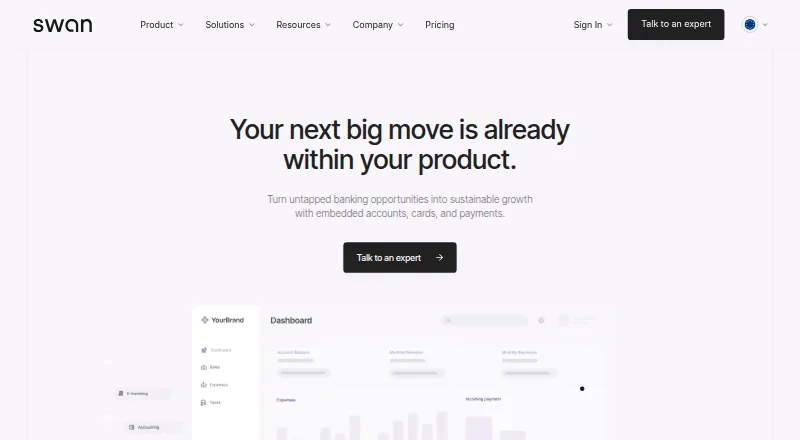
Swan provides embedded accounts, cards, and payment features that companies can add to their own products. It positions its white-labeled banking platform for European software companies. Mastercard debit cards are available in virtual, physical, and digital formats, including single-use virtual cards. Cards can be added to Apple Wallet and Google Wallet for NFC payments; other digital wallets are not supported. Partners can set spending limits and payment rules using amount, currency, merchant, city, or country. Swan offers a GraphQL API, a ready-made web banking interface, and an open-source frontend for customized web banking. For security, API calls must originate from a partner’s backend rather than a frontend application. Swan says it is an electronic money institution licensed by France’s ACPR. It also says client funds are segregated and deposited with BNP Paribas, with FGDR protection up to €100,000 per client if BNP Paribas defaults. The free Sandbox includes fake accounts, cards, and payments; paid services start at €2,990/mo.
Who it suits
Swan suits European software companies seeking to add white-labeled accounts, cards, and payments to their products. Its API and web banking options support partner integration and customization.
What it does well
- Cards include virtual, physical, digital, and single-use formats.
- Partners can set spending limits and payment rules.
- Free Sandbox includes fake accounts, cards, and payments.
- Offers a GraphQL API and web banking interfaces.
What to know first
- API calls must come from the partner’s backend.
- Other digital wallets beyond Apple Wallet and Google Wallet are unsupported.
- Paid services start at €2,990/mo.
Limits
The free Sandbox uses fake accounts, cards, and payments. Swan on demand starts at €2,990/mo and includes ready-made banking services and branded physical and virtual cards; Enterprise features and services are custom.
Plans
| Plan | Billed and limits | Price |
|---|---|---|
| Sandbox | Unlimited sandbox users · fake accounts, cards and payments · API Explorer/Postman · Testing API · Event Simulator | Free |
| Swan on demand | Starting from 2990€/m · Local IBAN accounts · SEPA and multi-currency transfers · virtual IBANs · branded physical and virtual cards · Apple Pay/Google Pay | €2,990 a month |
| Swan | Starting at €900/month · Listing reports subscription pricing · free version · no free trial available | €900 a month |
| Swan Enterprise | Custom · Dedicated implementation manager · interchange revenue sharing · fully customized physical cards | On request |
As swan.io lists them, read 15 Oct 2026. The maker's own page has the final word.
Getting started
- Open https://www.swan.io.
- Start with the free Sandbox to explore API tools and test fake accounts, cards, and payments.
- Choose Swan on demand starting at €2,990/mo, or contact Swan about its custom Enterprise plan.
- Integrate through the GraphQL API from your backend or use the ready-made web banking interface.
- Use the open-source Swan Banking Frontend if you want to customize web banking.
Overview
Swan Cards is an embedded-banking platform for software companies that want to add branded accounts, cards and payments to their products. It best suits European businesses building financial services around a backend integration. Configurable card rules and web banking components give product teams room to shape the service, but the live-service entry price and backend-only API access make it a substantial commitment.
Key features
Swan combines embedded accounts, Mastercard debit-card issuing, SEPA payments, KYC/AML tools and a ledger. Cards come in virtual, physical and digital formats, including single-use virtual cards. Partners can set spending limits and payment rules by amount, currency, merchant, city or country, which is useful when a product needs to constrain card use to particular transactions or locations.
Standard, Essential and Premium card packages set spending limits at €10,000, €40,000 and €100,000, with FX fees of 2%, 1% and 0%, respectively. Standard keeps the limit lowest and FX fee highest; Premium removes the FX fee but has the highest stated limit. The choice matters most for programs where customers regularly spend in other currencies or need larger limits.
Swan cards work with Apple Wallet and Google Wallet for NFC payments, but not other digital wallets. Online payments support 3-D Secure, while sensitive card-related changes require consent. For web banking, partners can use Swan's ready-made interface or customize the open-source Swan Banking Frontend. The GraphQL API must be called from the partner's backend, not a frontend application, so teams need a server-side integration rather than a browser-only connection.
Swan says it is a licensed electronic money institution authorized by France's ACPR. It says client funds are segregated and deposited with BNP Paribas, with FGDR protection up to €100,000 per client if BNP Paribas defaults. Support handles technical questions, setup, operations and transactions through a request form.
Pricing
The Sandbox plan is free, with unlimited sandbox users, fake accounts, cards and payments, plus an API explorer and testing tools. It is for teams exploring the integration without live banking services; its sandbox accounts, cards and payments are explicitly fake.
Swan on demand starts at €2,990 per month. It includes ready-made banking services, branded physical and virtual cards, and Apple Pay and Google Pay cards. That is the entry point for a product moving beyond sandbox exploration, but it is a meaningful monthly commitment for a team that only needs to validate an idea.
Swan Enterprise has custom pricing and adds custom features and services, a dedicated implementation manager and interchange revenue sharing. It fits businesses needing a tailored program and implementation support; the price depends on the arrangement. The plan terms do not state trial length, renewal conditions or seat limits.
Platforms
Swan is available through API and web. Its API constraint is material: calls must originate on the partner's backend. The web interface and open-source frontend provide web banking options, while Apple Wallet and Google Wallet support covers mobile NFC payments.
Who it's for
Swan is aimed at European software companies adding white-labeled banking services. Its stated supported regions span Austria, Belgium, Bulgaria, Croatia, Cyprus, Czechia, Denmark, Estonia, Finland, France, Germany, Greece, Hungary, Iceland, Ireland, Italy, Latvia, Liechtenstein, Lithuania, Luxembourg, Malta, Netherlands, Norway, Poland, Portugal, Romania, Slovakia, Slovenia, Spain and Sweden. It is a stronger fit for product teams prepared to build backend integration and operate a defined card program than for businesses seeking a standalone card app.
Pros and cons
- Pros: Accounts, cards, SEPA payments, KYC/AML tools and a ledger sit within one embedded-banking platform, which suits companies building a broader financial product.
- Pros: Configurable payment rules and three card packages let partners align card use, spending limits and FX fees with their program.
- Pros: The free sandbox includes unlimited sandbox users and testing tools, so teams can explore before paying for live services.
- Cons: API calls must come from a partner backend, ruling out frontend-only API integrations.
- Cons: Live services start at €2,990 per month, a substantial threshold for smaller products or early-stage experiments.
- Cons: Wallet support is limited to Apple Wallet and Google Wallet, so products relying on other digital wallets will need another approach.
Alternatives
Railsr is worth comparing for teams seeking a freemium option with a two-month free live sandbox API; its sandbox has real money but account, value and transaction restrictions.
Stripe Treasury may suit teams prioritizing a no-minimum, no-monthly-fee Treasury plan; ACH funding is included and wire funding costs $2.00 per wire.
Paynetics Card Issuing is another option for customizable card programs with physical and virtual Visa or Mastercard cards and custom pricing.
Unit is an alternative for teams willing to evaluate a paid platform where actual card pricing, shipping and order minimums depend on program and design choices.
Vodeno Cloud Platform, Column and Dock are other paid platform options.
Mbanq Cloud offers a pay-as-you-grow plan with IT infrastructure, support and operational costs included, which may appeal to teams comparing that cost structure with Swan's starting monthly price.
Browse more options in Banking-as-a-Service Platforms.
Verdict
Swan is a strong fit for European software companies building branded banking products that need accounts, configurable cards and web banking components, and can support a backend-led integration. The free sandbox lowers the barrier to evaluation, but the €2,990-per-month starting price for live services and limited wallet support are reasons to look elsewhere if the product needs a lighter-cost launch or broader wallet coverage.
Verdict
Swan offers embedded banking components with configurable card controls and integration options for partner products. Its backend-only API requirement and wallet support should be considered alongside the stated starting price.
Questions
Does Swan have a free plan?
Yes. The Sandbox costs nothing and includes unlimited sandbox users, fake accounts, cards, and payments, plus API explorer and testing tools.
How much does Swan on demand cost?
Swan on demand starts at €2,990/mo.
What platforms or integration options does Swan offer?
The listed platforms are API and web. Integration options include a GraphQL API, a ready-made web banking interface, and an open-source Swan Banking Frontend.
Can API calls come from a frontend application?
No. Swan requires API calls to originate from the partner’s backend.
Which mobile wallets work with Swan cards?
Swan cards can be added to Apple Wallet and Google Wallet for NFC payments. Other digital wallets are not supported.
What does Swan say about its regulatory status and safeguarding?
Swan states it is licensed by France’s ACPR as an electronic money institution. It says client funds are segregated and deposited with BNP Paribas, with FGDR protection up to €100,000 per client if BNP Paribas defaults.
Facts from Swan Cards's own pages
- Account features
- The platform offers local IBAN accounts, virtual IBANs, account funding and SEPA or international transfers. · swan.io, 15 Oct 2026
- API
- Swan exposes a GraphQL API for accounts, cards, transactions and other banking actions. · docs.swan.io, 15 Oct 2026
- API constraint
- For security reasons, Swan requires API calls to originate from the partner’s backend rather than a frontend application. · docs.swan.io, 29 Sept 2026
- API environments
- Live and Sandbox environments use separate endpoints, credentials and projects, and Sandbox data cannot be moved to Live. · docs.swan.io, 15 Oct 2026
- API limits
- The default API rate limit is 2,000 requests per IP every five minutes; Sandbox operations also have complexity, depth and concurrency limits. · docs.swan.io, 15 Oct 2026
- API security model
- Swan blocks browser-originated API calls, requiring backend communication. · docs.swan.io, 15 Oct 2026
- Audience
- Swan describes itself as a platform helping European software companies add white-labeled banking services to their products. · swan.io, 29 Sept 2026
- Card controls
- Spending controls can be set by amount, currency, merchant, category, city or country. · swan.io, 15 Oct 2026
- Card formats
- Swan supports instant virtual, single-use virtual, physical and digital Mastercard debit cards. · swan.io, 15 Oct 2026
- Card package billing
- Card packages can involve a monthly active-card fee, non-euro FX fees and one-time physical-card printing and shipping fees. · docs.swan.io, 15 Oct 2026
- Card packages
- Standard, Essential and Premium packages have €10,000, €40,000 and €100,000 spending limits, with FX fees of 2%, 1% and 0%. · docs.swan.io, 15 Oct 2026
- Card programs
- Partners can create branded and compliant card programs under their own user experience. · swan.io, 15 Oct 2026
- Card types
- Swan offers Mastercard debit cards in virtual, physical, and digital formats, including single-use virtual cards. · docs.swan.io, 29 Sept 2026
- Company history
- Swan’s company history page says it was born in 2019, when its three co-founders began writing the first lines of code. · swan.io, 29 Sept 2026
- Company size
- LinkedIn lists Swan as privately held, founded in 2019, headquartered in Paris and employing 201–500 people. · linkedin.com, 15 Oct 2026
- Custom card limit
- Custom physical-card projects can take up to 16 weeks and require a first batch of at least 1,000 cards. · docs.swan.io, 15 Oct 2026
- Developer tooling
- Documentation links an API Explorer, API reference, Postman collection, Testing API, Event Simulator and MCP servers. · docs.swan.io, 15 Oct 2026
- Documentation depth
- The documentation includes product topics, task guides, API concepts, mutations, queries, webhooks, authentication, pagination and troubleshooting. · docs.swan.io, 15 Oct 2026
- Founded
- 2019 · swan.io, 28 Sept 2026
- Funding news
- TechCrunch reported on 29 January 2025 that Swan raised a €42 million Series B extension led by Eight Roads. · techcrunch.com, 15 Oct 2026
- Funds safeguarding
- Client funds are segregated with BNP Paribas and protected by FGDR up to €100,000 per client if the bank defaults. · swan.io, 15 Oct 2026
- Google Play listing
- The Swan app listing shows 10K+ downloads but no numerical rating or review count. · play.google.com, 15 Oct 2026
- Headquarters
- Paris, France · swan.io, 28 Sept 2026
- Integrations
- Swan offers a GraphQL API, a ready-made web banking interface, and an open-source Swan Banking Frontend for customized web banking. · docs.swan.io, 29 Sept 2026
Where Swan Cards stands on Freedom251
- Banking-as-a-Service Platforms#3 of 31