Freedom251 › Membership Site Platforms

Substack
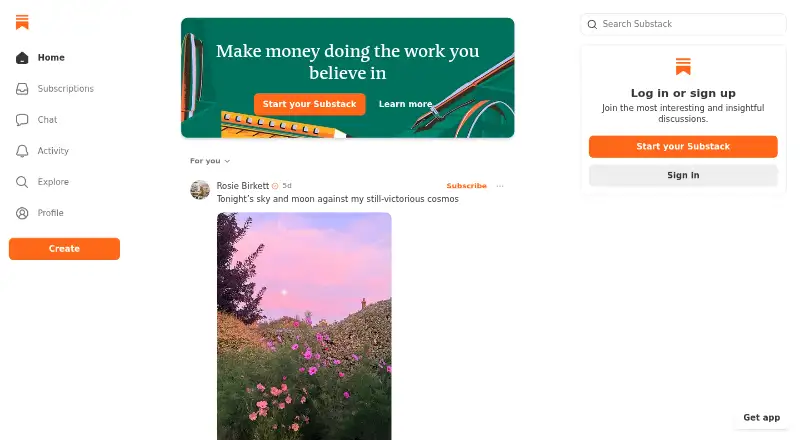
What Substack is
Substack is a publishing platform for writers, creators, and subscribers, bringing written posts, newsletters, podcasts, video, live streams, and pages into one publishing flow. Its editor supports scheduled publishing, autosaved drafts, version history, templates, SEO metadata, and headline A/B testing. Creators can publish free or paid posts and offer subscriptions, trials, gifts, and group plans. Audience tools include recommendations, Notes, leaderboards, referrals, search, and segmentation, alongside email automation. Podcast episodes can be distributed automatically to Apple Podcasts and Spotify, while video can be sent automatically to YouTube and LinkedIn. Publishing is free. If creators enable paid subscriptions, Substack keeps 10% of subscription revenue, and Stripe charges payment processing fees. Creators retain ownership of their intellectual property and mailing list and can export their data. Substack serves writers, journalists, podcasters, video creators, experts, educators, and media companies. It is available on the web, Android, and iOS. The platform directs users to its Help Center for FAQs and walkthroughs, and handles subscriber support questions on behalf of writers. Substack accepts vulnerability reports by email and commits to an initial confirmation within 72 hours. Its privacy policy says it endeavors to protect personal information but cannot guarantee complete security.
Who it suits
Substack suits writers, journalists, podcasters, video creators, experts, educators, and media companies who want to publish and grow an audience. It also fits creators who want to offer free and paid content while retaining ownership of their intellectual property and mailing list.
What it does well
- Supports posts, newsletters, podcasts, video, live streams, and pages.
- Includes scheduling, autosaved drafts, templates, and version history.
- Offers audience segmentation and email automation.
- Creators can export their data and mailing list.
- Automatically distributes podcasts and video to named platforms.
What to know first
- Substack keeps 10% of paid subscription revenue.
- Stripe payment processing fees also apply to paid subscriptions.
- The privacy policy does not guarantee complete security.
Limits
Publishing is free. When creators enable paid subscriptions, Substack keeps 10% of subscription revenue and Stripe charges payment processing fees.
Plans
| Plan | Billed and limits | Price |
|---|---|---|
| Free to start | No platform fees, no tiers, no contracts | Free |
| Free publishing | unlimited subscribers · no upfront platform fee · free posts | Free |
| Custom domain | one-time fee · optional custom domain | $50, paid once |
| Paid subscriptions | creator sets monthly, annual and founding-member prices; Substack keeps 10% plus Stripe fees · minimum $5/month and $30/year for US-dollar Stripe accounts · free trials · coupons · gifts · group billing · multi-currency | On request |
As substack.com lists them, read 7 Oct 2026. The maker's own page has the final word.
Getting started
- Visit Substack on the web or use its Android or iOS platform.
- Start publishing; publishing is free.
- Create written posts, newsletters, podcasts, video, live streams, or pages.
- Use the editor’s publishing and audience tools as needed.
- Enable paid subscriptions if you want to monetize, accounting for Substack’s share and Stripe processing fees.
- Use the Help Center for FAQs and walkthroughs.
Overview
Substack brings publishing and audience support together for creators who want to build a publication across formats. It is a strong fit for independent writers, journalists, podcasters, educators and media teams seeking discovery and subscription tools, though its share of paid revenue is a meaningful cost as a publication grows.
Creators retain their intellectual property and mailing list and can export their data. That ownership gives creators a route to take their work and audience information with them, even as the publishing relationship runs through Substack.
Key features
One publishing flow handles written posts, newsletters, podcasts, video, live streams and pages. The editor includes scheduling, autosaved drafts, version history, templates, SEO metadata and headline A/B testing. This range suits creators running a regular publication in multiple formats; a writer who only needs a place to draft may find the broader toolkit unnecessary.
Recommendations, Notes, leaderboards, referrals and search give creators multiple ways to reach potential readers. Audience segmentation and email automation add tools for communicating with different parts of an audience. Together, those features make Substack more useful for developing an ongoing reader relationship than for sending occasional, undifferentiated updates.
Creators can combine free and paid posts with subscriptions, trials, gifts and group plans. Podcast episodes can be distributed automatically to Apple Podcasts and Spotify, while video can be distributed to YouTube and LinkedIn. These options help a creator manage publishing and monetization across formats in one place, although enabling paid subscriptions means sharing revenue with the platform and paying Stripe processing fees.
Substack points users to its Help Center for FAQs and walkthroughs, and handles subscriber support questions on writers' behalf. For security reports, it accepts vulnerability reports by email and commits to an initial confirmation within 72 hours. Its privacy policy says it works to protect personal information but cannot guarantee complete security, a limitation to weigh when choosing any service to hold audience information.
Pricing
Substack is freemium, with a free plan listed as free. The “Free to start” plan has no platform fees, tiers or contracts, making it suitable for creators who want to publish without committing to paid subscriptions. Publishing itself is free; when creators enable paid subscriptions, Substack keeps 10% of subscription revenue and Stripe charges payment processing fees. Creators should account for both charges when deciding whether paid subscriptions fit their economics.
There is no separate paid plan described. Creators who need a different fee structure should compare alternatives before building a paid publication around Substack.
Platforms
Substack is available on web, Android and iOS, giving creators and subscribers access across browsers and the two major mobile platforms.
Who it's for
Substack suits writers, journalists, podcasters, video creators, experts and educators who want to publish regularly, grow an audience and offer free or paid access. Media companies can also use its multi-format publishing flow. It is less compelling for creators whose main concern is minimizing the cost of paid subscriptions, or who require a guarantee of complete security.
Pros and cons
- One flow for multiple formats: Writing, newsletters, podcasts, video, live streams and pages can share a publishing home, useful for creators working across formats.
- Several audience discovery tools: Recommendations, Notes, leaderboards, referrals and search provide multiple routes to finding readers.
- Creators retain their work and list: Ownership of intellectual property and the mailing list, plus data export, gives creators meaningful control over what they build.
- Paid subscriptions carry two costs: Substack takes 10% of subscription revenue and Stripe charges processing fees, reducing the proceeds creators keep.
- Security is not guaranteed: Substack's privacy policy acknowledges that complete security cannot be assured, which may matter to publishers handling audience information.
Alternatives
Patreon is another freemium option with a free plan and apps for Android, iOS and web, as well as an API. Its Standard plan mentions up to 100 hours per month of video hosting for creators with paying fans; compare its plan terms if that video allowance suits your publishing needs.
Appy Pie Membership Website Builder offers a free plan, a free trial and a paid plan at $18 a month. Choose it for a web-based membership site if its payment integration and custom domain match your needs.
Paid Memberships Pro has a free, open-source core plugin and add-ons under GPLv2 that can run on as many sites as desired. It is a better fit for someone who wants an open-source membership setup across one or more self-hosted sites.
Raklet has a free plan with 100 contacts, one admin seat and 1,250 free emails per month. That defined contact and email allowance may suit a small membership or community that wants explicit limits to plan around.
Systeme.io offers a free plan with 2,000 contacts, three sales funnels, one course, one blog and one custom domain. It is worth comparing for a creator who needs those specific tools and wants to stay within the free plan's stated caps.
memberplanet offers a Basic plan with unlimited members and admins, and an Essentials plan at $50 a month with a 2% platform fee. Consider it when unlimited member and admin counts are central to the choice.
Steady is free to use, has no audience limits, and takes a 10% fee when creators earn, plus variable payment-provider fees and applicable VAT. It may suit publishers who value an uncapped audience and accept a similar platform share on earnings.
Concord is a paid membership platform available on Android, iOS, Linux, macOS, web and Windows. Its Starter plan includes one recurring tier, one one-time offer and 150 MB of attachments; its Growth plan includes two recurring tiers, two one-time offers and 3 GB of attachments.
For a broader comparison, browse Membership Site Platforms, Newsletter Platforms, Writing Apps, Podcast Monetization Platforms or Email Marketing Software.
Verdict
Choose Substack if you want one publishing flow for several content formats, with audience discovery tools and paid subscription options. Creator ownership and data export make it a flexible base for a publication, while the 10% platform share plus Stripe processing fees are the clearest reason to look elsewhere if paid revenue is central to your business.
Verdict
Choose Substack if you want one publishing flow for several content formats, with audience discovery tools and paid subscription options. Look elsewhere if you want to avoid the 10% platform share on paid subscriptions or need a guarantee of complete security.
Questions
Is Substack free?
Publishing is free. Substack keeps 10% of subscription revenue when creators enable paid subscriptions, and Stripe charges payment processing fees.
Which platforms can I use?
Substack is available on the web, Android, and iOS.
What kinds of content can creators publish?
Substack supports written posts, newsletters, podcasts, video, live streams, and pages in one publishing flow.
Can creators offer paid subscriptions?
Yes. Creators can offer paid posts, subscriptions, trials, gifts, and group plans. Substack keeps 10% of subscription revenue, with Stripe processing fees also charged.
Do creators own their mailing list and content?
Creators own their intellectual property and mailing list, and they can export their data.
Does Substack distribute content to other platforms?
Podcast episodes can be distributed automatically to Apple Podcasts and Spotify. Video can be distributed automatically to YouTube and LinkedIn.
Facts from Substack's own pages
- API restrictions
- API data may be used for discovery, analytics and integrations but cannot be used for surveillance, spam, resale, competing services or source misrepresentation; rate limits can change at Substack's discretion. · substack.com, 15 Oct 2026
- API scope
- The public API terms allow access to selected public profile and publication data such as names, social links, subscriber counts, bestseller status and URLs. · substack.com, 15 Oct 2026
- Audience discovery
- Recommendations, Notes, app discovery, trending topics and leaderboards are built-in growth channels. · substack.com, 15 Oct 2026
- Audience growth
- Discovery tools include recommendations, Notes, leaderboards, referrals, and search. · substack.com, 7 Oct 2026
- Community
- Creators can use subscriber chats, comment threads and moderation tools to build communities around publications. · substack.com, 15 Oct 2026
- Company founders
- Crunchbase identifies Christopher Best, Hamish McKenzie and Jairaj Sethi as founders, with Best as CEO and Sethi as CTO. · crunchbase.com, 15 Oct 2026
- Company legal name
- Crunchbase lists the legal name as Substack Inc. · crunchbase.com, 15 Oct 2026
- Company size
- LinkedIn lists 51–200 employees, while Crunchbase lists headcount in the 101–250 range. · linkedin.com, 15 Oct 2026
- Content ownership
- Terms say creators retain ownership of posts, subscriber lists and other uploaded material while granting Substack a broad royalty-free license to operate the service. · substack.com, 15 Oct 2026
- Creator fees
- Publishing is free; when creators enable paid subscriptions, Substack keeps 10% of subscription revenue and Stripe charges payment processing fees. · support.substack.com, 7 Oct 2026
- Creator ownership
- Creators own their intellectual property and mailing list, and can export their data. · substack.com, 7 Oct 2026
- Documentation and support
- Substack provides a searchable Help Center with setup and billing articles, plus an in-app support bot. · support.substack.com, 15 Oct 2026
- Editor
- Its editor is designed for long-form writing, supports media embeds and scheduling, and manages an archive in one CMS. · substack.com, 15 Oct 2026
- Email automation
- Yes · substack.com, 20 Sept 2026
- Founded and headquarters
- LinkedIn lists Substack as founded in 2017 and headquartered at 111 Sutter St, San Francisco, California 94104. · linkedin.com, 15 Oct 2026
- Free plan
- Yes · substack.com, 20 Sept 2026
- Funding news
- On July 17, 2025, Substack announced a $100 million Series C led by BOND and The Chernin Group, with participation from Andreessen Horowitz, Rich Paul and Jens Grede. · substack.com, 15 Oct 2026
- Import and export
- Substack can import posts or subscribers from WordPress, Ghost, Medium, Beehiiv, Mailchimp, Tumblr, Webflow, Sanity, Seeking Alpha, Bulletin, TinyLetter, Blogspot and RSS, and lets creators export publication data. · substack.com, 15 Oct 2026
- Independent review limitation
- TechRadar praises simple publishing, Notes and recommendations but says customization, analytics, SEO and customer support are limiting for ambitious publishers. · techradar.com, 15 Oct 2026
- Infrastructure
- The service provides managed email delivery, CDN-hosted media, real-time messaging infrastructure, multilingual settings, MFA and privacy controls. · substack.com, 15 Oct 2026
- Integrations
- Official integrations include RSS, podcast distribution to Apple and Spotify, Google Analytics 4, Google Tag Manager, X and Facebook pixels, Google site verification, YouTube and LinkedIn account connections. · substack.com, 15 Oct 2026
- Limit: Android app
- Google Play reviewers report stale unread status, repetitive Notes recommendations, inability to edit comments or newsletters in-app, crashes, draft-sync failures and login problems. · play.google.com, 15 Oct 2026
- Limit: Apple app
- App Store reviewers report orientation and comment-heart bugs, lost comment drafts and dissatisfaction with redesigned navigation. · apps.apple.com, 15 Oct 2026
- Limit: G2 fees and features
- G2 reviewers criticize the continuing 10% revenue share, limited customization or monetization options, navigation confusion and lack of integrations. · g2.com, 15 Oct 2026
Where Substack stands on Freedom251
- Membership Site Platforms#3 of 85
- Writing Apps#5 of 135
- Email marketing tools#9 of 189
- Publishing and Subscriptions Software#4 of 22
- Newsletter Publishing Platforms#4 of 15
- Email Marketing Software#66 of 189
- Blog Software#10 of 25
- Podcast Monetization Platforms#14 of 31
- Newsletter Platforms#15 of 30