Freedom251 › Data Virtualization Software

Stardog
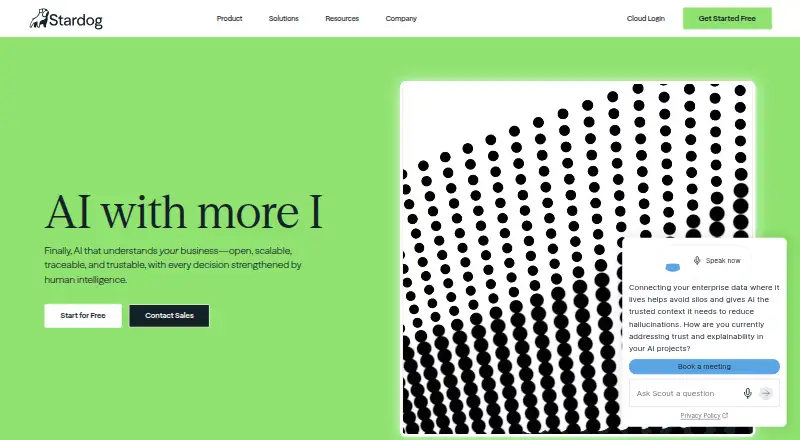
What Stardog is
Stardog connects enterprise data in a semantic layer for AI, analytics, search, and applications. Its virtualization feature lets teams work with on-premises and cloud sources without moving or copying the data. The Inference Engine applies business rules at query time and shows the logic behind results. Stardog Voicebox uses large language models to support knowledge-graph modeling, maintenance, and query writing; built-in machine learning provides similarity search and predictive analytics. SHACL constraints can validate data and identify inconsistencies across silos.
The platform supports SPARQL, SPARQL*, GraphQL, and W3C RDF standards. Connectors cover sources such as Snowflake, BigQuery, Oracle, PostgreSQL, MongoDB, Elasticsearch, Salesforce, Jira, Splunk, and REST services. Stardog runs as a managed AWS service, in customer cloud environments, or on premises. The graph database supports up to 100 billion data points per installation and scale-out deployments up to 1 trillion triples. Stardog Free is available for commercial use at no cost, with up to 1 million stored edges and three databases. It excludes high availability, caching, backups, LDAP integration, and the full breadth of Connectors.
Who it suits
Stardog suits organizations connecting data across cloud and on-premises sources for AI, analytics, search, or applications. Its free plan may suit commercial users who can work within its storage and feature limits.
What it does well
- Virtualizes data without moving or copying it
- Applies business rules during queries
- Supports SPARQL, GraphQL, and W3C RDF
- Runs in managed cloud, customer cloud, or on premises
- Free commercial plan includes up to three databases
What to know first
- Free plan is limited to 1 million stored edges
- Free plan excludes high availability and backups
- Free plan excludes LDAP and the full breadth of Connectors
Limits
Stardog Free is a renewable 1-year license with up to 1 million stored edges and three databases. It excludes high availability, caching, backups, LDAP integration, and the full breadth of Connectors.
Plans
| Plan | Billed and limits | Price |
|---|---|---|
| Stardog Free | renewable 1-year license · commercial use · excludes high availability, caching, backups, LDAP integration and full connector set · community support only | Free |
| Stardog Cloud Free | shared cloud hosting · up to 1 million stored edges · 3 databases · community support | Free |
| Stardog Enterprise | Contact us · custom stored-edge limit · unlimited databases · premium support · 99.9% uptime SLA · daily backups retained 30 days | On request |
| Stardog Cloud Enterprise | dedicated hosting · custom stored-edge limit · unlimited databases · premium support · 99.9% uptime SLA · daily backups retained 30 days | On request |
As stardog.com lists them, read 14 Oct 2026. The maker's own page has the final word.
Getting started
- Visit the Stardog website.
- Choose Stardog Free or contact Stardog about Enterprise.
- Select a deployment route: managed AWS, customer cloud, or on premises.
- Use Stardog on Linux, macOS, web, Windows, or through its API, as applicable.
Stardog is a semantic data platform for organizations that need to query and connect distributed enterprise data. It is best suited to teams building knowledge graphs or AI and analytics applications on top of varied data sources; its free tier makes a commercial start possible, but leaves out several operational safeguards.
Overview
Stardog’s strength is connecting data where it already lives, rather than requiring teams to move or copy it first. The semantic layer can support AI, analytics, search, and applications, while the graph database provides a way to work with relationships across disparate sources. That makes it a focused choice for organizations with fragmented data and graph-oriented use cases, not a default database for every workload.
Deployment can be managed through AWS, run in a customer cloud environment, or hosted on premises using Docker, Kubernetes, AWS Marketplace, or Azure Marketplace. Stardog was founded in 2006 and is headquartered in New York. Its published SOC 2 Type I report covers controls relevant to systems containing Stardog Cloud customer data.
Key features
Virtualization, graph queries, and inference
Virtualization lets teams access on-premises and cloud data without moving or copying it, which can reduce the need to create a separate consolidated data store. Support for SPARQL, SPARQL*, GraphQL, and W3C RDF standards suits teams already using semantic models or planning to build around them. SQL querying is also supported.
The Inference Engine applies business rules at query time and displays the logic behind its results. That transparency is useful when users need to understand how a relationship or conclusion was derived, though it depends on teams maintaining the relevant rules and graph model.
AI, quality, and integrations
Stardog Voicebox uses large language models to help with knowledge-graph modeling, maintenance, and query writing. Built-in machine learning adds similarity search and predictive analytics. SHACL constraints can validate data and flag inconsistencies across silos, giving teams a way to check data quality within the semantic layer.
Connectors include Snowflake, BigQuery, Oracle, PostgreSQL, MongoDB, Elasticsearch, Salesforce, Jira, Splunk, and REST sources. Officially supported BI tools include Tableau, Power BI, cumul.io, Apache Superset, Siren, IBM Cognos, Metabase, and RapidMiner. The graph database supports up to 100 billion data points per installation, with scale-out deployments up to 1 trillion triples; these ceilings make it relevant to large environments, though they do not remove the work of designing and operating a graph architecture.
Pricing
| Plan | Price and terms | What it includes |
|---|---|---|
| Stardog Free | free; billed Free; renewable 1-year license | Up to 1 million stored edges, 3 databases, community support |
| Stardog Enterprise | Custom pricing; billed Contact us | Custom stored-edge limit, unlimited databases, premium support, 99.9% uptime SLA, daily backups retained 30 days |
Free is commercially usable, so it can serve as a bounded starting point rather than only a personal evaluation tier. Its 1 million stored-edge cap and three-database limit constrain how far a growing deployment can go. It also excludes high availability, caching, backups, LDAP integration, and the full breadth of Connectors, making it a poor fit when resilience, identity integration, or broad source coverage is essential.
Enterprise removes the fixed stored-edge ceiling in favor of a custom limit and allows unlimited databases. Its 99.9% uptime SLA and 30-day retention of daily backups address operational needs absent from Free; premium support also includes base support, a dedicated Customer Success representative, and access to Solutions Architects. Organizations needing those protections should expect to discuss custom pricing rather than rely on a published rate.
Platforms
Stardog supports API access and runs on Linux, macOS, and Windows, as well as through web access. Both cloud-hosted and self-hosted deployment are available, giving teams a choice between managed AWS service, customer cloud environments, and on-premises operation. Self-hosting offers deployment control, while managed cloud may suit organizations that prefer not to operate the platform themselves.
Who it's for
Stardog is a strong candidate for enterprises that need a semantic layer over distributed data, especially where knowledge graphs, inference, standards-based querying, or AI applications are central. Its connector and BI coverage can help bring existing systems into that architecture. It is less compelling for teams seeking a straightforward, low-overhead query engine or for deployments that need high availability and broad connectors but cannot justify Enterprise.
Pros and cons
- Pro: Virtualization accesses disparate sources without copying data, useful where a consolidated duplicate store is undesirable.
- Pro: Standards support, inference, and visible reasoning suit knowledge-graph applications that need explainable query results.
- Pro: Free permits commercial use and includes three databases, giving teams room to start with a real deployment.
- Pro: Multiple cloud and on-premises deployment paths fit organizations with differing hosting requirements.
- Con: Free is capped at 1 million stored edges and excludes high availability, caching, backups, LDAP, and the full connector set.
- Con: Enterprise pricing is custom, so organizations needing its SLA, backups, unlimited databases, or premium support must obtain a quote.
- Con: The semantic and graph focus is specialized; teams that only need a general SQL query engine may not need its modeling and inference capabilities.
Alternatives
For a narrower data virtualization comparison, see Data Virtualization Software; for combining sources through federation, see Data Federation Software. Teams specifically evaluating graph-oriented products can browse RDF Databases and Knowledge Graph Software.
- Query Streams is a freemium option with a free plan and trial; choose it when its 5 MB monthly query traffic, one data source, and row-limited integration and API/federate allowances are enough.
- Apache Drill is free, downloadable software under Apache License 2.0 with embedded or cluster deployment; it is the alternative to consider when that deployment model and licensing are a better fit.
- Denodo Platform has a free Developer plan and trial, with one server, four cores, 50 data products, and 2.5 TB per year; it suits readers whose needs fit those stated limits.
- PrestoDB is a free, self-hosted open-source SQL query engine, a more direct option when SQL querying is the central need.
- Spice.ai OSS is a free, self-hostable binary or Docker image under Apache 2.0; consider it when that packaging and license suit the deployment.
- Teradata VantageCloud offers a freemium plan and trial; its Lake Standard plan includes Teradata Database and ClearScape Analytics with Open Analytics Framework.
- Starburst Galaxy has a free-forever tier with up to three clusters and standard ad hoc query execution; it is worth considering when those limits suit the workload.
- Teiid is a free, open-source data virtualization project with no commercial plans or prices.
Verdict
Choose Stardog when an enterprise needs a graph-based semantic layer that can query distributed sources, apply business rules, and support AI or analytics applications. Its commercially usable free plan is a credible way to begin, but the edge cap and missing operational features make Enterprise the likely destination for production deployments that need resilience and broad connectivity. Look elsewhere if your priority is a simpler SQL engine or a fully specified price before committing.
Verdict
Stardog offers data virtualization, semantic querying, and knowledge-graph tools across several deployment options. The free plan is commercially usable, but omits several capabilities and limits stored edges.
Questions
Does Stardog have a free plan?
Yes. Stardog Free costs nothing and is available for commercial use.
What limits apply to Stardog Free?
It allows up to 1 million stored edges and three databases on a renewable 1-year license. It excludes high availability, caching, backups, LDAP integration, and the full breadth of Connectors.
What platforms and deployment options does Stardog support?
Platforms include API, Linux, macOS, self-hosted, web, and Windows. Deployment options include managed AWS cloud, customer cloud environments, and on premises.
What does Stardog Enterprise include?
It lists a custom stored-edge limit, unlimited databases, premium support, a 99.9% uptime SLA, and daily backups retained for 30 days.
How much does Stardog Enterprise cost?
The plan is billed by contact; no fixed price is listed.
Which data standards and connectors does Stardog support?
It supports SPARQL, SPARQL*, GraphQL, and W3C RDF. Connectors include Snowflake, BigQuery, Oracle, PostgreSQL, MongoDB, Elasticsearch, Salesforce, Jira, Splunk, and REST sources.
Facts from Stardog's own pages
- AI and machine learning
- Built-in capabilities include Voicebox LLM assistance, similarity search and predictive analytics. · stardog.com, 14 Oct 2026
- AI features
- Stardog Voicebox uses large language models for knowledge-graph modeling, maintenance, and query writing, while built-in machine learning provides similarity search and predictive analytics. · stardog.com, 1 Oct 2026
- API
- Unified data is exposed through a REST API and a SQL-compatible BI server. · stardog.com, 14 Oct 2026
- BI integrations
- The BI/SQL server is documented for Tableau, Power BI, cumul.io, Apache Superset, Siren, IBM Cognos, Metabase and RapidMiner. · docs.stardog.com, 14 Oct 2026
- BI support
- Officially supported BI tools include Tableau, Power BI, cumul.io, Apache Superset, Siren, IBM Cognos, Metabase, and RapidMiner. · docs.stardog.com, 1 Oct 2026
- Company headquarters
- The current LinkedIn company profile lists headquarters in New York, New York, while Stardog’s own footer lists an Arlington, Virginia address. · linkedin.com, 14 Oct 2026
- Company legal name
- Crunchbase identifies the legal name as Stardog Union and lists it as an active for-profit private company. · crunchbase.com, 14 Oct 2026
- Company size
- LinkedIn lists Stardog at 51–200 employees. · linkedin.com, 14 Oct 2026
- Connectors
- Stardog connects to more than 80 enterprise sources and offers a generic REST connector for bespoke applications. · stardog.com, 14 Oct 2026
- Database scale
- The vendor states its ACID graph database supports near-real-time responses for up to 100 billion data points per installation and federation up to 1 trillion triples. · stardog.com, 14 Oct 2026
- Data quality
- Data-quality constraints use the SHACL open standard to validate, flag and prevent inconsistent RDF data. · stardog.com, 14 Oct 2026
- Deployment
- Stardog can run as a managed AWS cloud service, in customer cloud environments, or on premises through Docker, Kubernetes, AWS Marketplace, and Azure Marketplace. · stardog.com, 1 Oct 2026
- Documentation depth
- Official documentation includes administration, querying, virtualization, inference, constraints, tutorials, API references, examples and application-building guidance. · docs.stardog.com, 14 Oct 2026
- Explorer
- Stardog Explorer lets users search, build visual queries and inspect relationships without writing graph queries. · stardog.com, 14 Oct 2026
- Founded
- 2006 · stardog.com, 28 Sept 2026
- Free-plan exclusions
- The free license omits high availability, caching, backups, LDAP integration, the full connector breadth and paid support packages. · stardog.com, 14 Oct 2026
- Free-plan limitation
- Stardog Free is available for commercial use but excludes high availability, caching, backups, LDAP integration, and the full breadth of Connectors. · stardog.com, 1 Oct 2026
- Funding news
- A January 3, 2018 release said Stardog added $3 million from Tenfore Holdings, bringing its Series A total to $9 million. · prweb.com, 14 Oct 2026
- Headquarters
- New York, New York, United States · stardog.com, 28 Sept 2026
- Inference
- Its Inference Engine applies business rules at query time and exposes the logic behind results for explainability. · stardog.com, 14 Oct 2026
- Integration examples
- Listed connectors include Cassandra, Hive, AWS services, Databricks, Elasticsearch, BigQuery, Jira, MongoDB, Oracle, PostgreSQL, Salesforce, Snowflake, Spark SQL and Teradata. · stardog.com, 14 Oct 2026
- Integrations
- Connectors cover databases including Snowflake, BigQuery, Oracle, PostgreSQL, MongoDB, Elasticsearch, Salesforce, Jira, Splunk, and REST sources. · stardog.com, 1 Oct 2026
- License
- Stardog Free is proprietary, licensed software and the pricing FAQ explicitly says it is not open source. · stardog.com, 14 Oct 2026
- Limit: G2 cost and operations
- G2 reviews mention high enterprise pricing, high compute needs for large loads, memory problems, occasional crashes or backend failures and requests for multi-tenancy. · g2.com, 14 Oct 2026
Where Stardog stands on Freedom251
- Data Virtualization Software#9 of 25
- Data Federation Software#10 of 24
- Knowledge Graph Software#15 of 33
- RDF Databases#15 of 26