Freedom251 › Data Virtualization Software
Spice.ai OSS
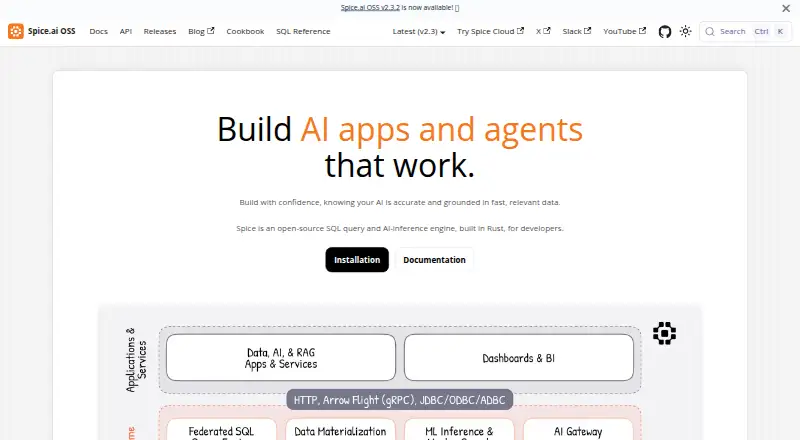
What Spice.ai OSS is
Spice.ai OSS is a free, open-source SQL query and AI-inference engine built in Rust for developers. Its SQL API can query structured and unstructured data across databases, data warehouses, and data lakes. Data can be materialized in DuckDB, SQLite, or PostgreSQL in memory or on disk, with results caching included. The AI compute engine provides an OpenAI-compatible API for local and hosted inference, search, memory, evaluations, and observability. Search supports vector, full-text BM25, and hybrid methods through SQL table-valued functions. Spice lists more than 40 data connectors, including PostgreSQL, MySQL, S3, Snowflake, Databricks, and DuckDB. Documented client integrations include DBeaver, JetBrains DataGrip, Apache Superset, Tableau, and Microsoft Power BI. Monitoring options include Prometheus-compatible metrics, OpenTelemetry metric export, and Zipkin tracing. Deployment choices include a binary, container, Kubernetes workload, or managed app on Spice Cloud. Spice can be self-hosted on macOS with Apple Silicon, Linux on x86_64 or aarch64, or Windows 10 or later with WSL. Its OSS plan is Apache 2.0 licensed.
Who it suits
Spice.ai OSS suits developers who need SQL access across varied data stores alongside AI inference or search APIs. It also fits teams that want a self-hostable deployment and integrations with SQL or BI clients.
What it does well
- Supports over 40 data connectors.
- Includes caching with in-memory or on-disk materialization.
- Offers vector, BM25, and hybrid search methods.
- Can run as a binary, container, or Kubernetes workload.
- Free under Apache 2.0 license.
What to know first
- Windows support requires WSL.
- macOS support listed for Apple Silicon only.
- Enterprise support is described as available for up to three years from release.
Plans
| Plan | Billed and limits | Price |
|---|---|---|
| Spice.ai OSS | Apache 2.0 licensed · self-hostable binary or Docker image | Free |
As spiceai.org lists them, read 30 Sept 2026. The maker's own page has the final word.
Getting started
- Visit https://www.spiceai.org/ to get started.
- Choose a deployment route: binary, container, Kubernetes workload, or managed app on the Spice Cloud Platform.
- For a binary install, use macOS with Apple Silicon, Linux on x86_64 or aarch64, or Windows 10 or later with WSL.
- Connect data sources using a supported connector.
- Use the SQL API or a documented SQL or BI client to query data.
Spice.ai OSS is an open-source engine for teams that need one SQL and AI layer across varied data systems. It suits developers and platform teams that can operate infrastructure themselves. Its broad federation, acceleration, search, and inference stack is compelling, provided your deployment environment matches its operating-system requirements.
Overview
Built in Rust, Spice provides a SQL API for structured and unstructured data across databases, warehouses, and data lakes. That federated model lets applications query multiple systems without first consolidating every dataset. The hybrid deployment approach supports a self-hosted binary or Docker image, Kubernetes workloads, and a managed application on the Spice Cloud Platform.
The Apache 2.0 licence and free OSS plan remove licence fees and permit self-hosting. This is strongest for engineering-led organisations that want control over runtime, credentials, and data placement; it is less suitable for teams seeking a turnkey analytics service with infrastructure handled for them.
Key features
Federated SQL and acceleration
More than 40 connectors include PostgreSQL, MySQL, S3, Snowflake, Databricks, and DuckDB. Applications can connect through HTTP, REST, Arrow Flight SQL, JDBC, ODBC, or ADBC, while documented integrations cover DBeaver, JetBrains DataGrip, Apache Superset, Tableau, and Microsoft Power BI. This breadth makes Spice a practical access layer for mixed estates, though connector-based federation still leaves you responsible for operating and governing the underlying systems.
Spice can materialise data in DuckDB, SQLite, or PostgreSQL, in memory or on disk, and cache results. Those options can reduce repeated reads from remote sources and improve responsiveness for recurring workloads. They also introduce choices about freshness, storage, and cache management that platform teams must own.
Search and AI inference
SQL table-valued functions support vector, full-text BM25, and hybrid search, allowing retrieval workflows to sit beside ordinary queries. The AI compute engine exposes an OpenAI-compatible API for local or hosted inference, search, memory, evaluations, and observability. Hosted OpenAI, Anthropic, and xAI models are listed alongside local Llama and Phi models, with CUDA and Metal acceleration. That combination is valuable for applications that need one interface across hosted and local models, but model serving and accelerator choices remain deployment decisions rather than a managed guarantee.
Operations and security
Prometheus-compatible metrics, OpenTelemetry metric export, and Zipkin distributed tracing provide standard ways to monitor a deployment, with Datadog and Grafana integrations. Optional API-key authentication protects API endpoints. Secrets can come from environment variables, files, AWS Secrets Manager, or Azure Key Vault, giving teams a path to fit existing security practice.
Pricing
| Plan | Price | What it includes |
|---|---|---|
| Spice.ai OSS | free | Apache 2.0-licensed, self-hostable binary or Docker image |
The free OSS plan is the natural choice for developers, prototypes, and organisations prepared to run Spice themselves. It does not add a seat charge or usage quota, but it also places deployment, scaling, upgrades, and support responsibility on your team. Spice.ai Enterprise provides full support for up to three years from release date for organisations that need a supported commercial arrangement.
Platforms
Spice is offered through an API and self-hosted deployments on Linux, macOS, and Windows. The installation requirements matter: macOS support is for Apple Silicon, Linux supports x86_64 and aarch64, and Windows 10 or later requires WSL. The prebuilt binary needs no other dependencies. Container and Kubernetes options make it suitable for platform-managed environments, while the Spice Cloud Platform provides a managed route.
Who it's for
Choose Spice if you are building developer-facing data products, retrieval applications, or internal services that need federated SQL and AI capabilities in one runtime. It is particularly well matched to teams already operating containers, Kubernetes, observability tooling, and secret managers. Look elsewhere if you need a conventional desktop analytics product, a Windows-native install without WSL, or a fully managed service with minimal infrastructure ownership.
Pros and cons
Pros
- Broad federation: More than 40 connectors and multiple SQL client protocols cover heterogeneous estates.
- One SQL and AI interface: Federated queries, search functions, and an OpenAI-compatible inference API can share an application layer.
- Flexible acceleration: DuckDB, SQLite, and PostgreSQL materialisation plus result caching offer practical ways to limit repeated remote reads.
- Open deployment model: Apache 2.0 licensing, binaries, Docker, Kubernetes, and cloud deployment support different operating preferences.
- Operational controls: Standard metrics, tracing, API keys, and external secret stores support production governance.
Cons
- Infrastructure ownership: The free plan is self-hosted, so your team handles capacity, reliability, upgrades, and day-to-day operations.
- Windows constraint: Windows 10 or later requires WSL, which complicates environments that require native Windows software.
- Deployment complexity: Choosing caches, materialisation targets, model providers, and accelerators demands platform expertise.
- Support boundary: Full support is associated with Enterprise rather than the free OSS plan.
Alternatives
Data Virtualization Software is a useful category comparison when you want to survey broader federation options.
- Query Streams suits smaller, quota-conscious use cases with a free plan capped at 5 MB of monthly query traffic, one data source, 125 rows per scheduled push, and 250 rows per API or federated request.
- Stardog is a better fit when a renewable one-year free licence, up to one million stored edges, three databases, and community support match your needs.
- Apache Drill is the simpler choice for an Apache-licensed, downloadable SQL engine deployed embedded or as a cluster.
- Denodo Platform offers a free Developer plan with one server, four cores, 50 data products, and 2.5 TB per year.
- PrestoDB is an alternative open-source, self-hosted SQL query engine.
- Teradata VantageCloud is an option for organisations seeking a commercial cloud data platform with Teradata Database and ClearScape Analytics.
- Starburst Galaxy provides a managed freemium route, including a free tier with up to three clusters for ad hoc queries.
- Teiid is another open-source data-virtualization project without commercial plans or prices listed.
Verdict
Spice.ai OSS is a strong choice for engineering teams that want self-hosted federated SQL, accelerated data access, search, and model inference behind one set of interfaces. Its main reason to choose it is the unusually broad combination of data connectivity and AI runtime features under an Apache 2.0 licence. Look elsewhere if you want native Windows deployment, vendor-managed operations, or support without moving to an Enterprise arrangement.
Verdict
Spice.ai OSS combines federated SQL, data acceleration, search, and AI inference in a self-hostable, open-source package. Check the listed operating-system requirements, especially Windows’ WSL requirement, against your deployment environment.
Questions
Is Spice.ai OSS free?
Yes. The plan is free at 0.00 USD and is Apache 2.0 licensed.
Can I self-host it?
Yes. It is available as a self-hostable binary or Docker image, and can also run in Kubernetes.
Which operating systems are supported?
The installation page lists macOS with Apple Silicon, Linux on x86_64 or aarch64, and Windows 10 or later with WSL.
What data sources and clients does it support?
It supports over 40 connectors, including PostgreSQL, MySQL, S3, Snowflake, Databricks, and DuckDB. Documented clients include DBeaver, JetBrains DataGrip, Apache Superset, Tableau, and Microsoft Power BI.
Which model providers are listed?
The feature overview lists hosted OpenAI, Anthropic, and xAI models, plus local Llama and Phi models.
What deployment options are available?
Spice can run as a binary, container, Kubernetes workload, or managed app on the Spice Cloud Platform.
Facts from Spice.ai OSS's own pages
- BI and SQL clients
- Documented client integrations include DBeaver, JetBrains DataGrip, Apache Superset, Tableau, and Microsoft Power BI. · spiceai.org, 30 Sept 2026
- Data acceleration
- It can materialize data in DuckDB, SQLite, and PostgreSQL in memory or on disk, with results caching included. · spiceai.org, 30 Sept 2026
- Data integrations
- The runtime components page says Spice supports over 40 data connectors, including PostgreSQL, MySQL, S3, Snowflake, Databricks, and DuckDB. · spiceai.org, 30 Sept 2026
- Deployment
- Spice runs as a binary, container, Kubernetes workload, or managed app on the Spice Cloud Platform. · spiceai.org, 30 Sept 2026
- Federated SQL
- It provides a SQL API to query structured and unstructured data across databases, data warehouses, and data lakes. · spiceai.org, 30 Sept 2026
- LLM interface
- Its AI compute engine provides an OpenAI-compatible API for local and hosted inference, search, memory, evaluations, and observability. · spiceai.org, 30 Sept 2026
- Model providers
- The feature overview lists hosted OpenAI, Anthropic, and xAI models and local Llama and Phi models, with CUDA and Metal acceleration. · spiceai.org, 30 Sept 2026
- Monitoring
- Observability includes Prometheus-compatible metrics, OpenTelemetry metric export, and Zipkin distributed tracing, with integrations such as Datadog and Grafana. · spiceai.org, 30 Sept 2026
- Operating systems
- The installation page lists macOS with Apple Silicon, Linux on x86_64 or aarch64, and Windows 10 or later with WSL; it says the prebuilt binary needs no other dependencies. · spiceai.org, 30 Sept 2026
- Product
- Spice is an open-source SQL query and AI-inference engine built in Rust for developers. · spiceai.org, 30 Sept 2026
- Search
- Search supports vector, full-text BM25, and hybrid methods through SQL table-valued functions. · spiceai.org, 30 Sept 2026
- Security
- Spice supports optional API-key authentication for API endpoints, and its secret stores can use environment variables, files, or external managers such as AWS Secrets Manager and Azure Key Vault. · spiceai.org, 30 Sept 2026
- Support
- The getting-started documentation says Spice.ai Enterprise provides full support for up to three years from release date. · spiceai.org, 30 Sept 2026
Where Spice.ai OSS stands on Freedom251
- Data Virtualization Software#8 of 25