Freedom251 › Ai Data Platforms

Starburst Galaxy
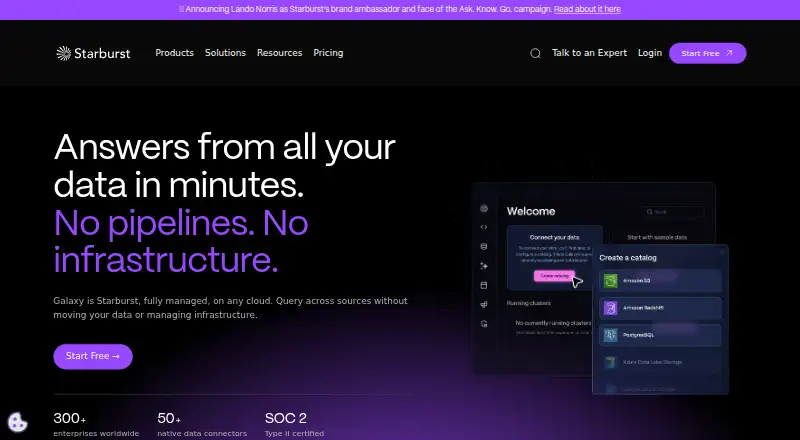
What Starburst Galaxy is
Starburst Galaxy is a managed, cloud-hosted analytics platform built on Trino. It lets organizations query data across sources in one SQL query without copying it, and is available on AWS, Google Cloud, and Microsoft Azure. Starburst lists more than 50 data sources, including Amazon S3, Snowflake, Redshift, BigQuery, and Azure Blob. Galaxy can stream data from Kafka or batch ingest CSV, JSON, and AVRO into Iceberg. LakeOps automates Iceberg table compaction, snapshot expiry, and orphan-file removal on a dedicated serverless engine. AIDA turns natural-language questions into governed insights through a customizable interface or MCP. Security features include fine-grained RBAC and ABAC, encryption, data classification, and private connectivity; Starburst describes Galaxy as SOC 2 Type II certified and HIPAA-ready. The free tier includes up to three clusters and standard execution mode for ad hoc queries. A 30-day trial includes Enterprise features and $500 in compute resources. Usage charges vary by plan and include compute, ingestion, and private-link data transfer.
Who it suits
Galaxy suits organizations that want to query across data sources without moving data. Starburst recommends it for organizations that do not yet have the resources to manage complex data clusters.
What it does well
- Federates queries across data lakes and warehouses.
- Lists more than 50 data sources and connectors.
- Supports Kafka streaming and batch ingestion into Iceberg.
- Free tier includes up to three clusters.
- 30-day trial includes Enterprise features and $500 in compute resources.
What to know first
- Usage billing varies by plan.
- Free tier uses standard execution mode for ad hoc queries.
- API authentication tokens expire after 10 minutes.
Limits
The free tier includes up to three clusters and standard execution mode for ad hoc queries. Pro starts at $0.50 per credit, Enterprise at $0.75 per credit and Mission-Critical at $1.00 per credit; billable usage includes cluster compute hours, ingestion compute and private-link data transfer. Enterprise and Mission-Critical list AIDA token usage as separately billed.
Plans
| Plan | Billed and limits | Price |
|---|---|---|
| Free | Free forever · Up to 3 clusters · standard execution mode for ad hoc queries | Free |
| Pro | Starting at $0.50/credit · Flexible cluster execution modes · streaming ingest · advanced cluster management | $0.50 |
| Enterprise | Starting at $0.75/credit · Advanced autoscaling · ABAC and SCIM · AWS PrivateLink for data sources · AIDA token usage billed separately | $0.75 |
| Mission-Critical | Starting at $1.00/credit · Elite support · advanced governance integrations · highest uptime guarantees · AIDA token usage billed separately | $1 |
As starburst.io lists them, read 30 Sept 2026. The maker's own page has the final word.
Getting started
- Visit the Starburst Galaxy website.
- Choose the free tier or start the 30-day trial with Enterprise features and $500 in compute resources.
- Select a listed cloud provider: AWS, Google Cloud or Microsoft Azure.
- Connect data sources, such as Amazon S3, Snowflake, Redshift, BigQuery or Azure Blob.
- Query across sources or configure ingestion into Iceberg.
Overview
Starburst Galaxy is a managed cloud analytics service built on Trino for querying data across systems with SQL. It suits organizations that want to analyze distributed data without taking on complex cluster management. Its combination of federation and Iceberg upkeep is useful, but usage-based charges make compute and ingestion costs important to weigh.
Key features
Galaxy can query data lakes and warehouses together in one SQL query without copying data. It connects to more than 50 sources, including Amazon S3, Snowflake, Redshift, BigQuery, and Azure Blob, and is available on AWS, Google Cloud, and Microsoft Azure. That breadth fits teams with data spread across these systems; a team working from a single source may not need a federation layer.
Galaxy can stream data from Kafka or batch ingest CSV, JSON, and AVRO into Iceberg. LakeOps automates Iceberg compaction, snapshot expiry, and orphan-file removal on a dedicated serverless engine, reducing routine table maintenance. Ingestion compute is billable, however, so this operational convenience has a usage cost.
AIDA turns natural-language questions into governed insights through a customizable interface or MCP. Its token usage is billed separately on Enterprise and Mission-Critical, a cost to factor in for teams planning to use it regularly. Security features include fine-grained RBAC and ABAC, end-to-end encryption, AI-powered data classification, and private connectivity. Starburst describes Galaxy as SOC 2 Type II certified and HIPAA-ready.
Galaxy supports SQL analytics, ACID transactions, open table formats, streaming ingestion, and a governance catalog. Users can contact Starburst support professionals from within the product. Its REST API runs over TLS/HTTPS, with authentication tokens that expire after 10 minutes.
Pricing
Galaxy has a free plan and usage-based paid plans. The headline rates are credit rates rather than a complete cost estimate: documented billable activity includes cluster compute hours, data ingestion compute, and private-link data transfer, with rates determined by plan.
- Free: free, billed Free forever. It allows up to three clusters and standard execution mode for ad hoc queries. This is a useful way to begin with limited workloads, but the cluster cap and execution mode constrain its role for broader production needs.
- Pro: price on request, billed Starting at $0.50/credit. It adds flexible cluster execution modes, streaming ingestion, and advanced cluster management, making it the step up for teams needing those capabilities.
- Enterprise: price on request, billed Starting at $0.75/credit. It adds advanced autoscaling, ABAC and SCIM, and AWS PrivateLink for data sources. AIDA token usage is billed separately.
- Mission-Critical: price on request, billed Starting at $1.00/credit. It adds elite support, advanced governance integrations, and the highest uptime guarantees. AIDA token usage is billed separately.
A 30-day free trial includes Enterprise features and $500 in Starburst Galaxy compute resources. That gives teams a defined allowance to assess higher-tier capabilities; it is distinct from the Free plan, whose three-cluster cap applies indefinitely.
Platforms
Galaxy is available through web and API, with Linux also listed as a platform. Its cloud availability spans AWS, Google Cloud, and Microsoft Azure.
Who it's for
Galaxy is a strong fit for organizations that want federated SQL across cloud data sources and managed Iceberg ingestion and maintenance without building the expertise to run complex data clusters. It is less suitable for teams that need predictable costs without monitoring usage, require self-hosted deployment, or only query a narrow set of data.
Pros and cons
- Pro: Federated SQL can query lakes and warehouses together without copying data, useful when information is distributed across many systems.
- Pro: Ingestion and automated Iceberg maintenance bring data landing and table upkeep into the same managed service.
- Pro: The free tier and a trial with Enterprise features provide two ways to evaluate Galaxy, including a trial compute allowance.
- Con: Usage charges span compute, ingestion, and private-link transfer, so the credit rate alone does not determine a workload's total cost.
- Con: The Free plan is limited to three clusters and ad hoc queries in standard execution mode.
- Con: AIDA adds separately billed token usage on Enterprise and Mission-Critical.
Alternatives
Oracle Autonomous AI Lakehouse is another freemium option with an unlimited-time free usage plan subject to capacity limits; consider it if that free-plan structure better fits your evaluation.
Starburst Data Platform also offers a free plan capped at three clusters and a Pro plan starting at $0.50/credit; compare it if you are weighing another Starburst offering with those tiers.
Amazon SageMaker Autopilot is a paid service with a free trial and pay-as-you-go pricing; consider it if that pricing model suits your needs.
Apache Hudi is a free, self-hosted option for teams seeking an open-source lakehouse platform rather than a managed cloud service.
Bauplan offers a freemium sandbox with public datasets or uploads, a CLI, SDK, API, and community support; consider it if a shared sandbox suits your work.
Databricks Notebooks offers a free edition with one serverless workspace and limited compute size and usage; consider it if notebook-based work within those limits is a better fit.
Google Cloud Lakehouse for Apache Iceberg is a paid option with a metadata-storage free tier of 1 GiB per month; consider it if that scope matches your requirement.
IOMETE offers a free self-hosted, on-premises plan capped at 100 vCPUs; consider it if deployment control is more important than managed cloud operation.
Galaxy also sits in Data Lakehouse Platforms, Query Engine Software, Data Federation Software, and Data Virtualization Software.
Verdict
Choose Starburst Galaxy if your organization needs SQL across distributed cloud data and wants ingestion and Iceberg maintenance managed alongside it. The free tier and Enterprise-feature trial lower the barrier to evaluation, while its broad connectors address a real multi-source need. Look elsewhere if you need tightly predictable costs, self-hosting, or a simpler setup than a multi-source analytics platform.
Verdict
Galaxy brings federated SQL queries, ingestion, and Iceberg maintenance together in a managed cloud service. The free tier has a three-cluster limit, and usage is billed according to plan and billable activity.
Questions
Is there a free plan?
Yes. The Free plan is billed free forever and includes up to three clusters with standard execution mode for ad hoc queries.
How long is the free trial, and what does it include?
The trial lasts 30 days and includes Enterprise features and $500 in Starburst Galaxy compute resources.
How is paid usage priced?
Pricing is usage-based and rates depend on the plan. Listed starting rates are $0.50 per credit for Pro, $0.75 for Enterprise and $1.00 for Mission-Critical; billable usage includes cluster compute hours, ingestion compute and private-link data transfer.
Which cloud providers are listed?
Galaxy is listed as available on AWS, Google Cloud and Microsoft Azure.
What data sources and ingestion options does it support?
Starburst lists more than 50 data sources, including Amazon S3, Snowflake, Redshift, BigQuery and Azure Blob. Galaxy can stream from Kafka or batch ingest CSV, JSON and AVRO into Iceberg.
Who makes Starburst Galaxy?
Starburst Galaxy is made by Starburst, founded in 2017 and headquartered in Boston, Massachusetts, USA.
Facts from Starburst Galaxy's own pages
- AI
- AIDA turns natural language questions into governed insights and is available through a customizable interface or MCP. · starburst.io, 30 Sept 2026
- API
- The Galaxy API is a REST API over TLS/HTTPS, and its authentication tokens expire after 10 minutes. · docs.starburst.io, 30 Sept 2026
- Clouds
- The product page lists availability on AWS, Google Cloud, and Microsoft Azure. · starburst.io, 30 Sept 2026
- Connectors
- Starburst says Galaxy has more than 50 data sources and names Amazon S3, Snowflake, Redshift, BigQuery, and Azure Blob among its connectors. · starburst.io, 30 Sept 2026
- Federated queries
- Galaxy can federate queries across data lakes and data warehouses in a single SQL query without copying data. · starburst.io, 30 Sept 2026
- Founded
- 2017 · starburst.io, 23 Sept 2026
- Free tier limit
- The pricing page says the free tier includes up to three clusters and standard execution mode for ad hoc queries. · starburst.io, 30 Sept 2026
- Headquarters
- Boston, Massachusetts, USA · starburst.io, 23 Sept 2026
- Ingestion
- Galaxy can stream from Kafka or batch ingest CSV, JSON, and AVRO into Iceberg. · starburst.io, 30 Sept 2026
- Intended users
- Starburst recommends Galaxy for organizations that do not yet have resources to manage complex data clusters. · docs.starburst.io, 30 Sept 2026
- Lakehouse maintenance
- LakeOps automates Iceberg table compaction, snapshot expiry, and orphan file removal on a dedicated serverless engine. · starburst.io, 30 Sept 2026
- Product
- Starburst Galaxy is a fully managed, cloud hosted analytics platform built on Trino for querying data across sources without moving it. · docs.starburst.io, 30 Sept 2026
- Security
- Galaxy supports fine-grained RBAC and ABAC, end-to-end encryption, AI-powered data classification, and private connectivity; Starburst describes it as SOC 2 Type II certified and HIPAA-ready. · starburst.io, 30 Sept 2026
- Support
- Galaxy users can contact Starburst support professionals from within the product UI. · docs.starburst.io, 30 Sept 2026
- Trial
- The pricing page states that a 30-day free trial includes Enterprise features and $500 in Starburst Galaxy compute resources. · starburst.io, 30 Sept 2026
- Usage billing
- Galaxy charges according to usage, with rates determined by plan; documented billable usage includes cluster compute hours, data ingestion compute, and private link data transfer. · docs.starburst.io, 30 Sept 2026
Where Starburst Galaxy stands on Freedom251
- Ai Data Platforms#6 of 17
- Cloud Analytics Solutions#11 of 29
- Data Virtualization Software#10 of 25
- Data Federation Software#11 of 24
- Query Engine Software#14 of 28
- Data Lakehouse Platforms#12 of 23
- Analytics Data#20 of 30
- Big Data Analytics Software#22 of 30