Freedom251 › Digital Transaction Management Software
Signater
What Signater is
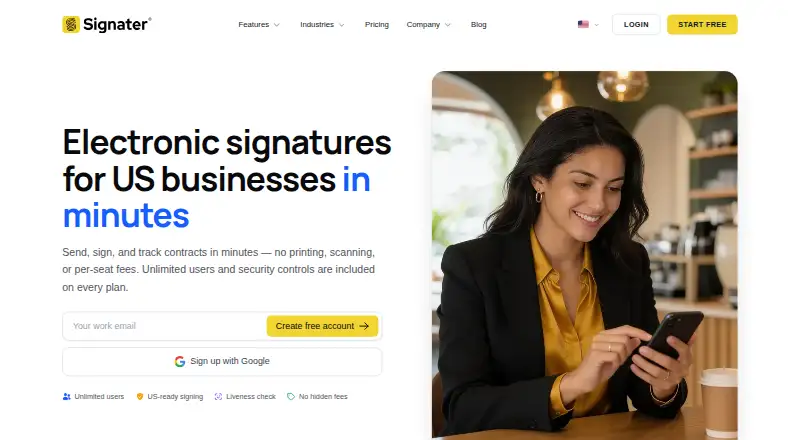
Signater is a digital contract service for businesses to send, sign, and track documents through a browser. It groups documents and signers into envelopes that can follow a sequential or parallel signing order, then provides a completion certificate. Identity checks range from passwords and email or SMS codes to selfie liveness checks, identity documents, facial biometrics, and geolocation. Templates store recurring text, support typed variable fields, and preserve a new version after each edit. Signers can use a browser link on a phone or computer without an app or Signater account. The service and its signing flow are available in six languages: English, Portuguese, Spanish, French, German, and Italian. Signater says its electronic signatures are legally binding under the U.S. ESIGN Act, UETA, and EU eIDAS. Its free plan allows three envelopes per month for one user and requires no credit card. Paid plans start at $39 per month; API and webhook access are included with Business and Enterprise.
Who it suits
Signater suits businesses that need to send and track digital contracts, including workflows with multiple documents or signers. Its browser links may also suit signers who do not want to create an account or install an app.
What it does well
- Free plan includes three envelopes monthly.
- Signers need no app or account.
- Supports sequential and parallel signing flows.
- Templates retain versions after edits.
- Signing is available in six languages.
What to know first
- Free plan is limited to three envelopes monthly.
- API and webhooks require Business or Enterprise.
- No free trial is available.
Limits
The free plan includes three envelopes per month, one user, up to three signers per envelope and two documents per envelope, with a 5 MB limit per document. It does not include API or webhook access, which is available on Business and Enterprise plans.
Plans
| Plan | Billed and limits | Price |
|---|---|---|
| Free | $ 0 / month · 3 envelopes/month · 1 user · 3 signers/envelope · 2 documents/envelope · 5 MB/document | Free |
| Starter | $ 39 / month; or $ 23 / month billed annually · 30 envelopes/month · unlimited users · 20 signers/envelope · 20 documents/envelope · 25 MB/document | $39 a month |
| Enterprise | $ 499 / month; or $ 299 / month billed annually · 200 envelopes/month · unlimited users · unlimited signers/envelope · unlimited documents/envelope · 100 MB/document | $499 a month |
| Business | $ 79 / month; or $ 47 / month billed annually · 30 envelopes/month · unlimited users · 50 signers/envelope · 50 documents/envelope · 50 MB/document | $79 a month |
As signater.com lists them, read 30 Sept 2026. The maker's own page has the final word.
Getting started
- Open the Signater website.
- Choose the Free plan or a paid plan; the free plan requires no credit card.
- Use Signater on the web or its Android or iOS platform.
- Create an envelope with documents and signers, then choose sequential or parallel signing.
- Send signers a browser link; they can sign without an app or Signater account.
- For API or webhook workflows, choose Business or Enterprise.
Overview
Signater is a browser-based contract signing service for businesses that need to route agreements among multiple people or connect signing to internal systems. It is a stronger fit for teams that value configurable identity checks and structured workflows than for occasional users needing a large free allowance.
Its envelope model, signer verification options and signed-file retrieval cover a broad business workflow, but the free tier stops at three envelopes a month and API access begins at Business.
Key features
An envelope bundles documents and signers into either a sequential or parallel signing flow, then produces a completion certificate. That structure suits agreements involving several parties; per-envelope signer and document caps determine how complex a workflow each plan can accommodate.
Identity options include passwords, email and SMS one-time codes, selfie liveness, identity documents, facial biometrics and geolocation. The range gives businesses room to choose checks appropriate to their process, rather than forcing every signer through one method. Signers use a browser link on a phone or computer without installing an app or creating an account, which removes a setup step for outside participants.
Templates retain recurring text, use typed fields for variable content and create a new version when edited. The REST API can create, send and track envelopes, upload documents, use templates and retrieve signed files and certificates. Webhooks deliver envelope events through POST requests with automatic retries. Workflow status API, signed-file retrieval and a sandbox are also available, but the API and webhooks are limited to Business and Enterprise, leaving Starter for teams that do not need those integrations.
Signater uses HTTPS/TLS with HSTS, AES-256 encryption at rest, AES-256-GCM for secrets and PBKDF2 password derivation. Signed PDFs use embedded PAdES signatures, SHA hashes and RFC 3161 timestamps, with optional long-term validation. Signater says its electronic signatures are legally binding under the U.S. ESIGN Act, UETA and EU eIDAS. The platform, signing flow and messages support English, Portuguese, Spanish, French, German and Italian.
Pricing
The Free plan costs nothing and is free forever, with no credit card required. It allows 3 envelopes/month, 1 user, 3 signers/envelope, 2 documents/envelope and 5 MB/document. That is useful for light individual use, but the envelope cap and single seat make it a limited option for a working team.
Starter costs $39 a month, or $ 23 / month billed annually. It raises the allowance to 30 envelopes/month, provides unlimited users, and supports 20 signers and 20 documents per envelope, with 25 MB/document. This is the practical entry point for teams sharing routine signing work, provided they do not need API or webhook access.
Business costs $79 a month, or $ 47 / month billed annually. It keeps the 30-envelope monthly limit but raises per-envelope allowances to 50 signers and 50 documents, with 50 MB/document, and includes API and webhooks. It suits teams whose integration need justifies the higher price; those sending more than 30 envelopes a month will still hit the same quota as Starter.
Enterprise costs $499 a month, or $ 299 / month billed annually. It includes 200 envelopes/month, unlimited users, signers and documents per envelope, and 100 MB/document, as well as API and webhooks. Its larger quotas and unlimited envelope composition fit heavier or more complex workflows, while Enterprise also adds priority chat support. There is no free trial.
Platforms
Signater supports web, Android and iOS, as well as API access on eligible plans. Since signers can complete a browser-link flow without an app or account, businesses can send agreements to people outside their organization without requiring them to adopt the service.
Who it's for
Signater is best for businesses with recurring contracts, multi-party signing flows or a need to retrieve signed files and certificates through an integration. Its multiple verification methods and multilingual signing flow can also help teams serving signers across different locations. Occasional users can try the free tier, but three envelopes per month and one user are restrictive; teams that need integrations must budget for Business rather than Starter.
Pros and cons
- Pros: Multiple identity checks, including selfie liveness and facial biometrics, give businesses more control over signer verification.
- Pros: Sequential or parallel envelopes end with completion certificates, accommodating multi-party agreements in one workflow.
- Pros: API workflows include envelope status, signed-file retrieval, certificates and retrying webhooks, useful for connecting signing to business systems.
- Cons: The free plan allows just three envelopes monthly and one user, limiting its usefulness for regular team work.
- Cons: API and webhook access starts at Business, despite Starter supporting unlimited users.
- Cons: Business remains capped at 30 envelopes per month; higher-volume use requires Enterprise.
Alternatives
For a wider comparison, browse Digital Signature API Software. Consider PandaDoc if its free plan's yearly 60-document allowance and two-recipient limit better match your signing volume. Dropbox Sign API is another option, with a free package of up to three signature requests monthly and a test mode for building and testing the API.
Skribble may suit a team comparing per-signature pricing, with its Starter plan charging by signature and distinguishing SES, AES and QES rates. Xodo Sign is worth considering when a small free API sandbox allowance is enough: its free plan includes up to two production API documents, one document per week, one signer, one seat and no active templates. BoldSign offers a free Essential plan with 25 envelopes per month, two templates and one user, which may fit a solo user prioritizing envelope volume.
PearSign is another freemium option with three envelopes per month on its free plan. Documenso is an alternative for readers interested in software its maker describes as open source. DocuSeal offers a free Basic plan with 10 field types and 10 request emails per month.
Verdict
Choose Signater if your business needs configurable identity checks, multi-party envelope flows and a path to API-based signing with signed-file retrieval. Its clearest limitation is the gap between plans: Starter has no API or webhook access, while Business still allows only 30 envelopes monthly. Teams with light needs can start free, but those needing integrated or higher-volume workflows should weigh whether Enterprise's price and capacity fit their operation.
Verdict
Signater combines document workflows, identity checks, and browser-based signing for business contracts. The free tier is small, while API access is reserved for higher plans.
Questions
Is there a free plan?
Yes. The Free plan is free forever and includes three envelopes per month for one user. It requires no credit card.
What do paid plans cost?
Starter is $39/mo, or $23/mo billed annually. Business is $79/mo, or $47/mo billed annually; Enterprise is $499/mo, or $299/mo billed annually.
Which platforms does Signater support?
Signater lists Android, iOS, web and API. Signers can use a browser link on a phone or computer without a Signater account or app.
Which plans include API and webhooks?
API and webhook access are available on Business and Enterprise plans.
Who makes Signater, and when was it founded?
Signater was founded in 2020 and lists headquarters in Miami, Florida, United States, and Barueri, São Paulo, Brazil.
Facts from Signater's own pages
- API
- The REST Integration API can create, send and track envelopes, upload documents, use templates and retrieve signed files and certificates. · signater.com, 30 Sept 2026
- API availability
- The API and webhooks are available on the Business and Enterprise plans. · docs.api.signater.com, 30 Sept 2026
- Browser access
- Signers use a browser link on phones or computers and do not need an app or Signater account. · signater.com, 30 Sept 2026
- Core function
- Signater lets businesses send, sign and track contracts digitally in minutes through a browser. · signater.com, 30 Sept 2026
- Envelopes
- An envelope combines multiple documents and signers in one sequential or parallel signing flow and ends with a completion certificate. · signater.com, 30 Sept 2026
- Founded
- 2020 · signater.com, 28 Sept 2026
- Free tier
- The free tier is free forever, includes three envelopes per month and requires no credit card. · signater.com, 30 Sept 2026
- Headquarters
- Miami, Florida, United States; Barueri, São Paulo, Brazil · signater.com, 28 Sept 2026
- Identity verification
- Identity checks include password, email OTP, SMS OTP, selfie with liveness, identity document, facial biometrics and geolocation. · signater.com, 30 Sept 2026
- Languages
- The platform, signing flow and messages are available in English, Portuguese, Spanish, French, German and Italian. · signater.com, 30 Sept 2026
- Legal validity
- Signater states that its electronic signatures are legally binding under the U.S. ESIGN Act, UETA and EU eIDAS. · signater.com, 30 Sept 2026
- Security
- Signater uses HTTPS/TLS with HSTS, AES-256 encryption at rest, AES-256-GCM for secrets and PBKDF2 password derivation. · signater.com, 30 Sept 2026
- Signature standards
- Signed PDFs use embedded PAdES signatures, SHA hashes, RFC 3161 timestamps and optional long-term validation. · signater.com, 30 Sept 2026
- Support
- Signater directs customers to get answers about features, plans and implementation through WhatsApp, and Enterprise includes priority chat support. · signater.com, 30 Sept 2026
- Templates
- Templates keep recurring document text ready, with typed fields for variable content and a new version for each edit. · signater.com, 30 Sept 2026
- Webhooks
- Envelope events are delivered by webhook POST requests with automatic retries. · signater.com, 30 Sept 2026