Freedom251 › Warehouse Management Software

Sentry WMS
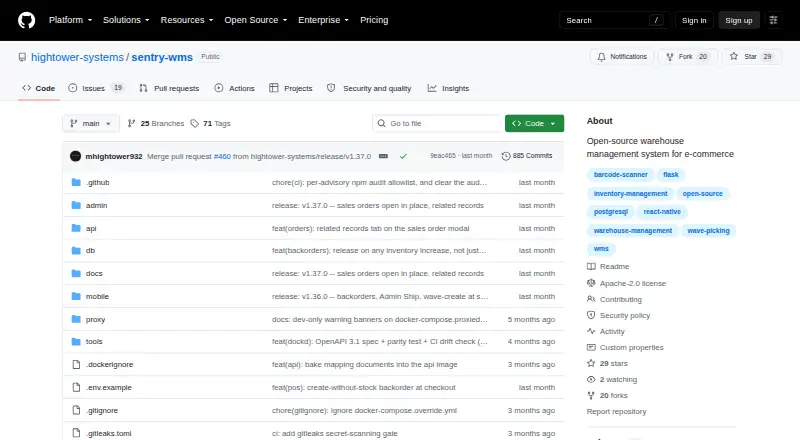
What Sentry WMS is
Sentry WMS is a self-hosted warehouse execution system for e-commerce businesses that already use a system of record or ERP. It handles receiving, storage, picking, packing, shipping, and counting, with support for multiple warehouses. Teams can batch-pick multiple orders using serpentine walk-path optimization. Inventory features include bin-level cycle counts with variance detection and an admin approval workflow, plus adjustments and transfers. Barcode lookup from the mobile app can identify items, bins, purchase orders, or sales orders. An inbound API lets external systems send updates for sales orders, items, customers, vendors, and purchase orders, using source-specific YAML mappings and scoped WMS tokens. The connector framework is designed for ERP and commerce platforms, but operators or developers must build the connectors; first-party connectors are planned for v2.0.0. Setup documentation describes Docker Compose with a Flask API, PostgreSQL 16, a React admin panel, and a React Native Expo mobile app. The project is public under the Apache-2.0 license and documents encrypted connector credentials, a hash-chained audit log, and protections against SSRF in outbound connector requests. The software is free and open source.
Who it suits
Sentry WMS suits e-commerce businesses that already rely on a system of record or ERP and can operate a self-hosted deployment. Teams should be prepared to build their own connectors where needed.
What it does well
- Supports receiving through shipping and warehouse counting.
- Batch picking includes serpentine walk-path optimization.
- Mobile barcode lookup identifies items and orders.
- Documents encrypted credentials and an append-only audit log.
- Free, self-hosted, and licensed under Apache-2.0.
What to know first
- No first-party ERP or commerce connectors yet.
- Operators or developers must write connectors.
- Deployment is self-hosted.
Limits
The free plan is for self-hosted deployment. It does not include first-party ERP or commerce connectors, so operators or developers must build connectors; first-party connectors are planned for v2.0.0.
Plans
| Plan | Billed and limits | Price |
|---|---|---|
| Free, open-source | Self-hosted deployment · No first-party ERP or commerce connectors yet | Free |
| Self-hosted Sentry WMS | Self-hosted · no monthly fees · no per-user pricing stated | Free |
As github.com lists them, read 7 Oct 2026. The maker's own page has the final word.
Getting started
- Open the Sentry WMS project website
- Review the documentation and contributing guide
- Prepare a self-hosted deployment using Docker Compose
- Set up the documented Flask API, PostgreSQL 16, React admin panel, and React Native Expo mobile app
- Build the needed connectors against the connector framework or send updates through the inbound API
Sentry WMS is a free, self-hosted warehouse execution system for e-commerce businesses that already run an ERP or another system of record. It suits teams that want focused warehouse workflows and can handle the technical work of connecting their existing systems. Its strongest case is the combination of batch picking, mobile barcode lookup, and bin-level inventory controls without a license fee.
Overview
Sentry covers warehouse work from receiving and storage through picking, packing, shipping, and counting. Support for multiple warehouses makes it relevant to operations spread across sites, while its intended role as an execution layer keeps it focused on fulfillment rather than replacing the system that owns business records. That focus is useful for teams with an established ERP; businesses looking for a ready-connected, all-in-one operations suite should look elsewhere.
Deployment is self-managed through Docker Compose, with a Flask API, PostgreSQL 16, a React admin panel, and a React Native Expo mobile app. The public Apache-2.0 project includes documentation and a contributing guide. This setup offers a clear route for technically capable teams that want control over deployment, but it also means they take responsibility for operating the system.
Key features
Picking and barcode workflows
Batch picking lets staff handle several orders in a pass, with serpentine walk-path optimization to structure the route. That is a practical fit for warehouses processing multiple orders together, where organized movement through the facility matters. The mobile app can identify items, bins, purchase orders, or sales orders from a barcode lookup on its home screen, making it useful for staff who need to retrieve records while working on the floor.
Inventory control
Cycle counts work at bin level and flag variances, with an administrator approval step for review. Staff can also record inventory adjustments and transfers. Together, these controls give teams a way to investigate discrepancies and govern changes; they are especially relevant where stock is tracked by warehouse bin.
Connecting business systems
The inbound API accepts updates for sales orders, items, customers, vendors, and purchase orders. Source-specific YAML mappings and scoped WMS tokens provide a defined way for external systems to send that data. The connector framework is designed with ERPs such as NetSuite or QuickBooks and commerce platforms such as Shopify or BigCommerce in mind, but it currently expects operators or developers to build connectors against its interface. First-party connectors are planned for v2.0.0, so teams that need turnkey synchronization should not assume it is ready today.
Security measures documented by the project include Fernet-encrypted connector credentials, an append-only hash-chained audit log, and protections against SSRF in outbound connector requests. These are relevant safeguards for deployments handling connector credentials and external requests, though they do not remove the operational work of running a self-hosted service.
Pricing
Free, open-source
The plan costs nothing and includes self-hosted deployment. There is no license charge, which makes Sentry a low-cost option for teams able to supply hosting and technical effort. Its principal trade-off is the absence of first-party ERP or commerce connectors: the operator or development team must build the integrations needed to bring orders and records into the warehouse workflow.
Platforms
Sentry supports Android, API, self-hosted, and web use. The mobile app and barcode scanning support floor workflows, while the API and web admin panel serve integration and administration needs. Multi-warehouse support and cycle counting add practical breadth for warehouse operations.
Who it's for
Sentry is best suited to e-commerce businesses that already use an ERP or other system of record and have the people to manage self-hosted software and connector development. It makes less sense for a small team seeking immediate links to its commerce platform, or for a business that wants a vendor-managed warehouse service rather than software to deploy itself.
Pros and cons
- Pros: Free, open-source self-hosting avoids a software license charge.
- Pros: Batch picking with serpentine routing and mobile barcode lookup supports practical warehouse-floor work.
- Pros: Bin-level counts, variance detection, approval, adjustments, and transfers provide several inventory control steps.
- Cons: No first-party ERP or commerce connectors are available yet, so integrations require operator or developer work.
- Cons: Self-hosted deployment requires the business to operate its own installation.
Alternatives
OpenBoxes is another free self-hosted option, with a Community Self-Hosted plan that includes unlimited users and storage on the customer’s server; choose it if those stated terms are the priority. Its Shared OpenBoxes Lift plan is 75.00 US. Sentry WMS is the same product under another listing, so the product choice is unchanged. ShipBob offers software for ShipBob customers to connect ecommerce stores and manage inventory, orders, and shipments; it is the relevant alternative for businesses already using ShipBob. For Anchanto Warehouse Management, Vinculum Vin OMS, Deck Commerce, Extensiv 3PL Warehouse Manager, and Flowspace Order Management, pricing is custom or requires a quote or demo.
Compare more options in Order Fulfillment Software and Warehouse Management Software.
Verdict
Choose Sentry WMS if your e-commerce operation already has a system of record, needs multi-warehouse execution with batch picking and barcode workflows, and can own hosting and integrations. Its free, open-source core is the main draw; the need to build connectors is the main reason to choose a more turnkey system instead.
Verdict
Sentry WMS covers core warehouse execution and inventory workflows, including mobile barcode lookup and multi-warehouse support. Its connector framework is flexible, but integrations require operator or developer work until first-party connectors arrive.
Questions
How much does Sentry WMS cost?
The free, open-source plan costs nothing.
Is Sentry WMS open source?
Yes. Its public source repository is licensed under Apache-2.0.
Which platforms does it support?
The listed platforms are Android, API, self-hosted, and web.
Does it support multiple warehouses and barcode scanning?
Yes. It supports multiple warehouses, and the mobile app offers barcode lookup for items, bins, purchase orders, and sales orders.
Does it include Shopify, BigCommerce, NetSuite, or QuickBooks connectors?
The connector framework is designed for ERP and commerce platforms such as these, but first-party connectors are not yet included. Operators or developers must build connectors against its interface.
What does the inbound API accept?
External systems can push updates for sales orders, items, customers, vendors, and purchase orders using source-specific YAML mappings and scoped WMS tokens.
Facts from Sentry WMS's own pages
- API
- The published API reference documents authentication, receiving, put-away, picking, packing, shipping, inventory, transfers, lookups, and administrative endpoints. · hightower-systems.github.io, 21 Oct 2026
- App ratings
- The pages reviewed did not identify a Sentry WMS listing or rating in the Apple App Store, Google Play, Chrome Web Store, or Microsoft Store. · github.com, 21 Oct 2026
- Architecture
- The documented stack uses a React Native Expo mobile app, Python Flask API, PostgreSQL 16, and a React web administration panel. · github.com, 21 Oct 2026
- Barcode lookup
- The home screen can scan barcodes to identify items, bins, purchase orders, and sales orders. · hightower-systems.github.io, 21 Oct 2026
- Barcode workflows
- Barcode lookup can identify items, bins, purchase orders, or sales orders from the mobile app home screen. · hightower-systems.github.io, 7 Oct 2026
- Changelog
- The changelog records a v1.8.0 transfer-orders and productivity-dashboard release dated 2026-05-07. · hightower-systems.github.io, 21 Oct 2026
- Company
- The repository identifies the maker as Hightower Systems L.L.C. · github.com, 21 Oct 2026
- Cycle counting
- Cycle counts track bin-level quantities, detect variances, and can require administrator approval. · hightower-systems.github.io, 21 Oct 2026
- Deployment and stack
- The documented setup uses Docker Compose with a Flask API, PostgreSQL 16, a React admin panel, and a React Native Expo mobile app. · hightower-systems.github.io, 7 Oct 2026
- Documentation
- The documentation site includes API reference, deployment, admin panel, connectors, ERP integration, transfer orders, test lab, contributing, and changelog pages. · hightower-systems.github.io, 21 Oct 2026
- ERP scope
- The maker says Sentry does not manage orders, products, or customers as an ERP would; it connects to existing systems such as NetSuite, QuickBooks, and SAP. · github.com, 21 Oct 2026
- Founded and headquarters
- The product pages reviewed do not state the maker's founding year or headquarters. · github.com, 21 Oct 2026
- Funding and ownership
- The product pages reviewed do not state funding, employee count, or ownership details beyond identifying Hightower Systems L.L.C. as maker. · github.com, 21 Oct 2026
- Inbound API
- The deployment guide describes inbound endpoints for external systems to submit sales orders, items, customers, vendors, and purchase orders. · hightower-systems.github.io, 21 Oct 2026
- Independent editorial coverage
- A DEV Community article by the maker describes Sentry as a free, open-source warehouse system and links to the public repository. · dev.to, 21 Oct 2026
- Independent maker post
- In a Reddit post, the maker describes Sentry as free, self-hosted software intended to run on a user's own computer or server. · reddit.com, 21 Oct 2026
- Independent post limitation
- The Reddit post says the product was intended to get users off spreadsheets, while Shopify, BigCommerce, and NetSuite connections were described there as roadmap plans. · reddit.com, 21 Oct 2026
- Installation requirements
- The deployment guide names Docker and Docker Compose as prerequisites and Node.js 18 or later for mobile app development. · hightower-systems.github.io, 21 Oct 2026
- Integrations
- A connector framework supports ERP and commerce synchronization, with credentials stored in an encrypted vault and sync health monitoring. · github.com, 21 Oct 2026
- Intended users
- The project describes Sentry as a warehouse execution layer for e-commerce businesses that already use a system of record or ERP. · github.com, 7 Oct 2026
- Inventory
- It provides bin-level cycle counts with variance detection and an admin approval workflow, plus inventory adjustments and transfers. · hightower-systems.github.io, 7 Oct 2026
- Inventory adjustments
- Administrators can add or remove inventory with a reason recorded. · hightower-systems.github.io, 21 Oct 2026
- License
- The repository lists Apache-2.0; its README says releases before v1.7.0 remain MIT-licensed and v1.7.0 onward use Apache 2.0. · github.com, 21 Oct 2026
- Limits
- The connector framework expects operators or developers to write connectors against its interface; first-party connectors are described as planned for v2.0.0. · hightower-systems.github.io, 7 Oct 2026
Where Sentry WMS stands on Freedom251
- Warehouse Management Software#2 of 44
- Order Fulfillment Software#2 of 36