Freedom251 › Order Management Software

Deck Commerce
What Deck Commerce is
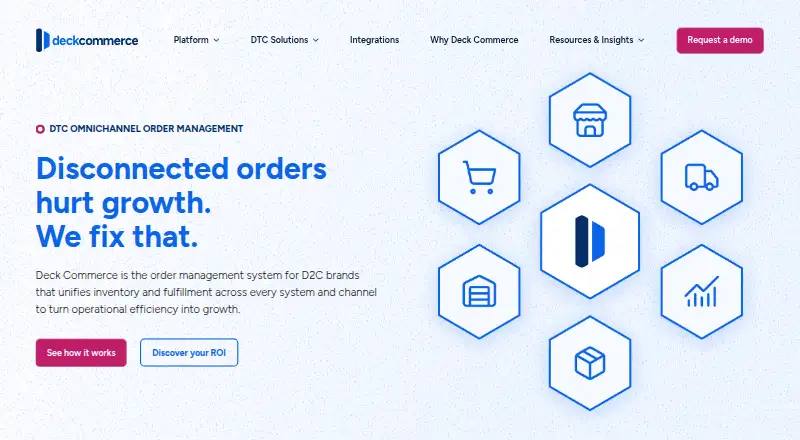
Deck Commerce is web-based software for coordinating sales orders and fulfillment across several channels. Businesses can use it to manage commerce activity from websites, mobile apps, retail, brand channels, marketplaces, social channels, and call centers. The platform includes multi-warehouse support, so its order handling can span more than one warehouse. Order routing directs orders through fulfillment workflows, which include pick-and-pack activities and shipment handoff. Returns workflows cover another part of the order lifecycle, while automation rules support automated handling of commerce operations. These capabilities bring channel sales, order movement, warehouse fulfillment, shipment handoff, and returns into a single web platform. Deck Commerce is headquartered in St. Louis, Missouri, United States. Its pricing model is paid, and pricing is available on request. The listed platform is web, and the described sales channels include both digital routes, such as websites, mobile apps, marketplaces, and social channels, and routes such as retail and call centers. Businesses coordinating orders across multiple channels or warehouses may find the combination of routing, packing, shipment handoff, and returns workflows relevant. The product’s stated capabilities center on commerce operations and fulfillment.
Who it suits
Deck Commerce suits businesses managing orders across several sales channels and warehouses. It may fit teams that need order routing, pick-and-pack workflows, shipment handoff, returns handling, and automation rules in a web platform.
What it does well
- Supports sales through websites, mobile apps, retail, marketplaces, and social channels.
- Includes multi-warehouse support and order routing.
- Covers pick-and-pack workflows and shipment handoff.
- Includes returns workflows and automation rules.
What to know first
- Pricing is available on request.
- The listed platform is web.
Plans
| Plan | Billed and limits | Price |
|---|---|---|
| Deck Commerce OMS | Pricing not listed; request a demo | On request |
As deckcommerce.com lists them, read 9 Oct 2026. The maker's own page has the final word.
Getting started
- Visit the Deck Commerce website.
- Request pricing from Deck Commerce.
- Use the web platform.
Deck Commerce is an order management system for brands coordinating inventory, orders, and fulfillment across commerce channels and warehouses. It is best suited to mid-market and enterprise direct-to-consumer operations with high order volumes across regions. Its strongest case is a unified, automation-focused operating layer; buyers needing transparent pricing or a non-web user experience should compare alternatives.
Overview
Deck Commerce brings inventory, order processing, fulfillment, store operations, and post-purchase work into one platform. Inventory Center provides real-time, channel-aware visibility across a brand’s network, helping teams make allocation and availability decisions with a current view of stock. Order Center handles routing and processing, then extends into returns and ERP updates after purchase.
The platform is designed for complex commerce estates rather than a single online storefront. It supports websites, mobile apps, retail, brand channels, marketplaces, social commerce, and call centers, along with multiple warehouses. That breadth is useful when orders must be coordinated across selling and fulfillment locations, but it also points to an implementation project rather than a lightweight shop plug-in.
Key features
Routing and fulfillment
Order Center uses AI-powered delivery estimates and predictive fulfillment logic to route orders. In practice, this is aimed at improving decisions about where and how an order should be fulfilled as conditions change. Fulfillment Center automates scanning and batch picking and supports flexible workflows, while shipment handoff and pick-and-pack processes cover the operational steps between order acceptance and carrier transfer.
Stores, returns, and automation
Store Center gives store teams workflows for buy online, pick up in store (BOPIS), returns, and ship-from-store orders. Automation rules and post-purchase workflows can connect fulfillment, returns, and ERP updates, reducing manual transitions between commerce and back-office processes. Role-based views and access let administrators match data and tools to each team.
Integrations and implementation
Deck Commerce names more than 75 prebuilt integrations, including Salesforce Commerce Cloud, Amazon, BigCommerce, NetSuite, Shopify, and SAP. Its API-first framework is intended to connect systems beyond those packaged connectors, which is valuable for organizations with proprietary or unusual architecture. Deck Commerce says it owns implementation and remains engaged as customers’ businesses evolve; most brands reportedly go live in 90 days, although timing varies with systems and scope.
Pricing
Deck Commerce OMS uses custom pricing; a demo is required. The plan covers the platform’s sales-channel, multi-warehouse, routing, fulfillment, returns, shipment-handoff, and automation capabilities, but no public seat, order, usage, or contract limits are provided. This model fits enterprises that need a scoped implementation and can budget through a sales process. It is a poor fit for smaller teams that need to forecast cost from a public price or start without a procurement conversation.
Platforms
Deck Commerce is offered through web access and an API. The API-first approach supports connections to commerce, ERP, marketplace, and other systems, while web access serves operational teams. There is no stated native Android or iOS application.
Who it's for
Choose Deck Commerce when a mid-market or enterprise DTC brand must coordinate high-volume orders across several channels, stores, regions, and warehouses. It is particularly suitable for businesses combining ship-from-store, BOPIS, returns, batch picking, and ERP synchronization. Smaller merchants with one warehouse, modest volume, or a need for self-service pricing may find the platform’s enterprise orientation excessive.
Pros and cons
Pros
- Broad channel coverage: Website, mobile, retail, marketplaces, social, and call-center orders can share one operating model.
- Operational depth: Real-time inventory, predictive routing, scanning, batch picking, shipment handoff, and returns address the full fulfillment flow.
- Extensible architecture: More than 75 integrations plus an API-first framework help accommodate established and custom systems.
- Implementation ownership: Deck Commerce says it manages implementation and ongoing engagement, a useful distinction for complex rollouts.
Cons
- Custom pricing only: Buyers cannot compare a published price or stated usage limits before contacting sales.
- Enterprise-weighted scope: The feature set and implementation model are difficult to justify for a simple, low-volume operation.
- Web and API access: Teams seeking a stated native mobile app should look elsewhere.
Alternatives
For a broader category comparison, see Order Fulfillment Software and Order Management Software.
- OpenBoxes is the better choice for organizations wanting a freemium, self-hosted option with unlimited users on its free Community Self-Hosted plan.
- Sentry WMS suits teams seeking free, open-source, self-hosted warehouse software across web, API, Android, and iOS.
- Sentry WMS is another free open-source option, though its free plan has no first-party ERP or commerce connectors yet.
- ShipBob is worth considering if you are already a ShipBob customer and want its free software for connected ecommerce stores, inventory, orders, and shipments.
- Anchanto Warehouse Management is an alternative for teams wanting Android and web access with a demo-led purchasing process.
- Vinculum Vin OMS is another paid OMS available through Android, API, and web, with demo-based pricing.
- Extensiv 3PL Warehouse Manager is aimed at 3PL operations and offers Professional and Enterprise subscriptions through customized pricing.
- Flowspace Order Management is a paid alternative whose quote reflects order volume, shipment mix, storage footprint, locations, product handling, and value-added services.
Verdict
Deck Commerce is a strong candidate for high-volume DTC brands that need one system for channel-aware inventory, intelligent routing, warehouse workflows, store fulfillment, and returns. Its integration breadth and implementation support strengthen the case for complex environments. Look elsewhere if public pricing, self-hosting, native mobile apps, or a lighter deployment matters more than enterprise orchestration.
Verdict
Businesses coordinating order fulfillment across sales channels or warehouses should consider Deck Commerce for its routing, pick-and-pack, shipment handoff, and returns workflows. The listed product is web-based and paid, with pricing available on request. Buyers who need a published price or a platform beyond web should check whether it fits their requirements.
Questions
How much does Deck Commerce cost?
The pricing model is paid, with pricing available on request.
Which platform does it support?
The listed platform is web.
What sales channels does it support?
Listed channels include websites, mobile apps, retail, brand channels, marketplaces, social channels, and call centers.
Can it handle multiple warehouses?
Yes. Multi-warehouse support is listed.
What fulfillment workflows are included?
The listed workflows include order routing, pick-and-pack, shipment handoff, and returns.
Where is Deck Commerce headquartered?
Deck Commerce is headquartered in St. Louis, Missouri, United States.
Facts from Deck Commerce's own pages
- Access controls
- Order Center offers role-based views and access so teams can be given the data and tools they need. · deckcommerce.com, 9 Oct 2026
- API
- The company describes its platform as API-first and says its API-based framework can connect systems beyond its listed integrations. · deckcommerce.com, 9 Oct 2026
- Audience
- Deck Commerce says it is suited to mid-market and enterprise DTC brands, especially those with high order volumes across multiple channels or regions. · deckcommerce.com, 9 Oct 2026
- Founded
- 2015 · deckcommerce.com, 23 Sept 2026
- Fulfillment
- Fulfillment Center automates tasks such as scanning and batch picking, with flexible workflows. · deckcommerce.com, 9 Oct 2026
- Go-live
- The company says most brands go live in 90 days, with timing varying according to systems and scope. · deckcommerce.com, 9 Oct 2026
- Headquarters
- St. Louis, Missouri, United States · deckcommerce.com, 28 Sept 2026
- Integrations
- Deck Commerce lists more than 75 prebuilt integrations and names Salesforce Commerce Cloud, Amazon, BigCommerce, NetSuite, Shopify, and SAP among them. · deckcommerce.com, 9 Oct 2026
- Inventory
- Inventory Center provides real-time, channel-aware inventory visibility across a brand’s network. · deckcommerce.com, 9 Oct 2026
- Order routing
- Order Center routes, processes, and fulfills orders, using AI-powered delivery estimates and predictive fulfillment logic. · deckcommerce.com, 9 Oct 2026
- Post-purchase
- Order Center can automate post-purchase workflows, including fulfillment, returns, and ERP updates. · deckcommerce.com, 9 Oct 2026
- Store operations
- Store Center supports store teams handling BOPIS, returns, and ship-from-store orders. · deckcommerce.com, 9 Oct 2026
- Support
- Deck Commerce says it owns implementation and stays engaged with customers as their businesses evolve. · deckcommerce.com, 9 Oct 2026
- What it does
- Deck Commerce is an order management system that coordinates inventory, orders, and fulfillment across commerce systems and channels. · deckcommerce.com, 9 Oct 2026
Where Deck Commerce stands on Freedom251
- Order Management Software#22 of 68
- Order Fulfillment Software#16 of 36