Freedom251 › Warehouse Management Software

Sentry WMS
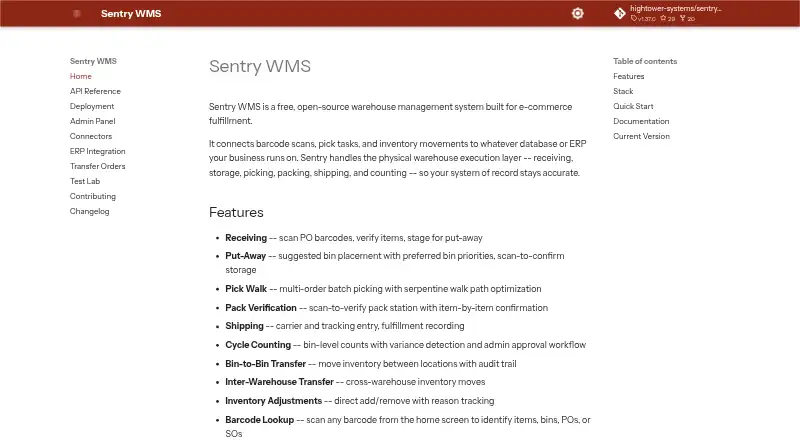
What Sentry WMS is
Sentry WMS is a free, open-source warehouse management system for e-commerce fulfillment. It covers receiving, storage, picking, packing, shipping, and counting, while relying on an existing database or ERP for orders, products, or customers. Pick Walk supports batch picking across multiple orders with a serpentine route. Inventory functions include bin-level cycle counts with variance detection and approval, transfers, and adjustments recorded by reason. The documented platform includes a React web admin panel, a React Native mobile app, a Flask API, and Docker Compose deployment. Android setup involves installing an APK and connecting it to the operator’s API server. A connector framework provides a starting point for HTTP API connections, but does not include first-party connectors for named ERP or commerce systems. Production setup requires configured secrets; HTTPS also requires a reverse proxy in front of the HTTP-only API. The free plan is self-hosted, and imports are limited to 5,000 records per CSV or JSON import.
Who it suits
Sentry WMS may suit e-commerce fulfillment teams that can operate a self-hosted system and already use a separate system for orders, products, or customers. It supports multiple warehouses, barcode scanning, cycle counting, and batch picking.
What it does well
- Free and open source with self-hosted deployment.
- Covers receiving through shipping and counting.
- Batch picking includes serpentine walk path optimization.
- Cycle counts include variance detection and approval.
- Supports multiple warehouses and barcode scanning.
What to know first
- It is not an ERP and expects an existing system.
- No first-party connectors for named commerce or ERP systems.
- Imports are capped at 5,000 records per file.
- HTTPS requires a reverse proxy in production.
Limits
Bulk CSV or JSON imports are limited to 5,000 records per import. Sentry WMS also expects an existing system to manage orders, products, or customers, and does not include first-party connectors for the named systems NetSuite, QuickBooks, Shopify, or BigCommerce.
Plans
| Plan | Billed and limits | Price |
|---|---|---|
| Sentry WMS | Free and open source · self-hosted deployment | Free |
| Free, open-source | Free forever · Self-hosted deployment · no paid tiers stated | Free |
As hightower-systems.github.io lists them, read 8 Oct 2026. The maker's own page has the final word.
Getting started
- Visit https://hightower-systems.github.io/sentry-wms/ for the project and deployment guide.
- Deploy the system with Docker Compose and configure production secrets.
- Put a reverse proxy in front of the HTTP-only API to serve it over HTTPS.
- For Android use, sideload the APK and configure it to connect to your API server.
- Connect the warehouse operations to your existing database or ERP, using the connector framework as needed.
Overview
Sentry WMS is a free, open-source warehouse management system for e-commerce fulfillment teams able to run their own software. It is strongest as an execution layer alongside an existing order, product, and customer system—not as a standalone business platform. Its price removes a software fee, but self-hosting and connector work are part of the decision.
Key features
Sentry covers receiving, storage, picking, packing, shipping, and counting. Its Pick Walk feature batches multiple orders and optimizes the walking route, which can help teams reduce backtracking while fulfilling several orders in one pass. Batch picking is a focused strength for warehouse execution, rather than a broad promise to manage the rest of the commerce operation.
Inventory controls include bin-level cycle counts, variance detection, and an administrator approval step. Transfers and adjustments are tracked, with a reason recorded for adjustments. Multi-warehouse support and barcode scanning extend the system beyond a basic stock ledger, though teams should confirm that its workflows match their own warehouse processes.
The connector framework offers scaffolding for ERP, commerce, and other HTTP API integrations, but Sentry does not ship first-party connectors for NetSuite, QuickBooks, Shopify, or BigCommerce. That makes it a more plausible fit for teams with integration capacity than for businesses expecting a ready-made connection to their current systems. Sentry also expects another system to manage orders, products, and customers; it is not an ERP.
The documented stack includes a React web admin panel, a React Native mobile app, a Flask API, and Docker Compose deployment. For production, the deployment guide calls for configured secrets and a reverse proxy to provide HTTPS in front of the HTTP-only API. It also documents an encrypted connector credential vault, a hash-chained audit log, a content security policy, and rate limiting. Connector controls include SSRF protection with DNS-rebinding safeguards; credentials are encrypted, not returned in plaintext through the API, and credential writes are logged. These controls address important deployment risks, but teams still need to operate the environment and configure it appropriately.
An Android deployment is documented through sideloading an APK and configuring it to connect to the operator's API server. That offers a mobile path without implying a managed app-store installation. Bulk CSV or JSON imports are capped at 5,000 records per import, a constraint to plan around when loading larger catalogs or datasets.
Pricing
Sentry WMS costs nothing. Its free, open-source plan is self-hosted, so the absence of a subscription price comes with responsibility for deployment and operation. There is no separate trial to weigh against a paid tier: the product is offered as a free plan.
The plan is a better fit for teams that can manage hosting and build the integrations they need than for buyers seeking packaged, vendor-connected warehouse software. The import ceiling of 5,000 records per CSV or JSON import matters during setup and bulk maintenance. The repository states that v1.7.0 and later use the Apache License 2.0; earlier tagged releases remain MIT-licensed, so teams should check which license applies to the release they adopt.
Platforms
Sentry supports web, Android, API, and self-hosted deployment. The web admin panel and mobile app are documented alongside the Flask API, with Docker Compose as the documented deployment method. Android requires sideloading and connection to the operator's API server, so organizations should be comfortable managing that installation path.
Who it's for
Sentry suits e-commerce fulfillment operations that already rely on a separate system for orders, products, and customers, and that want warehouse workflows for picking, inventory, and shipping without a software charge. It is especially relevant to teams that can self-host, handle API integration work, and operate their own Android deployment if needed.
It is a weaker fit for a business looking for an ERP, turnkey commerce connections, or a hosted service that removes deployment duties. Teams importing more than 5,000 records at once will also need to split those imports.
Pros and cons
- Pros: Free and open source, with self-hosted deployment, avoids a recurring software fee for teams able to run it themselves.
- Pros: Batch picking with route optimization, bin-level counts with variance review, and reason-tracked adjustments cover practical warehouse execution needs.
- Pros: Documented credential encryption, audit logging, SSRF protections, and production security measures give operators concrete controls to configure.
- Cons: No first-party ERP or commerce connectors means integrations require additional work.
- Cons: Self-hosting and HTTPS reverse-proxy setup put deployment and ongoing operation on the adopting team.
- Cons: Sentry does not manage orders, products, or customers, and imports are limited to 5,000 records per file operation.
Alternatives
For a broader shortlist, compare Order Fulfillment Software and Warehouse Management Software. Among the named options, OpenBoxes is worth considering when a self-managed warehouse system with a free community plan and unlimited users is a closer match; its shared-hosted plan is 75.00 US. Choose ShipBob if you are a ShipBob customer seeking its free software for ecommerce-store connections and inventory, order, and shipment management.
Anchanto Warehouse Management is another option for teams seeking a paid warehouse product, with demo and pricing by request. Vinculum Vin OMS may suit buyers considering a paid OMS, while Deck Commerce is another paid OMS option; both require a demo or pricing request. Extensiv 3PL Warehouse Manager is an alternative for buyers evaluating a paid 3PL warehouse manager with professional and enterprise subscriptions. Flowspace Order Management is a paid, quote-based alternative whose pricing is tailored to operational requirements.
Verdict
Choose Sentry WMS if your team needs free warehouse execution software, can self-host it, and has the capacity to connect it to an existing ERP or commerce system. Its practical picking and inventory controls are the strongest reason to adopt it. Look elsewhere if you need an ERP, ready-made integrations, or a deployment model that does not put hosting and setup on your team.
Verdict
Sentry WMS covers core warehouse execution and inventory work without replacing an ERP. Teams should account for self-hosting, connector setup, and the documented import limit before adopting it.
Questions
How much does Sentry WMS cost?
The Sentry WMS plan is free and is described as free and open source for self-hosted deployment.
Which platforms are available?
The listed platforms are Android, API, self-hosted, and web. The documented stack includes a React web admin panel, a React Native mobile app, and a Flask API.
Is Sentry WMS an ERP?
No. It expects an existing system to manage orders, products, or customers.
Does it include Shopify or NetSuite connectors?
The connector framework provides scaffolding for integrations, but first-party connectors for Shopify, NetSuite, QuickBooks, and BigCommerce are not included.
What is the import limit?
Bulk CSV or JSON imports support up to 5,000 records per import.
Who makes Sentry WMS, and what license does it use?
The repository identifies Hightower Systems L.L.C. as the maker. Releases v1.7.0 and later use Apache License 2.0; earlier tagged releases remain MIT-licensed.
Facts from Sentry WMS's own pages
- Android app
- The deployment guide documents sideloading an APK onto a device and configuring it to connect to the operator's API server. · hightower-systems.github.io, 8 Oct 2026
- API surface
- The documented REST API covers authentication, receiving, put-away, picking, packing, shipping, inventory, transfers, lookups and administration. · hightower-systems.github.io, 14 Oct 2026
- Authentication
- Programmatic callers use bearer tokens while the browser admin panel uses HttpOnly cookies with CSRF protection. · hightower-systems.github.io, 14 Oct 2026
- Company facts
- The repository credits Hightower Systems L.L.C. as the builder. · github.com, 14 Oct 2026
- Connector security
- Connector security controls include an SSRF guard with DNS-rebinding protection, encrypted credentials that are not returned in plaintext through the API, and audit logging of credential writes. · hightower-systems.github.io, 8 Oct 2026
- Current version
- The project homepage identifies v1.37.0 as the current version and describes in-place sales-order opening improvements. · hightower-systems.github.io, 14 Oct 2026
- Deployment requirement
- The production deployment guide says HTTPS requires a reverse proxy in front of the HTTP-only API. · hightower-systems.github.io, 8 Oct 2026
- Documentation
- The project publishes endpoint examples, deployment instructions, admin-panel guidance, test-lab setup and contribution instructions. · hightower-systems.github.io, 14 Oct 2026
- Feature: barcode lookup
- The mobile home screen can identify items, bins, purchase orders and sales orders from barcodes. · hightower-systems.github.io, 14 Oct 2026
- Feature: cycle counting
- Bin-level counts detect variances and support administrator approval. · hightower-systems.github.io, 14 Oct 2026
- Feature: packing
- Packing screens verify each item by barcode before completion. · hightower-systems.github.io, 14 Oct 2026
- Feature: picking
- Multi-order batch picking uses serpentine walk-path optimization. · hightower-systems.github.io, 14 Oct 2026
- Feature: put-away
- The system suggests preferred bins and confirms storage by scanning. · hightower-systems.github.io, 14 Oct 2026
- Feature: receiving
- Workers scan purchase-order barcodes, verify items and place receipts into staging bins. · hightower-systems.github.io, 14 Oct 2026
- Feature: shipping
- Shipping records carrier and tracking information and fulfillment status. · hightower-systems.github.io, 14 Oct 2026
- Feature: transfers
- Inventory can move between bins and between warehouses with audit records. · hightower-systems.github.io, 14 Oct 2026
- Independent catalog entry
- The Awesome Selfhosted submission categorizes Sentry WMS as Python, Node.js and Docker software for inventory management. · github.com, 14 Oct 2026
- Independent cost claim
- The DEV Community article characterizes Sentry WMS as free forever and contrasts it with warehouse systems costing about $2,000 per month. · dev.to, 14 Oct 2026
- Independent deployment report
- The DEV Community article says a Chainway C6000 Android scanner was used for hardware testing and that a standalone APK is attached to the GitHub release. · dev.to, 14 Oct 2026
- Independent praise: deployment cost
- A Reddit product post praises the absence of monthly and per-user fees and says users can run it on their own computer or server. · reddit.com, 14 Oct 2026
- Independent praise: workflow coverage
- The same Reddit post highlights receiving, put-away, optimized pick walks, pack verification, shipping, cycle counts and bin transfers. · reddit.com, 14 Oct 2026
- Independent project description
- DEV Community describes the product as a warehouse execution layer intended to keep an ERP as the system of record. · dev.to, 14 Oct 2026
- Independent rating
- Rating on DeepNLP: 0.0 out of 5 from 0 reviews. · deepnlp.org, 14 Oct 2026
- Integration API
- Machine-readable surfaces include outbound event polling, webhooks, inbound writes for five resource types, dockd shipping and POS endpoints. · hightower-systems.github.io, 14 Oct 2026
Where Sentry WMS stands on Freedom251
- Warehouse Management Software#3 of 44
- Order Fulfillment Software#3 of 36