Freedom251 › Logistics Management Software
OpenWMS.org
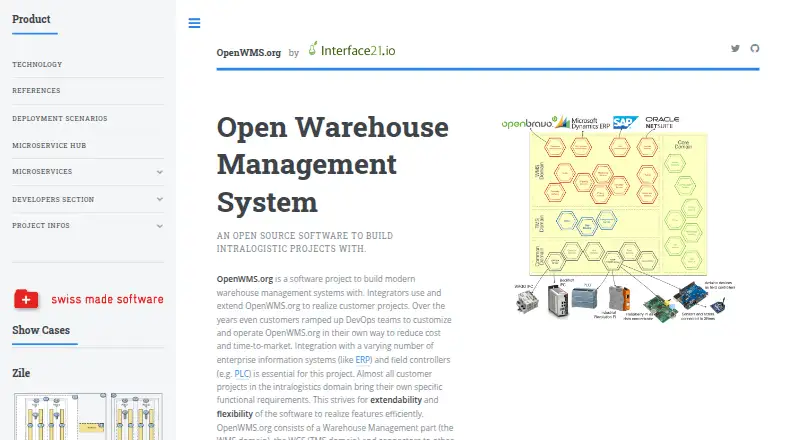
What OpenWMS.org is
OpenWMS.org is open-source software for building warehouse management and intralogistics systems. It brings warehouse management, transport management, and connections to other systems into a set of independently deployable microservices. Integrators and customer DevOps teams can extend it for specific warehouse projects and operate the resulting systems. COP is a web application for operators and superusers to manage inventory and processes; Roma is a cross-platform handheld app for phones and tablets. A workflow engine can change material handling while work continues. Services can use relational or NoSQL databases, and the project describes connections to ERP systems and field controllers such as PLCs and Raspberry Pi devices. Deployment options include cloud, fog or private cloud, hybrid, and monolith; monolith deployments offer elasticity at infrastructure rather than service level. The project also describes OAuth 2.0 and OIDC authentication, plus Grafana and Kibana interfaces for monitoring and log analysis. It is free, supports barcode scanning and multiple warehouses, and has been actively developed by its founder since 2005.
Who it suits
OpenWMS.org suits integrators and customer DevOps teams building and operating warehouse projects. It is designed for teams that need to adapt warehouse and intralogistics workflows to customer requirements.
What it does well
- Combines warehouse and transport management.
- COP manages inventory and warehouse processes.
- Roma supports mobile warehouse operations.
- Supports relational and NoSQL datastores.
- Offers cloud, fog, hybrid, and monolith deployment.
What to know first
- Monolith elasticity is at infrastructure level.
- Ready-to-use public cloud services require valid access tokens.
- Online services require account registration.
- Demo UAA endpoint has no SLA.
Limits
In a monolith deployment, elasticity is available at infrastructure level rather than service level. Ready-to-use public cloud services require valid access tokens, online services require account registration, and the demo UAA endpoint has no SLA.
Getting started
- Visit the OpenWMS.org project website.
- Select a documented deployment model: cloud, fog or private cloud, hybrid, or monolith.
- Plan the warehouse project around its warehouse management, transport management, and connectors.
- Choose operator access through COP or handheld operations through Roma.
- Register for online services; ready-to-use public cloud services require valid access tokens.
- Contact the team for support or an end-customer project.
OpenWMS.org is a free, open-source foundation for organizations building warehouse and intralogistics software around their own processes. It suits integrators and customer DevOps teams more than buyers wanting a fixed package. Its strongest case is broad, adaptable coverage; its cost is the engineering and operational responsibility that comes with that freedom.
Overview
Founded in 2005, the project brings warehouse management, transport management and system connectors into one extensible environment. Business capabilities are delivered as small, independently deployable microservices, allowing a team to adapt the system to customer-specific intralogistics requirements. Services can run in the cloud, but cloud operation is optional.
Deployment can follow cloud, fog or private-cloud, hybrid, or monolith patterns. That range helps organizations fit the software to existing infrastructure and operating constraints. Monolith deployment has an important limitation: elasticity is handled at infrastructure level rather than independently for each service. Teams that need to scale individual functions should favor the other models.
Key features
Warehouse operations
COP is a browser-based application for operators and superusers to manage inventory and warehouse processes. Roma adds a cross-platform handheld interface for warehouse work on phones and tablets. Barcode scanning and multiple-warehouse operation support practical needs across sites, while the combination of web supervision and mobile execution suits mixed workforces.
Workflows and integration
A workflow engine can alter material-flow handling dynamically without interrupting operations or requiring downtime. Support for Activiti, Flowable and Camunda gives implementation teams choices when modeling those processes. The project describes ERP connections for the WMS and links from its transport-management functions to field controllers such as PLCs and Raspberry Pi devices, making it relevant to automation-heavy facilities as well as conventional warehouse projects.
Data, messaging and observability
OpenWMS.org does not tie services to one database or storage technology: relational and NoSQL datastores can be used where appropriate. RabbitMQ is among the supported integration technologies. Grafana interfaces cover monitoring of microservices, messaging, databases and servers, while Kibana supports transaction monitoring and log analysis. These choices favor teams that already operate a distributed-systems toolchain.
Identity and service access
The authentication and authorization server supports multitenant, multidomain OAuth 2.0 and OIDC. The Microservice Hub requires valid access tokens for ready-to-use public-cloud services, and online services require account registration. That model is suitable for controlled, multi-tenant deployments but adds identity-management work to implementation.
Pricing
OpenWMS.org is free, with a free plan and no free trial because the software itself is offered at no charge. There are no published seat, transaction or usage quotas in the plan. The economic advantage is clear for integrators and DevOps teams able to supply implementation, hosting and ongoing operations; organizations seeking a vendor-managed rollout should budget for that work and contact the team about support or an end-customer project. The demo UAA endpoint is uncharged and carries no SLA, so it should not be treated as a production service commitment.
Platforms
OpenWMS.org supports Android, iOS, Linux, web and API access, as well as self-hosted operation. This combination covers handheld warehouse users, browser operators, integrations and teams retaining control of deployment infrastructure.
Who it's for
Integrators are the natural audience: they can extend the project for customer warehouses, transport flows and automation connections. Customer DevOps teams that want to customize, deploy and operate their own warehouse platform also fit well. It is less suitable for a small business wanting a turnkey WMS with a single supported deployment and minimal engineering involvement.
Pros and cons
Pros
- Broad operational scope: warehouse management, transport management and connectors reduce the need to stitch together unrelated foundations.
- Genuine architectural flexibility: independently deployable microservices, multiple deployment models and cloud-optional services let teams match infrastructure to project needs.
- Adaptable data and workflows: relational or NoSQL storage and dynamic workflow changes support varied warehouse designs without planned downtime for flow adjustments.
- Free software: there is no published license charge, seat fee or transaction cost, which is attractive for project-based implementations.
Cons
- Operational burden: customization, security, monitoring and deployment are responsibilities for the implementing team rather than a turnkey vendor.
- Monolith scaling trade-off: monolith mode cannot scale services independently, limiting elasticity for workloads that need function-level growth.
- No SLA on the demo UAA endpoint: the uncharged endpoint is unsuitable as a reliability guarantee for production authentication.
- Access controls add complexity: public-cloud services require tokens and online services require registration, so identity setup is part of the rollout.
Alternatives
For a broader category starting point, see Logistics Management Software and Warehouse Management Software.
- Fleetbase is the better fit when you want a freemium product with a $29 a month cloud plan offering unlimited orders and users, plus a free trial.
- Open TMS suits transport-only projects needing free-forever, MIT-licensed software with no per-user fees, transaction costs or feature gates.
- Made4net WMS is a paid, quote-based choice for teams seeking a commercial WMS across cloud or on-premise deployment.
- Bluerock TMS is a tailored paid transport-management alternative priced through an expert consultation.
- Infor Public Sector is a paid option for organizations that prefer a commercial suite and a vendor quote.
- Shipwell TMS is another paid TMS with customized quoting through sales.
- Freightos fits users needing subscription freight-pricing data; its Individual Starter Ocean plan is $119 a month billed annually for one user and defined historical, lane and route allowances.
- Magaya Supply Chain is a paid, subscription-based platform with pricing tailored to required solutions and user count.
Verdict
Choose OpenWMS.org if you are an integrator or capable DevOps organization that wants a free, extensible base spanning warehouse, transport and automation connections. Its microservices, workflow flexibility and deployment choices are the main reasons to choose it. Look elsewhere if you need a turnkey product, vendor-managed operations or service-level scaling without building that capability yourself.
Verdict
OpenWMS.org covers warehouse operations, transport management, integrations, and deployment choices in an extensible microservices system. It is aimed at teams prepared to adapt and operate warehouse software for their projects.
Questions
Is OpenWMS.org free and open source?
It is open source software with a free plan. No free trial is listed.
Who is OpenWMS.org for?
Integrators use and extend it for customer projects, and customers have built DevOps teams to customize and operate it.
What deployment options are documented?
The project lists cloud, fog or private cloud, hybrid, and monolith deployment models.
What interfaces are available for warehouse operations?
COP is a web application for operators and superusers to manage inventory and processes. Roma is a cross-platform handheld app for phones and tablets.
What systems and technologies can it connect with?
The project describes WMS connections to ERP systems and transport management connections to field controllers such as PLCs and Raspberry Pi devices. It also describes support for Activiti, Flowable, and Camunda workflow engines, RabbitMQ, and relational or NoSQL databases.
What account or access requirements apply to its online services?
Online services require account registration. Ready-to-use public cloud services require valid access tokens.
Facts from OpenWMS.org's own pages
- Architecture
- The software uses microservices and supports cloud operation, while services do not require the cloud. · openwms.github.io, 5 Oct 2026
- Authentication
- The site describes a multitenant, multidomain OAuth 2.0 and OIDC authentication and authorization server. · openwms.github.io, 5 Oct 2026
- Availability
- The demo UAA endpoint is listed as uncharged and without an SLA. · openwms.github.io, 5 Oct 2026
- Data storage
- It does not depend on a particular database or storage technology, and services may use relational or NoSQL datastores. · openwms.github.io, 5 Oct 2026
- Deployment
- Documented deployment models are cloud, fog/private cloud, hybrid, and monolith. · openwms.github.io, 5 Oct 2026
- Deployment limit
- In monolith deployment, elasticity is available at infrastructure level rather than service level. · openwms.github.io, 5 Oct 2026
- Deployment options
- The project lists cloud, fog, hybrid and monolith deployment models; in the monolith model, elasticity is available at infrastructure level rather than service level. · openwms.github.io, 5 Oct 2026
- Extensibility
- The project is designed to be extended and adapted to customer-specific intralogistics requirements. · openwms.github.io, 5 Oct 2026
- Founded
- 2005 · openwms.github.io, 28 Sept 2026
- Integrations
- The project describes connecting its WMS to ERP systems and its transport management system to field controllers such as PLCs and Raspberry Pi devices. · openwms.github.io, 5 Oct 2026
- Intended users
- Integrators and customer DevOps teams use and extend the system to build and operate warehouse projects. · openwms.github.io, 5 Oct 2026
- Microservices
- Its business functions are organized as small, independently deployable microservices. · github.com, 5 Oct 2026
- Mobile app
- Roma is a cross-platform handheld application for warehouse operations on mobile phones and tablets. · openwms.github.io, 5 Oct 2026
- Mobile interface
- Roma is a cross-platform handheld app for warehouse operations on mobile phones and tablets. · openwms.github.io, 5 Oct 2026
- Monitoring
- The listed interfaces include Grafana for monitoring microservices, RabbitMQ, databases and servers, and Kibana for transaction monitoring and log analysis. · openwms.github.io, 5 Oct 2026
- Operator interface
- COP is a web application for operators and superusers to manage warehouse inventory and processes. · openwms.github.io, 5 Oct 2026
- Operator interfaces
- COP is a web application for operators and superusers to manage warehouse inventory and processes. · openwms.github.io, 5 Oct 2026
- Project history
- The project founder has been actively developing OpenWMS.org since 2005. · openwms.github.io, 5 Oct 2026
- Purpose
- OpenWMS.org is open source software for building warehouse management systems and intralogistics projects. · openwms.github.io, 5 Oct 2026
- Security
- The main site describes a multitenant, multidomain OAuth 2.0 OIDC server for authentication and authorization. · openwms.github.io, 5 Oct 2026
- Security and service access
- The Microservice Hub says ready-to-use public cloud services require valid access tokens and online services require account registration. · openwms.github.io, 5 Oct 2026
- Support
- The project invites users who need support or want an end-customer project to contact the team. · openwms.github.io, 5 Oct 2026
- Technology integrations
- The project describes support for Activiti, Flowable, and Camunda workflow engines, RabbitMQ, and relational or NoSQL databases. · github.com, 5 Oct 2026
- Warehouse functions
- It combines warehouse management, transport management and connectors to other systems. · openwms.github.io, 5 Oct 2026
Where OpenWMS.org stands on Freedom251
- Logistics Management Software#4 of 36
- Warehouse Management Software#5 of 44