Freedom251 › Customer Community Software

Scoold
What Scoold is
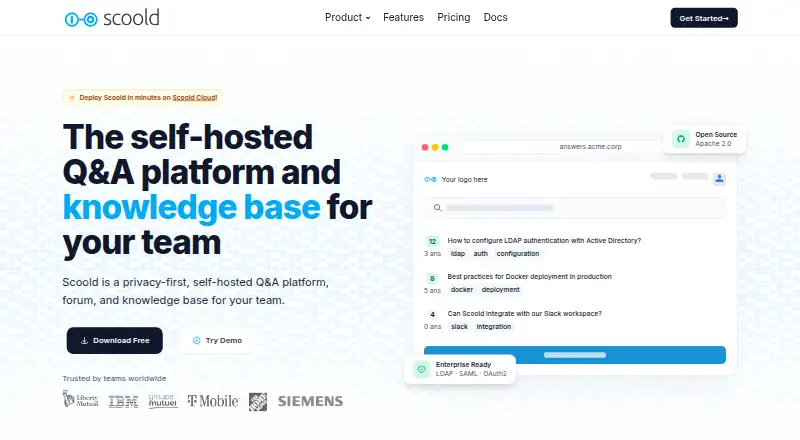
Scoold is a self-hosted Q&A platform, forum and knowledge base for teams. It can support team knowledge bases, community forums, developer hubs, support centers, Q&A platforms and issue trackers. Members can ask and answer questions, vote, earn badges and reputation, and review edit history. Full-text search indexes content, which can include Markdown, media, files and code snippets with syntax highlighting. Scoold offers a RESTful JSON API defined with an OpenAPI specification. Listed integrations include Slack, Microsoft Teams, Mattermost, Zapier and n8n, though chat integrations are marked Pro. Identity options include LDAP, social login and two-factor authentication; Pro adds SAML 2.0 SSO, SCIM and custom authentication. Teams can deploy a JAR or Docker setup on an operating system with Java 21 or higher and a Para backend, keeping data on their own infrastructure. The free plan allows up to 10 spaces, one admin and one whitelisted identity domain. Scoold Pro costs €499, paid once; Pro + Source costs €1,999, paid once.
Who it suits
Scoold may suit teams that want to host a searchable Q&A space, forum or knowledge base on their own infrastructure. Teams needing more than the free plan’s listed limits or Pro identity and chat integrations should review the paid options.
What it does well
- Self-hosted deployment keeps data on a team's infrastructure.
- Full-text search indexes community content.
- Markdown, media, files and code snippets are supported.
- A RESTful JSON API has an OpenAPI specification.
- Pro includes updates and support for 12 months.
What to know first
- Free plan caps spaces, admins and whitelisted identity domains.
- Chat integrations are marked Pro.
- Deployment requires Java 21 or higher and a Para backend.
Limits
The free plan allows at most 10 spaces, one admin, and one whitelisted identity domain. Pro removes those listed caps. Pro licenses include updates and support for 12 months after purchase; the maker also offers a 14-day money-back guarantee.
Plans
| Plan | Billed and limits | Price |
|---|---|---|
| Scoold | Free forever · Up to 10 spaces · 1 admin · 1 whitelisted identity domain | Free |
| Pro + Source | one-time fee · One production instance · Source code access · Updates and support for 12 months | €1,999, paid once |
| Scoold Pro | one-time fee · One production instance · Updates and support for 12 months | €499, paid once |
As scoold.com lists them, read 8 Oct 2026. The maker's own page has the final word.
Getting started
- Visit https://scoold.com/ to review the product and plans.
- Choose the free Scoold plan or a paid plan; a 5-day trial is listed.
- Deploy using a JAR or Docker setup.
- Run it on an operating system with Java 21 or higher and a Para backend.
Scoold is a self-hosted workspace for questions, forums, and durable team knowledge. It fits organizations that need control of their infrastructure, searchable technical content, and an API for custom workflows. The main trade-off is operational: you run its Java-based stack yourself, and the free edition is deliberately small.
Overview
Scoold brings Q&A and forum discussion together with knowledge-base publishing. People can ask and answer questions, vote, build reputation, earn badges, and review edit history. Those mechanics give contributors visible incentives and give maintainers a record of how answers changed over time.
Search indexes the accumulated content for full-text retrieval. Markdown, attached media, files, code snippets, and syntax highlighting make the system suitable for engineering documentation as well as less technical team material. Self-hosting keeps data on your own infrastructure, which is valuable for organizations with residency or internal-control requirements, but it also makes deployment and maintenance your responsibility.
Key features
The product is positioned for internal knowledge bases, community forums, developer hubs, support centers, Q&A sites, and issue tracking. That breadth is useful when one installation must serve both discussion and lasting reference material. Moderation tools and a custom-domain option support a branded community, while the absence of community analytics is a drawback for operators who need built-in engagement reporting.
Scoold offers a RESTful JSON API documented through OpenAPI, giving development teams a defined base for integrations and automations. Listed connections include Slack, Microsoft Teams, Mattermost, Zapier, and n8n; the chat integrations are Pro features, so free users cannot assume those channels are included. LDAP, social login, and two-factor authentication cover common identity needs. Pro adds SAML 2.0 single sign-on, SCIM provisioning, and custom authentication, which matter most in larger or centrally managed organizations.
Pricing
| Plan | Price and terms | What you get |
|---|---|---|
| Scoold | free, billed Free forever | Up to 10 spaces, 1 admin, and 1 whitelisted identity domain |
| Scoold Pro | €499, paid once, billed one-time fee | One production instance; updates and support for 12 months |
| Pro + Source | €1,999, paid once, billed one-time fee | One production instance, source-code access, and updates and support for 12 months |
The free plan is a sensible fit for a small team or pilot that can stay within ten spaces and one administrator. Its single whitelisted identity domain can constrain organizations with multiple domains. Pro removes those listed caps and is the practical choice for a broader deployment, but its €499 payment covers support and updates for 12 months rather than indefinitely. Pro + Source is aimed at buyers who require source access and can justify the additional €1,500 for one production instance. The maker also advertises a 5-day trial and a 14-day money-back guarantee; Pro licenses include free updates and support for 12 months after purchase.
Platforms
Scoold is offered for web use, self-hosted deployment, and through an API. You can deploy it as a JAR or with Docker, on any operating system that supports Java 21 or higher and a Para backend. This is a strong fit for teams already operating Java or container infrastructure, and a poor fit if you want a vendor-managed service with no runtime to administer.
Who it's for
Choose Scoold when data ownership, a searchable internal reference, and integration flexibility outweigh the convenience of hosted software. It is particularly suited to technical teams, support organizations, and communities that need Markdown and code presentation alongside Q&A. Smaller groups can start free; organizations needing several administrators, more than ten spaces, or enterprise identity controls should budget for Pro.
Pros and cons
Pros
- Self-hosting keeps organizational data on infrastructure you control.
- Q&A reputation features, edit history, and full-text search help turn conversations into reusable knowledge.
- OpenAPI-described REST access and multiple listed integrations support custom workflows.
- Pro identity options include SAML 2.0 SSO, SCIM, and custom authentication.
Cons
- The free edition permits only 10 spaces, one admin, and one whitelisted identity domain.
- Running Java 21+, Para, and a JAR or Docker deployment requires infrastructure ownership.
- Updates and support are included for 12 months, so ongoing coverage needs renewal planning.
- Community analytics are not included as a listed capability.
Alternatives
Customer Community Software is the broader category to browse when you want to compare community-focused products. Sugester is a freemium option spanning Android, iOS, web, API, and self-hosting, with a free tier for three users and specified email, project, and storage quotas. Apache Answer is free, Apache-licensed, open-source software for self-hosted Q&A across Linux, macOS, Windows, and web.
HelloBox suits a hosted API and web setup, with plans from $5.00 per month and member and view quotas. Discourse is another self-hosted, freely available open-source community platform, with a free plan offering unlimited members, two staff seats, and monthly page-view limits. Freshdesk is a paid support-desk alternative with a free program for 1–2 agents for six months and a Growth plan at $19.00 per month when billed annually. Zoho Desk offers a three-user free tier and paid plans billed annually, making it more appropriate when you want a service-desk product rather than self-hosted Q&A. Oracle Community Self Service is a paid option for Android, iOS, and web. Flarum is free, open-source forum software with self-hosted, web, API, and extension support.
Verdict
Scoold is a strong choice for technically capable organizations that want self-hosted Q&A, searchable knowledge, and integration control in one system. Choose it for data ownership and its API; look elsewhere if you need managed hosting, built-in analytics, or a free plan with generous administrative capacity.
Verdict
Scoold combines Q&A, forum and knowledge-base functions with self-hosted deployment and an API. Its free caps are specific, while Pro adds identity and chat options; check the plan limits against your setup.
Questions
Is Scoold free?
Yes. The Scoold plan is free forever and costs nothing. A 5-day trial is also listed.
How much do the paid plans cost?
Scoold Pro costs €499.00 EUR as a one-time fee for one production instance. Pro + Source costs €1999.00 EUR as a one-time fee for one production instance and source code access.
What platforms does Scoold support?
Scoold is listed for API, self-hosted, and web use. Deployment is available as a JAR or Docker setup, on an operating system with Java 21 or higher and a Para backend.
Which integrations are available?
The maker lists Slack, Microsoft Teams, Mattermost, Zapier, and n8n. Chat integrations are marked as Pro features.
Which identity options does Scoold offer?
Listed options include LDAP, social login, and two-factor authentication. Pro adds SAML 2.0 SSO, SCIM, and custom authentication.
Who makes Scoold?
Scoold is presented as a product of Erudika, an EU-based software company located in Sofia, Bulgaria.
Facts from Scoold's own pages
- API
- Scoold provides a RESTful JSON API defined with an OpenAPI specification. · scoold.com, 8 Oct 2026
- Data ownership
- The maker describes Scoold as self-hosted and says users can keep their data on their own infrastructure. · scoold.com, 8 Oct 2026
- Deployment
- Scoold can be deployed as a JAR or Docker setup, and the maker says it can run on any operating system with Java 21 or higher and a Para backend. · scoold.com, 8 Oct 2026
- Founded
- 2008 · scoold.com, 28 Sept 2026
- Identity and security
- Listed identity options include LDAP, social login, two-factor authentication, and Pro features for SAML 2.0 SSO, SCIM, and custom authentication. · scoold.com, 8 Oct 2026
- Integrations
- The maker lists Slack, Microsoft Teams, Mattermost, Zapier, and n8n integrations; chat integrations are marked Pro. · scoold.com, 8 Oct 2026
- Maker
- Scoold is presented as a product of Erudika, an EU-based software company located in Sofia, Bulgaria. · erudika.com, 8 Oct 2026
- Notable limits
- The free plan allows at most 10 spaces, 1 admin, and 1 whitelisted identity domain; Pro removes those listed caps. · scoold.com, 8 Oct 2026
- Q&A features
- Users can ask and answer questions, vote on posts, earn badges and reputation, and view edit history. · scoold.com, 8 Oct 2026
- Search and content
- Scoold indexes content for full-text search and supports Markdown, attached media, files, code snippets, and syntax highlighting. · scoold.com, 8 Oct 2026
- Support
- Scoold Pro licenses include free updates and support for 12 months after purchase; the maker offers a 14-day money-back guarantee. · scoold.com, 8 Oct 2026
- Use cases
- The maker presents Scoold for team knowledge bases, community forums, developer hubs, support centers, Q&A platforms, and issue trackers. · scoold.com, 8 Oct 2026
- What it does
- Scoold is a self-hosted Q&A platform, forum, and knowledge base for teams. · scoold.com, 8 Oct 2026
Where Scoold stands on Freedom251
- Customer Community Software#7 of 37