Freedom251 › Pair Programming Software

Saros
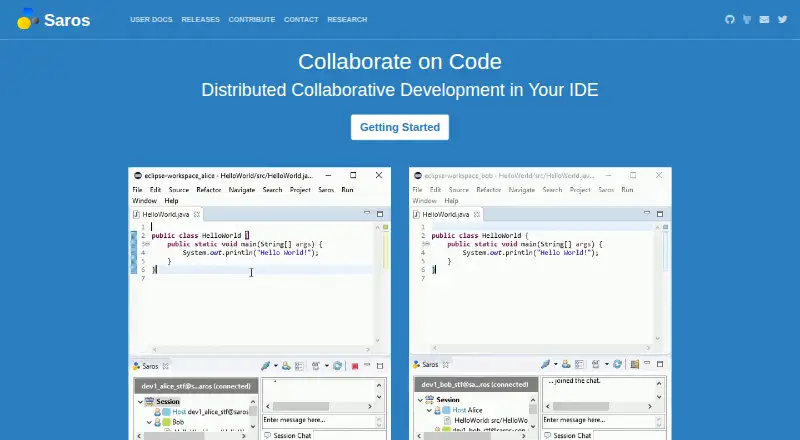
What Saros is
Saros is a free, open-source IDE plugin for distributed collaborative software development. It synchronizes text-file editing so participants with write access can work in shared files at once. Follow mode lets one person observe another participant’s navigation and editing, while session awareness shows where teammates are working and what they have changed. It includes instant messaging for group or one-to-one chat; the project recommends a separate voice or audio-conferencing tool. Documented integrations are Eclipse and IntelliJ-platform IDEs, and sessions use an XMPP/Jabber account. Teams can host their own server to keep session communication inside their network. The homepage describes sessions with up to five team members, but Saros/I release notes specify a limit of two participants. Saros/I also shares only one module, and that module must have exactly one content root; sub-modules are excluded. Collaboration requires more bandwidth and lower latency than ordinary chat, and public chat servers may be too slow for smooth sessions. Bug reports go through the project's GitHub issue tracker.
Who it suits
Saros suits software teams collaborating remotely in Eclipse or IntelliJ-platform IDEs. It may also suit organizations that want to host their own XMPP server and keep session communication within their network.
What it does well
- Shared files support simultaneous editing by multiple writers.
- Follow mode shows a teammate’s navigation and edits.
- Built-in chat supports group and one-to-one messaging.
- Teams can host their own session server.
- The plugin is free and open source.
What to know first
- No voice or audio conferencing is included.
- Saros/I release notes limit sessions to two participants.
- Saros/I sharing excludes sub-modules.
- Smooth sessions require higher bandwidth and lower latency than chat.
Limits
Saros/I release notes limit that plugin to two participants; its shared module must have exactly one content root, and sub-modules are excluded. Saros requires higher bandwidth and lower latency than ordinary chatting, and public chat servers may be too slow for smooth operation.
Plans
| Plan | Billed and limits | Price |
|---|---|---|
| Saros | Completely open source; no paid plans or price listed | Free |
As saros-project.org lists them, read 2 Oct 2026. The maker's own page has the final word.
Getting started
- Open the Saros project website.
- Use Eclipse or an IntelliJ-platform IDE with the documented Saros integration.
- Set up an XMPP/Jabber account for sessions.
- Host your own server if you want session communication to stay within your network.
- Start a collaboration session and use instant messaging for text chat.
Saros is a free, open-source plugin for collaborative software development in Eclipse and IntelliJ-platform IDEs. It best suits developers who want to edit and follow work inside a supported IDE, especially teams that can host their own XMPP server. Its appeal is focused IDE collaboration without a subscription, but participant and project-structure limits make fit important.
Overview
Saros synchronizes text-file editing so several participants with write access can work in the same shared files at once. Follow mode lets one person track a colleague’s navigation and editing, while session awareness shows where others are working and what they have changed. Together, those tools help a team stay oriented during a joint coding session; they are less compelling if the group needs a full remote-meeting tool.
Instant messaging supports one-to-one and multi-user chat, but Saros has no voice audio or screen sharing. The project recommends a separate VoIP or audio-conferencing tool, so teams wanting code collaboration and live voice in one application should choose another option.
Key features
Editing and awareness in the IDE
Saros integrates with Eclipse and IntelliJ-platform IDEs, and sessions use an XMPP/Jabber account. Developers who already work in those IDEs can collaborate without shifting the shared editing workflow to a separate editor. IntelliJ users face a significant project constraint: Saros/I shares only one module, that module must have exactly one content root, and sub-modules are excluded. Teams with a different project structure should look elsewhere or confirm that the shared work fits this boundary.
Messaging and connections
Chat is useful for short coordination, but it does not replace voice communication. Saros also needs more bandwidth and lower latency than ordinary chatting; public chat servers may be too slow for smooth sessions. For company use or sessions with more than one peer, the project recommends an organization’s own XMPP server. Users can self-host a server to keep session communication within their network, a useful option for teams that want that control, though Saros states no security certification.
The homepage describes sessions of up to five team members, while Saros/I release notes cap that plugin at two participants. That distinction matters: IntelliJ users planning larger sessions should treat the two-person limit as the practical constraint. Bug reports go through the project’s GitHub issue tracker.
Pricing
Saros costs nothing. The Saros plan is completely open source, with no paid plans or price listed; there is no free trial because the software is free. That makes it a straightforward choice for teams willing to use its supported IDE workflow and manage the connection setup themselves. The trade-off is not a cheaper tier but a narrower tool: no voice or screen sharing, plus the participant and IntelliJ module limits.
Platforms
Saros supports Linux, macOS, and Windows, as well as self-hosted deployments. Editor support is Eclipse, IntelliJ IDEA, and IntelliJ-platform IDEs. The platform range is broad, but collaboration still depends on using one of those IDE families and an XMPP/Jabber account.
Who it's for
Saros is a good fit for distributed developers who use Eclipse or an IntelliJ-platform IDE, need concurrent editing and shared awareness, and are comfortable arranging voice separately. Self-hosting is particularly relevant to organizations that want session communication kept within their network. It is a poor fit for teams that need voice or screen sharing built in, larger Saros/I sessions, or support for IntelliJ projects with multiple modules or content roots.
Pros and cons
- Pro: Concurrent editing, follow mode, awareness, and chat bring several collaboration tools into supported IDE workflows.
- Pro: The software is free and open source, with a self-hosted server option for keeping session communication within a team network.
- Con: No voice audio or screen sharing means teams need separate tools for those parts of a session.
- Con: Saros/I is limited to two participants and one module with exactly one content root, excluding sub-modules.
- Con: Higher bandwidth and lower latency requirements can make public chat servers unsuitable for smooth collaboration.
Alternatives
For a broader comparison, see Pair Programming Software.
- Drovio is worth considering if screen sharing and calls are central: its free Basic plan includes unlimited screen sharing and calls for up to two participants, with remote control limited to 30 minutes per day.
- Pop may suit teams looking for a meeting-oriented option; its Pro plan is free while in beta and includes unlimited meetings without a time limit.
- Zed is an alternative for developers seeking a code editor with a free Personal plan, including 2,000 accepted edit predictions and external-agent or API-key support.
- Hopp offers a self-hosted plan that is free to run on your own infrastructure, making it an option for readers prioritizing self-hosting.
- CodeInterview is an option for interview-focused coding sessions; its free plan allows two interviews per month with unlimited users.
- Coterm is another free, open-source option with a macOS app and optional self-hosted collaboration backend.
- Duckly may suit occasional sessions needing video: its free plan has no video calls and allows two simultaneous participants, while its Hacker plan is $6 a month.
- Remote Collab is an open-source SublimeText plugin for multiple developers collaborating on the same project in real time.
Verdict
Choose Saros if your team uses Eclipse or IntelliJ-platform IDEs and wants free, open-source concurrent editing, awareness, and chat, with the option to self-host session communication. Its strongest reason to choose is focused collaboration within the IDE without a subscription. Look elsewhere if your sessions need voice or screen sharing, if Saros/I’s two-person cap is too small, or if your IntelliJ project does not fit its single-module structure.
Verdict
Saros provides shared editing, awareness, and messaging for supported IDE workflows, with self-hosting available. Check the participant and module limits for Saros/I, and plan separate voice communication if needed.
Questions
How much does Saros cost?
Saros is free and open source. No paid plans or price are listed.
Which IDEs does Saros support?
The documented integrations are Eclipse and IntelliJ-platform IDEs, including IntelliJ IDEA.
Does Saros include chat or voice?
It includes instant messaging for one-to-one and multi-user chat. Voice audio is not included, and the documentation recommends a separate VoIP or audio conferencing tool.
Can a team host Saros itself?
Yes. Users can host their own server and keep session communication within their network.
How many people can join a session?
The homepage says a session can include up to five team members, while Saros/I release notes limit that plugin to two participants.
What account does Saros use for sessions?
Sessions use an XMPP/Jabber account.
Facts from Saros's own pages
- Awareness
- During a session, users can see where others are working and what they have changed. · saros-project.org, 2 Oct 2026
- Communication
- Saros provides instant messaging and supports multi-user or one-to-one chat; its documentation recommends using a separate VoIP or audio conferencing tool. · saros-project.org, 2 Oct 2026
- Concurrent writers
- Participants with write access can edit shared files at the same time. · saros-project.org, 2 Oct 2026
- Connection requirements
- Saros requires higher bandwidth and lower latency than normal chatting, and public chat servers may be too slow for smooth operation. · saros-project.org, 2 Oct 2026
- Follow mode
- Follow mode lets a participant observe another team member’s navigation and editing activity. · saros-project.org, 2 Oct 2026
- Integrations
- The documented IDE integrations are Eclipse and IntelliJ-platform IDEs, and sessions use an XMPP/Jabber account. · saros-project.org, 2 Oct 2026
- IntelliJ limitations
- Saros/I currently shares only one module, which must have exactly one content root, and does not include sub-modules when sharing. · saros-project.org, 2 Oct 2026
- Platforms
- Saros is distributed as IDE plugins for Eclipse and IntelliJ-platform IDEs; the installation guide lists Eclipse 4.8 or newer and IntelliJ 2019.2.3 or newer. · saros-project.org, 2 Oct 2026
- Purpose
- Saros is an open-source IDE plugin for distributed collaborative software development. · saros-project.org, 2 Oct 2026
- Real-time editing
- It synchronizes collaborative text-file editing among participants. · saros-project.org, 2 Oct 2026
- Security and privacy
- The project recommends setting up an own XMPP server for company use or sessions with more than one peer; it does not state a security certification on the pages reviewed. · saros-project.org, 2 Oct 2026
- Self-hosting
- Users can host their own server and keep session communication within their network. · saros-project.org, 2 Oct 2026
- Session limit
- The homepage says a session can include up to five team members, while the Saros/I release notes limit that plugin to two participants. · saros-project.org, 2 Oct 2026
- Support
- The project directs users to its GitHub issue tracker to report bugs. · saros-project.org, 2 Oct 2026
Where Saros stands on Freedom251
- Pair Programming Software#9 of 26