SAP Business One
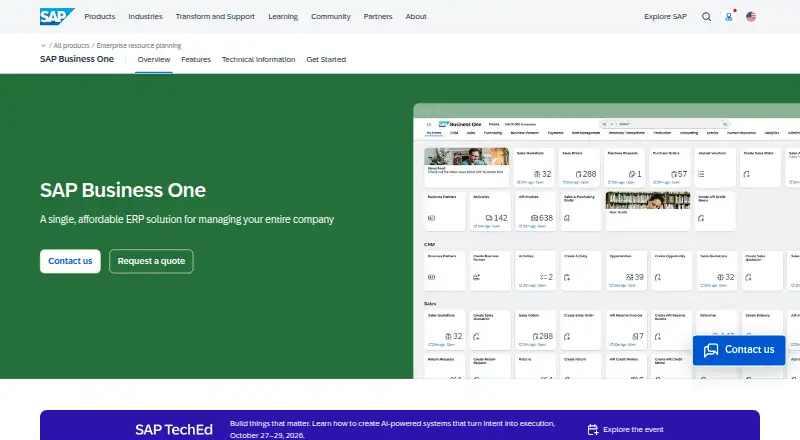
What SAP Business One is
SAP Business One is an ERP system for small and midsize businesses that combines accounting, purchasing, inventory, sales, customer relationships, reporting, and analytics. Its financial tools cover cash flow and budget controls, fixed assets, banking, reconciliation, and financial reporting. Sales and customer functions include opportunities, campaigns, customer information, service agreements and calls, and sales reporting. Purchasing tools include procurement, accounts payable, purchasing data, warehouse coordination, and accounting synchronization. Analytics include real-time dashboards, predefined metrics, reports, and interactive analysis with Microsoft Excel functionality. The web client supports marketing documents, master data, approvals, activity tracking, charts, and predefined analytics. Android and iOS apps let users manage leads and customer accounts, view stock, and place orders; available mobile functions depend on each user's SAP Business One license. SAP describes both cloud and on-premise deployment options. Its Service Layer provides an extension API using HTTP and OData protocols. SAP lists capabilities for consumer products, manufacturing, professional services, retail, and wholesale distribution. Pricing is available by quote based on business requirements.
Who it suits
SAP Business One suits small and midsize businesses seeking financial, sales, purchasing, inventory, and reporting functions in one ERP system. It may fit organizations needing cloud or on-premise deployment and mobile access subject to user licenses.
What it does well
- Combines finance, sales, purchasing, and inventory.
- Offers cloud and on-premise deployment.
- Includes real-time dashboards and analytics.
- Service Layer API uses HTTP and OData.
- Mobile apps support leads, stock views, and orders.
What to know first
- Pricing is available by quote only.
- Mobile functions depend on each user's license.
Plans
| Plan | Billed and limits | Price |
|---|---|---|
| SAP Business One | Pricing by quote based on business requirements | On request |
As sap.com lists them, read 12 Oct 2026. The maker's own page has the final word.
Getting started
- Visit the SAP Business One product website.
- Request pricing based on your business requirements.
- Choose cloud or on-premise deployment.
- Select the relevant platform: web, Windows, Android, iOS, API or self-hosted.
- Use the mobile apps according to each user's SAP Business One license.
Overview
SAP Business One is an ERP system for small and midsize businesses that brings finance, purchasing, inventory, sales, customer management, and reporting into one system. It is best suited to companies that need those functions to work across operations, especially in manufacturing, retail, wholesale distribution, consumer products, and professional services. Its breadth is the main draw; custom pricing and license-dependent mobile functions are the main trade-offs.
Key features
Financial management combines accounting, cash flow and budget controls, fixed assets, banking and reconciliation, and financial reporting. That range gives businesses a way to manage financial activity alongside purchasing and sales, rather than treating accounting as a separate tool. For companies needing only bookkeeping, the wider ERP scope may be more than they need.
Sales and customer tools cover opportunities, marketing campaigns, customer records, service agreements and calls, and sales reporting. Purchasing and inventory connect procurement and purchasing data with warehouse activity, accounting, accounts payable, and reporting. This combination suits businesses where stock, orders, and finance need to stay aligned.
Analytics include real-time dashboards, reports, predefined metrics, and interactive analysis with Microsoft Excel functionality. The Web client supports marketing documents and master data, approval processes, activity tracking, charts, and predefined analytics, giving users a browser-based way to handle common work. Microsoft Outlook Integration can synchronize appointments, contacts, and tasks and exchange quotations, emails, and documents with SAP Business One.
Mobile apps for iOS and Android let users manage leads and customer accounts, check stock, and place orders. Available functions depend on each user's SAP Business One license, so mobile access should be evaluated against the licenses a business plans to assign. The Service Layer API uses HTTP and OData to expose SAP Business One data and services for extensions, which can support tailored integrations.
Deployment is available in cloud and on-premise options. Customers with a valid maintenance contract receive 24x7 support for critical issues, support tools, upgrades and updates, and knowledge transfer through SAP and its partner network. SAP says more than 85,000 customers worldwide rely on the product.
Pricing
SAP Business One
SAP Business One uses paid, custom pricing based on business requirements. A quote-based model can suit companies whose needs call for a tailored ERP configuration, but it makes costs harder to compare before discussing requirements with SAP or a partner. No public plan tiers, seat limits, or trial terms are provided.
Platforms
SAP Business One supports Android, iOS, web, Windows, self-hosted deployment, and an API. The combination of browser access, mobile apps, and cloud or on-premise deployment gives businesses several ways to fit the system into their environment. Mobile functionality varies by license.
Who it's for
SAP Business One is a strong fit for small and midsize businesses that want finance, customer management, procurement, inventory, sales, and analytics in a connected ERP, particularly in consumer products, manufacturing, professional services, retail, and wholesale distribution. Its manufacturing tools and multi-entity support also suit businesses with broader operational requirements. Companies seeking a focused accounting product or clear public pricing may find its scope and quote process less suitable.
Pros and cons
- Broad operational coverage: Finance, sales, purchasing, inventory, and manufacturing tools sit within one ERP, supporting coordination across departments.
- Flexible deployment and access: Cloud and on-premise options, plus web, desktop, mobile, and API access, accommodate varied operating environments.
- Useful analytics and integrations: Real-time reporting, Excel functionality, Outlook synchronization, and an HTTP/OData API support analysis and connected workflows.
- Pricing requires a quote: Buyers cannot compare a published price or plan tiers without discussing their requirements.
- Mobile access depends on licensing: Users may not all receive the same app functions, so license choices affect the mobile experience.
Alternatives
For professional services accounting needs, compare professional services accounting software; for manufacturing-focused needs, consider food manufacturing software, manufacturing ERP software, or material requirements planning software. Companies handling intercompany or lease accounting can browse intercompany accounting software or lease accounting software.
Acumatica Professional Services Edition is an alternative for professional services buyers seeking custom pricing based on applications, expected usage, resource needs, and deployment preferences; its plan states unlimited usage. Beyond Software may suit teams wanting a subscription that can be adjusted as they grow, with Android, iOS, web, and Windows support. Kantata offers paid PSA software with pricing tailored to company size, goals, and team practices.
Unanet ERP AE is another paid ERP option. ConnectWise PSA has paid tiers that include project management, ticketing, and resource management, with its Standard plan also including a customer portal. Datto Endpoint Backup for Windows uses consumption-based pricing tied to storage used, making it a different option for buyers focused on endpoint backup. Infor Learning Management System is a paid learning management option with a free trial. Unit4 FP&A offers paid financial planning and analysis software with pricing on request and no public tiers or usage limits.
Verdict
Choose SAP Business One if your small or midsize business needs a broad ERP that connects finance, sales, purchasing, inventory, customer work, and analytics, with deployment options to match your environment. Look elsewhere if you need upfront pricing or consistent mobile functions across users: quotes depend on business requirements, and app capabilities vary by license.
Verdict
SAP Business One covers core ERP areas alongside analytics, web tools, mobile apps, and an extension API. Its pricing depends on business requirements, and mobile capabilities vary with licensing.
Questions
How much does SAP Business One cost?
Pricing is available on request and based on business requirements.
Can SAP Business One be deployed in the cloud?
Yes. SAP describes both cloud and on-premise deployment options.
Which platforms are listed?
Android, iOS, web, Windows, API and self-hosted.
What does the mobile app support?
SAP says the iOS and Android apps support lead and customer account management, stock viewing and order placement. Available functions depend on the user's license.
Does SAP Business One have an API?
Yes. Its Service Layer API provides access to data and services using HTTP and OData.
Who provides SAP Business One?
The listed maker is SAP Business One, headquartered in Walldorf, Germany, and founded in 1972.
Facts from SAP Business One's own pages
- Analytics
- SAP Business One provides real-time analytics, dashboards, reports, predefined metrics, and interactive analysis with Microsoft Excel functionality. · sap.com, 12 Oct 2026
- API
- The Service Layer is an extension API for SAP Business One data and services that uses HTTP and OData protocols. · help.sap.com, 12 Oct 2026
- Customer base
- SAP says more than 85,000 customers worldwide rely on SAP Business One. · sap.com, 12 Oct 2026
- Deployment
- SAP describes cloud and on-premise deployment options for SAP Business One. · sap.com, 12 Oct 2026
- Finance module
- Yes · sap.com, 20 Sept 2026
- Financial management
- Features include accounting, cash flow and budget controls, fixed asset management, banking and reconciliation, and financial reporting. · sap.com, 12 Oct 2026
- Founded
- 1972 · sap.com, 4 Oct 2026
- Headquarters
- Walldorf, Germany · sap.com, 4 Oct 2026
- Industries
- SAP lists capabilities for consumer products, manufacturing, professional services, retail, and wholesale distribution. · sap.com, 12 Oct 2026
- Inventory management
- Yes · sap.com, 20 Sept 2026
- Manufacturing tools
- Yes · sap.com, 20 Sept 2026
- Microsoft integration
- The Microsoft Outlook Integration add-on can synchronize appointments, contacts, and tasks and exchange quotations, emails, and documents with SAP Business One. · help.sap.com, 12 Oct 2026
- Mobile apps
- SAP says its iOS and Android mobile apps let users manage leads and customer accounts, view stock, and place orders. · sap.com, 12 Oct 2026
- Multi-entity support
- Yes · sap.com, 20 Sept 2026
- Notable limit
- SAP states that mobile app functions available to a user depend on that user's SAP Business One license. · help.sap.com, 12 Oct 2026
- Order management
- Yes · sap.com, 20 Sept 2026
- Purchasing and inventory
- The product supports procurement, purchasing data, warehouse and accounting synchronization, accounts payable, and reporting. · sap.com, 12 Oct 2026
- Purpose
- SAP Business One is an ERP system for small and midsize businesses that brings accounting, purchasing, inventory, sales, customer relationships, reporting, and analytics into one system. · sap.com, 12 Oct 2026
- Sales and customer management
- Features cover sales opportunities, marketing campaigns, customer information, service agreements, service calls, and sales reporting. · sap.com, 12 Oct 2026
- Support
- Customers with a valid maintenance contract receive 24x7 support for critical issues, support tools, software upgrades and updates, and knowledge transfer through SAP and its partner network. · support.sap.com, 12 Oct 2026
- Web client
- The Web client supports creating, processing, and updating marketing documents and master data, approval processes, activity tracking, charts, and predefined analytics. · sap.com, 12 Oct 2026
Where SAP Business One stands on Freedom251
- ERP Software#36 of 128
- Campus Management Software#6 of 21
- Quote-to-Cash Software#12 of 32
- Lease Accounting Software#24 of 55
- Insurance Financial Management#6 of 13
- Chemical Manufacturing Software#9 of 17
- Manufacturing ERP Software#18 of 32
- Food Manufacturing Software#14 of 23
- Process ERP Software#11 of 18
- Material Requirements Planning Software#19 of 31
- Mixed Mode ERP Software#16 of 25
- Intercompany Accounting Software#27 of 42
- Cost Accounting Software#30 of 46
- Enterprise Resource Planning - Midmarket Software#15 of 23
- Bill of Materials Software#31 of 47
- Strategic Portfolio Management#14 of 21
- Retail ERP Software#12 of 18
- Manufacturing Inventory Management#13 of 19
- Professional Services Accounting Software#20 of 29
- Google Workspace ERP Software#7 of 10
- MRP Software#17 of 24
- Enterprise Resource Planning Erp#13 of 18
- Preventive Maintenance Software#17 of 23
- Discrete Manufacturing ERP#17 of 23
- Enterprise Resource Planning - Enterprise Software#17 of 22
- Enterprise Resource Planning Software#18 of 23
- Core Financial Management#23 of 28