Freedom251 › Ad Creative Testing Tools

SaliencyLab
What SaliencyLab is
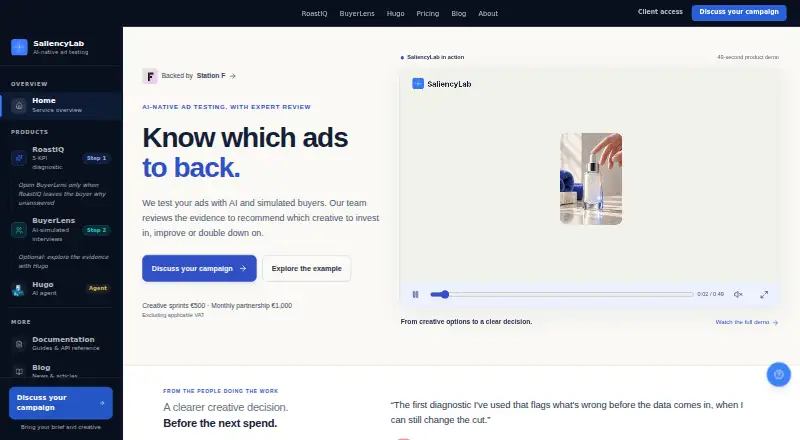
SaliencyLab is an AI-native ad testing platform for brands and agencies assessing creative before media spend. Its RoastIQ diagnostic evaluates five KPIs: Beat the Skip, Get Noticed, Brand Impact, Sell Proposition, and Build Brand. BuyerLens uses synthetic-user scenario simulations to explore possible buyer resistance; these are not interviews with a real consumer panel. The Hugo agent can run RoastIQ, explore simulated interviews, query benchmarks, and display its reasoning trace in one conversation. Supported files are MP4, MOV, JPG, PNG, and WebP, with videos up to 60 seconds. GIF and HEIC are unsupported. Listed channels include Instagram Feed, Reels, and Stories, TikTok, YouTube Pre-roll and Shorts, Facebook Feed, and Display; TV is not supported. SaliencyLab says its KPI scores are modeled diagnostics, not predictions of sales, ROAS, attributed conversion, or in-market success. The free plan includes 10 analyses a month, up to three per day, but excludes BuyerLens, Hugo, and brief generation. Pro costs €99 a month and adds those features, report export, and MCP access. REST API and webhooks are listed as private preview.
Who it suits
SaliencyLab suits brand and agency marketers or strategists who want to assess creative before media spend. Its synthetic interviews may help explore possible buyer resistance, but they are not real consumer research.
What it does well
- RoastIQ evaluates creative against five named KPIs.
- Hugo combines diagnostics, interviews, and benchmarks.
- Pro includes BuyerLens and report export.
- Free plan includes 10 monthly analyses.
- Uploads are not used to train models.
What to know first
- Synthetic interviews are not a real consumer panel.
- Scores do not predict sales or in-market success.
- Free plan excludes BuyerLens and Hugo.
- GIF and HEIC files are unsupported.
Limits
The Free plan allows 10 analyses per month, up to three per day, and one teammate seat. It excludes BuyerLens, Hugo, and brief generation. Pro costs €99 a month and includes 300 analyses per month, up to 30 per day, with up to five seats.
Plans
| Plan | Billed and limits | Price |
|---|---|---|
| Free | forever · 10 analyses/month (up to 3/day) · 5-KPI diagnostic and verdict · platform and category benchmark context · visual attention timeline · 1 teammate seat · no BuyerLens, Hugo, or brief generation | Free |
| Creative Decision Partner | €1,000 / month · One brand · 2 cycles · up to 6 creatives per cycle · two reserved review slots · two campaign briefs · shared decision log | €1,000 a month |
| Launch with Confidence | €500 / sprint · One brand · one campaign · up to 6 creatives · prioritized shortlist · annotated frames and editing recommendations · 30-minute decision call · one review of up to 6 revised creatives | €500, paid once |
| Pro | €99/month · 300 analyses/month (30/day) · BuyerLens up to 12 personas per study and 50 runs/workspace/month · Hugo AI agent · brief generation · up to 5 seats · MCP access · report export | €99 a month |
| Enterprise | Custom · Everything in Pro · custom benchmark pools · tailored BuyerLens rollout · custom seats and persona library · dedicated support · contracted support terms | On request |
As saliencylab.com lists them, read 2 Oct 2026. The maker's own page has the final word.
Getting started
- Visit https://www.saliencylab.com/.
- Use the web platform or API.
- Start with the Free plan for up to 10 analyses per month, with a daily limit of three.
- Choose Pro at €99 a month for BuyerLens, Hugo, brief generation, MCP access, and report export.
- Consider a listed service plan for campaign review or contact the company about Enterprise.
SaliencyLab is an AI-based platform for assessing advertising creative through diagnostics, simulated buyer scenarios and team review. It is best suited to brand and agency teams deciding what to improve before spending on media. Its structured evaluations can guide discussion, but they are not evidence of how an ad will perform in market.
Overview
The platform brings creative scoring, synthetic buyer interviews and review workflows together across web and API. That makes it a focused option for teams that want a repeatable pre-campaign assessment. The important boundary is that its five KPI scores are modeled diagnostics: SaliencyLab does not claim they predict sales, ROAS, attributed conversion or in-market success.
Key features
RoastIQ assesses each creative against Beat the Skip, Get Noticed, Brand Impact, Sell Proposition and Build Brand. Its verdict, platform and category benchmark context, and visual attention timeline give reviewers several lenses for comparing work. This is useful for organizing a creative discussion, but teams should not use the resulting scores as a substitute for campaign evidence.
BuyerLens simulates interviews with synthetic users to explore possible buyer resistance. It can help teams surface questions about a concept, but it is not a real consumer panel. Pro permits up to 12 personas per study and 50 runs per workspace each month.
Hugo can run RoastIQ, explore synthetic interviews, query benchmarks and show its reasoning trace in a single conversation. Pro also includes MCP access for connected AI clients. REST API and webhooks are in private preview, so teams that need those integrations should not treat them as standard production capabilities.
RoastIQ accepts MP4, MOV, JPG, PNG and WebP files, with videos capped at 60 seconds; GIF and HEIC are unsupported. The supported advertising placements include Instagram Feed, Reels and Stories; TikTok; YouTube Pre-roll and Shorts; Facebook Feed; and Display. TV is not supported, limiting the fit for teams whose work centers on television ads.
SaliencyLab says customer uploads are not used to train its models, and Google Vertex AI API inputs and outputs are not retained for training. Traffic uses TLS 1.3, stored data is encrypted with AES-256, and workspaces are isolated with row-level security. Its primary database and object storage are hosted in Supabase EU (Frankfurt). Active uploads and results remain while an account is active, with deletion from active systems within 30 days after account deletion. The company does not yet hold SOC 2 Type II or ISO/IEC 27001 certifications.
Pricing
Free costs nothing, billed forever. It includes 10 analyses per month, capped at three per day, the five-KPI diagnostic and verdict, benchmark context, a visual attention timeline and one teammate seat. The free tier is a useful way for an individual to assess the basic review workflow, but it excludes BuyerLens, Hugo and brief generation.
Pro costs €99 a month, billed €99/month. It raises capacity to 300 analyses per month, with a 30-per-day limit, and adds BuyerLens, Hugo, brief generation, report export, MCP access and up to five seats. This is the practical tier for small teams that need simulated buyer scenarios or agent-assisted review; its monthly run and analysis caps still matter for frequent, multi-campaign use.
Launch with Confidence costs €500, paid once, billed €500 / sprint. It covers one brand and campaign, up to six creatives, a prioritized shortlist, annotated frames, editing recommendations, a 30-minute decision call and one review of up to six revised creatives. It suits a team looking for a bounded review sprint rather than an ongoing subscription.
Creative Decision Partner costs €1,000 a month, billed €1,000 / month. For one brand, it provides two cycles, up to six creatives per cycle, two reserved review slots, two campaign briefs and a shared decision log. It is aimed at teams that want a recurring decision process, though the one-brand and per-cycle creative limits make its scope explicit.
Enterprise has custom pricing. It includes Pro, custom benchmark pools, a tailored BuyerLens rollout, custom seats and persona library, dedicated support and contracted support terms. This is the plan for organizations needing tailored setup and formal support arrangements.
Platforms
SaliencyLab is available on web and through an API. MCP access is included with Pro, while REST API and webhooks remain in private preview.
Who it's for
SaliencyLab is most appropriate for marketers and strategists at brands or agencies who need to assess creative before media spend and want a structured review, not a sales forecast. It is less suitable for teams seeking validated consumer-panel findings, predictive performance measurement, TV support or certified SOC 2 Type II or ISO/IEC 27001 coverage.
Pros and cons
Pros
- Five named diagnostic KPIs, benchmark context and an attention timeline provide concrete prompts for creative review.
- The free plan allows 10 monthly analyses and one seat without a stated end date, giving individuals a limited route to assess the core workflow.
- Pro combines synthetic interviews, Hugo and up to five seats, making the platform more useful for collaborative assessment than the free tier.
- EU-hosted primary storage, encryption and stated model-training protections address several practical data-handling concerns.
Cons
- The scores are modeled diagnostics, not predictions of sales, ROAS, conversion or market success, so they cannot settle performance questions.
- BuyerLens uses synthetic users rather than a real consumer panel, limiting its value as direct customer evidence.
- GIF and HEIC files are unsupported, videos cannot exceed 60 seconds, and TV is outside the supported channel list.
- REST API and webhooks are only in private preview, and the company does not yet hold SOC 2 Type II or ISO/IEC 27001 certifications.
Alternatives
Ad Creative Testing Tools is a broader category list for readers who want to compare options across creative testing tools.
Kettio is another freemium web and API option; its free plan scores 20 ads monthly, compares two ads at a time and includes four pre-built buyer personas. Choose it if those stated free-tier limits better match a small comparison workflow.
Marpipe offers free catalog-creative and feed-management plans, with design previews and dynamic product-ad capabilities. It is a better fit for teams focused on catalog design and product-feed advertising rather than modeled diagnostics and synthetic interviews.
Lumen Research is a paid attention-technology suite spanning mobile, desktop and web platforms. Consider it when attention technology across those platforms is the priority.
Framework by NewForm uses custom pricing scoped to ad spend and creative volume and is for advertisers spending $50K+ a month. It is the more relevant option for advertisers at that stated spend level seeking a scoped service.
Pencil is a paid web tool with a free plan and free trial, and its Core plan includes 50 monthly generations, one workspace and chat support for $11 a month billed monthly, billed annually. Pick it if creative generation is the priority rather than testing and review.
Watchable is a paid web alternative.
AdTest.AI is a paid option with a free trial and no free plan; its Creator plan is $30 a month for 20 credits, or $1.50 per test. It may suit readers looking for a credit-based testing plan.
Ipsos Creative|Spark AI is priced on request, with no billing period or included limits stated. Consider it if a contact-priced offer is a better fit.
Verdict
Choose SaliencyLab if your brand or agency needs a repeatable way to compare and refine creative before media spend, especially if Pro's simulated buyer interviews and collaborative tools fit the workflow. Look elsewhere if you need real consumer-panel evidence, predictive campaign outcomes, TV support or certified security credentials. Its strongest role is to structure creative decisions, not forecast results.
Verdict
SaliencyLab brings creative diagnostics and simulated buyer scenarios into one platform, with clear limits on what its scores mean. The free plan offers a limited way to assess the workflow; Pro costs €99 a month.
Questions
Does SaliencyLab have a free plan?
Yes. The Free plan is billed forever and allows 10 analyses per month, up to three per day, with one teammate seat.
How much does Pro cost?
Pro costs €99 a month.
Which platforms can I use?
SaliencyLab is available via web and API. REST API and webhooks are listed as private preview.
Which creative file formats are supported?
MP4, MOV, JPG, PNG, and WebP are supported. Videos can be up to 60 seconds; GIF and HEIC are unsupported.
Are BuyerLens interviews with real consumers?
No. BuyerLens uses synthetic users in scenario simulations, not a real consumer panel.
Does SaliencyLab offer an open source version?
The listed information does not describe an open source version.
Facts from SaliencyLab's own pages
- Accuracy limits
- The company says its five KPI scores are modeled diagnostics and does not claim they predict sales, ROAS, attributed conversion, or in-market success. · saliencylab.com, 2 Oct 2026
- Advertising channels
- The pricing FAQ lists Instagram Feed, Reels, and Stories; TikTok; YouTube Pre-roll and Shorts; Facebook Feed; and Display, and says TV is not supported. · saliencylab.com, 2 Oct 2026
- AI agent
- Hugo can run RoastIQ, explore synthetic buyer interviews, query benchmarks, and show its reasoning trace through one conversation. · saliencylab.com, 2 Oct 2026
- Audience
- SaliencyLab says it is for brands and agencies, including marketers and strategists who need to assess creative before media spend. · saliencylab.com, 2 Oct 2026
- Buyer interviews
- BuyerLens runs scenario simulations with synthetic users to explore possible buyer resistance, and is not a real consumer panel. · saliencylab.com, 2 Oct 2026
- Certifications
- SaliencyLab says it does not yet hold SOC 2 Type II or ISO/IEC 27001 certifications and relies on the compliance posture of infrastructure providers. · saliencylab.com, 2 Oct 2026
- Core diagnostic
- RoastIQ assesses creative against five KPIs: Beat the Skip, Get Noticed, Brand Impact, Sell Proposition, and Build Brand. · saliencylab.com, 2 Oct 2026
- Creative formats
- RoastIQ supports MP4, MOV, JPG, PNG, and WebP files, with videos up to 60 seconds; GIF and HEIC are unsupported. · saliencylab.com, 2 Oct 2026
- Data protection
- SaliencyLab says customer uploads are not used to train its models and Google Vertex AI API inputs and outputs are not retained for training. · saliencylab.com, 2 Oct 2026
- Founded
- 2025 · saliencylab.com, 28 Sept 2026
- Headquarters
- Paris, France · saliencylab.com, 28 Sept 2026
- Hosting and retention
- The primary database and object storage are hosted in Supabase EU (Frankfurt); active account uploads and results are retained while the account is active, with deletion from active systems within 30 days after deletion. · saliencylab.com, 2 Oct 2026
- Integrations and API
- Pro includes Hugo agent and MCP access for connected AI clients; REST API and webhooks are listed as private preview. · saliencylab.com, 2 Oct 2026
- Purpose
- SaliencyLab describes itself as an AI-native ad testing platform that combines AI diagnostics, simulated buyers, and team review to help choose which creative to invest in or improve. · saliencylab.com, 2 Oct 2026
- Security
- The security page states that traffic uses TLS 1.3, data at rest is encrypted with AES-256, and workspace isolation is enforced with row-level security. · saliencylab.com, 2 Oct 2026
- Support
- The Enterprise plan includes dedicated support and contracted support terms. · saliencylab.com, 2 Oct 2026
Where SaliencyLab stands on Freedom251
- Ad Creative Testing Tools#3 of 24