Freedom251 › ML Experiment Tracking Software
Rubicon-ML
What Rubicon-ML is
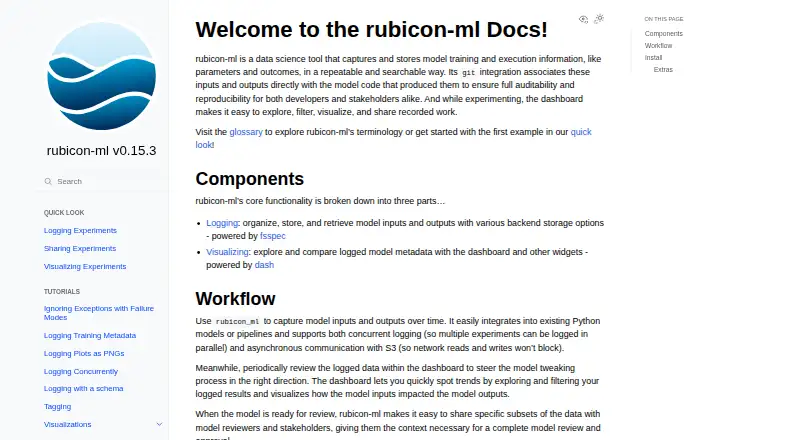
Rubicon-ML is a free, open-source Python package for recording and reviewing model training and execution information. It stores model inputs, outputs, parameters, and outcomes in a searchable, repeatable form. Its Git integration can attach repository origin, branch, and commit details to projects and experiments, helping connect recorded results with the code that produced them. A dashboard and widgets let users filter, visualize, compare, and share logged work with reviewers or stakeholders. The package supports parallel experiment logging and asynchronous communication with S3. Storage options include a local filesystem, Amazon S3, in-memory storage, and Weights & Biases. Integrations cover Git, Prefect, and Scikit-learn; RubiconPipeline can log parameters and metrics when Scikit-learn pipelines are fit and scored. Install with pip or conda-forge. Visualization tools are an optional pip extra, while conda installs optional extras by default. The dashboard is a Dash app that can be dockerized, and remote logging does not require a hosted server. The Weights & Biases backend is experimental and lacks project-level artifacts and dataframes, as well as get_projects() listing. Rubicon-ML is licensed under Apache License 2.0.
Who it suits
Rubicon-ML suits developers and science or research users who want searchable experiment records tied to model code. It supports local and remote storage without requiring a hosted server.
What it does well
- Records inputs, outputs, parameters, and outcomes.
- Connects experiments with Git branch and commit details.
- Supports local filesystem, S3, and in-memory storage.
- Integrates with Prefect and Scikit-learn.
- Logs experiments in parallel.
What to know first
- Weights & Biases backend is experimental.
- W&B lacks project-level artifacts and dataframes.
- Visualization tools are an optional pip extra.
Limits
The Weights & Biases backend is experimental and does not support project-level artifacts or dataframes, or listing all projects with get_projects(). With pip, visualization tools require an optional extra.
Plans
| Plan | Billed and limits | Price |
|---|---|---|
| rubicon-ml | Open-source Python package · install with pip or conda | Free |
As capitalone.github.io lists them, read 9 Oct 2026. The maker's own page has the final word.
Getting started
- Install the Python package with pip or conda-forge.
- Choose a documented storage backend: local filesystem, Amazon S3, in-memory storage or Weights & Biases.
- For visualization with pip, install the optional visualization extra; conda installs optional extras by default.
- Use the dashboard as a Dash app, which can be dockerized.
- For EC2 S3 logging, grant the IAM role s3:GetObject, s3:PutObject and s3:DeleteObject permissions for the bucket.
Verdict
Rubicon-ML provides experiment logging, storage choices, and review tools in a Python package that can work without a hosted server. Users considering its Weights & Biases backend should account for the documented missing capabilities.
Questions
How much does Rubicon-ML cost?
The listed plan is free. Rubicon-ML is an open-source package.
Which storage backends does it support?
Documented backends are a local filesystem, Amazon S3, in-memory storage and Weights & Biases. The Weights & Biases backend is experimental and has documented limitations.
Which integrations are included?
The documentation includes Git, Prefect and Scikit-learn integrations. RubiconPipeline can log parameters and metrics when Scikit-learn pipelines are fit and scored.
Does it require a hosted server for remote logging?
No. It supports local, S3 or in-memory data storage without a hosted server requirement.
How can I install it?
Install the Python package with pip or conda-forge. Visualization tools are an optional pip extra, while conda installs optional extras by default.
What license does Rubicon-ML use?
It is licensed under Apache License 2.0.
Facts from Rubicon-ML's own pages
- Auditability
- Its Git integration associates model inputs and outputs with the model code that produced them to support auditability and reproducibility. · capitalone.github.io, 9 Oct 2026
- Concurrent and asynchronous logging
- The documentation says rubicon-ml supports logging experiments in parallel and asynchronous communication with S3 so network reads and writes do not block. · capitalone.github.io, 9 Oct 2026
- Concurrent logging
- Rubicon-ML supports logging multiple experiments in parallel and asynchronous communication with S3. · capitalone.github.io, 9 Oct 2026
- Dashboard deployment
- The dashboard is a Dash app that can be dockerized like other Dash apps. · capitalone.github.io, 9 Oct 2026
- Experiment review
- The dashboard lets users explore, filter, visualize, and share logged work with reviewers and stakeholders. · capitalone.github.io, 9 Oct 2026
- Founded
- 1994 · capitalone.github.io, 28 Sept 2026
- Git audit trail
- Its Git integration can record repository origin, branch names, and commit hashes alongside projects and experiments. · capitalone.github.io, 9 Oct 2026
- Git integration
- With auto_git_enabled=True, projects can record the GitHub origin URL and experiments can record the active branch and last commit hash. · capitalone.github.io, 9 Oct 2026
- Headquarters
- McLean, Virginia, United States · capitalone.github.io, 28 Sept 2026
- Installation
- The Python package can be installed using pip or conda-forge. · capitalone.github.io, 9 Oct 2026
- Integrations
- The documentation includes integrations for Git, Prefect, and Scikit-learn. · capitalone.github.io, 9 Oct 2026
- Intended users
- The package metadata identifies developers and science or research users as its intended audience. · github.com, 9 Oct 2026
- License
- The project is licensed under Apache License 2.0. · github.com, 9 Oct 2026
- Logging
- The logging component organizes, stores, and retrieves model inputs and outputs using pluggable storage backends powered by fsspec. · capitalone.github.io, 9 Oct 2026
- No hosted server requirement
- The FAQ says rubicon-ml does not require a hosted server for remote logging and supports local, S3, or in-memory data storage. · capitalone.github.io, 9 Oct 2026
- Prefect integration
- The Prefect integration adds rubicon-ml logging tasks to Prefect workflows to persist experimentation metadata. · capitalone.github.io, 9 Oct 2026
- Purpose
- Rubicon-ML captures and stores model training and execution information, including parameters and outcomes, in a repeatable and searchable way. · capitalone.github.io, 9 Oct 2026
- Scikit-learn integration
- RubiconPipeline can automatically log parameters and metrics when Scikit-learn pipelines are fit and scored. · capitalone.github.io, 9 Oct 2026
- Security guidance
- For EC2 S3 logging, the documentation says the IAM role needs s3:GetObject, s3:PutObject, and s3:DeleteObject permissions for the bucket. · capitalone.github.io, 9 Oct 2026
- Storage backends
- Documented backends include local filesystem, Amazon S3, in-memory storage, and Weights & Biases. · capitalone.github.io, 9 Oct 2026
- Storage options
- Documented backends include local filesystem, Amazon S3, in-memory storage, and Weights & Biases. · capitalone.github.io, 9 Oct 2026
- Support
- The project README directs users to open a GitHub issue to report a bug or make a suggestion. · github.com, 9 Oct 2026
- Visualization
- The dashboard and widgets let users explore and compare logged model metadata. · capitalone.github.io, 9 Oct 2026
- Visualization dependencies
- The visualization tools are an optional pip extra, while conda installs the optional extras by default. · capitalone.github.io, 9 Oct 2026
Where Rubicon-ML stands on Freedom251
- ML Experiment Tracking Software#12 of 39