Freedom251 › ML Experiment Tracking Software
LabML
What LabML is
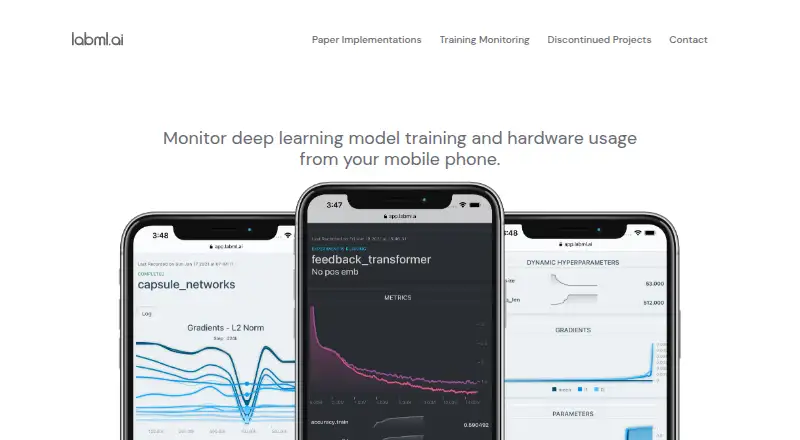
LabML is a free, open-source platform for monitoring deep learning experiments and hardware usage. It can display experiment results, hardware use, and performance metrics in real time on mobile devices and laptops. You can record metrics such as training loss, track hyperparameters and Git commits, create custom charts, and compare multiple runs. Built-in support covers distributed training across multiple machines. LabML offers Python API and CLI modules for experiments, tracking, monitoring, configuration, and logging, with sample integrations for FastAI, Keras, and PyTorch Lightning. The quick start installs labml-app with pip and starts a local server; hosting an experiments server requires MongoDB. A related labml-nn collection provides documented PyTorch implementations covering transformers, diffusion models, reinforcement learning, optimizers, and normalization layers. LabML supports Android, iOS, Linux, web, API, and self-hosting.
Who it suits
LabML suits deep learning researchers and engineers who need experiment tracking, hardware monitoring, reproducibility details, or distributed-training support. Its annotated implementations also suit people studying documented PyTorch research implementations.
What it does well
- Free and open-source
- Real-time experiment and hardware monitoring
- Tracks hyperparameters and Git commits
- Compares results across multiple runs
- Supports distributed training across machines
What to know first
- Self-hosted server requires MongoDB
- MIT License provides no warranty
Getting started
- Install the app with pip install labml-app.
- Start the local server with labml app-server.
- Use the Python API to record an experiment metric such as training loss.
- For a hosted experiments server, provide MongoDB as a prerequisite.
- Install the annotated implementations collection with pip install labml-nn if needed.
Verdict
LabML combines experiment tracking, live hardware monitoring, run comparison, and reproducibility details across several access options. Its related PyTorch implementations add practical reference material for common deep learning topics.
Questions
Is LabML free?
LabML is free and open source.
Which platforms can I use it on?
Listed platforms are Android, iOS, Linux, web, API, and self-hosted. The app page says it is accessible from mobile phones and laptops.
Can I compare experiment runs?
Yes. LabML supports run comparison and lets users create custom charts.
Does LabML support distributed training?
Yes. It has built-in support for training across multiple machines.
What integrations are documented?
Sample integrations are listed for FastAI, Keras, and PyTorch Lightning.
Who operates LabML, and how can I contact it?
LabML, Inc. is identified as the operator in its privacy policy. The site lists [email protected].
Facts from LabML's own pages
- Access
- The app page says the platform is accessible from any device, including mobile phones and laptops. · labml.ai, 11 Oct 2026
- Additional project
- LabML's main site links to annotated PyTorch implementations of research papers, with examples covering transformers, diffusion models, reinforcement learning, and optimizers. · nn.labml.ai, 11 Oct 2026
- API and CLI
- The documentation describes itself as the Python API and CLI reference and lists experiment, tracker, monitor, configuration, logger, and other modules. · docs.labml.ai, 11 Oct 2026
- Company name
- A LabML privacy policy identifies the operator as LabML, Inc. · labml.ai, 11 Oct 2026
- Contact
- The LabML site lists [email protected] as its contact address. · labml.ai, 11 Oct 2026
- Distributed training
- The app page says it has built-in support for distributed training across multiple machines. · labml.ai, 11 Oct 2026
- Examples
- The implementations site lists topics including transformers, diffusion models, reinforcement learning, optimizers and normalization layers. · nn.labml.ai, 11 Oct 2026
- Experiment details
- The platform can track hyperparameters and Git commits to support reproducibility. · labml.ai, 11 Oct 2026
- Experiment metrics
- The example uses Python’s `tracker.save` to record a training loss metric. · labml.ai, 11 Oct 2026
- Experiment tracking
- The platform tracks metrics and experiment details including hyperparameters and Git commits. · labml.ai, 11 Oct 2026
- Founded
- 2020 · labml.ai, 28 Sept 2026
- Framework integrations
- LabML documentation lists sample integrations for FastAI, Keras, and PyTorch Lightning. · docs.labml.ai, 11 Oct 2026
- Installation
- The annotated implementations collection can be installed with `pip install labml-nn`. · nn.labml.ai, 11 Oct 2026
- License
- The LabML repository provides its software under the MIT License, which states that it is provided without warranty. · github.com, 11 Oct 2026
- Live monitoring
- The app can show experiment results, hardware usage, and performance metrics in real time from mobile devices and laptops. · labml.ai, 11 Oct 2026
- Paper implementations
- LabML’s annotated implementations site provides documented PyTorch implementations of neural networks and related algorithms. · nn.labml.ai, 11 Oct 2026
- Purpose
- LabML is an open-source platform for monitoring deep learning experiments and hardware usage. · labml.ai, 11 Oct 2026
- Self-hosting
- The quick start installs the app with pip and starts a local server with `labml app-server`. · labml.ai, 11 Oct 2026
- Server requirement
- The repository instructions list MongoDB as a prerequisite for hosting the experiments server. · github.com, 11 Oct 2026
- Setup
- The quick start installs the app with pip install labml-app and starts it with labml app-server. · labml.ai, 11 Oct 2026
- Support
- The LabML app page lists contact email [email protected]. · labml.ai, 11 Oct 2026
- Visualizations
- Users can create custom charts and compare results across multiple runs. · labml.ai, 11 Oct 2026
Where LabML stands on Freedom251
- ML Experiment Tracking Software#10 of 39