Freedom251 › Medical Residency Scheduling Software
rPraxis
What rPraxis is
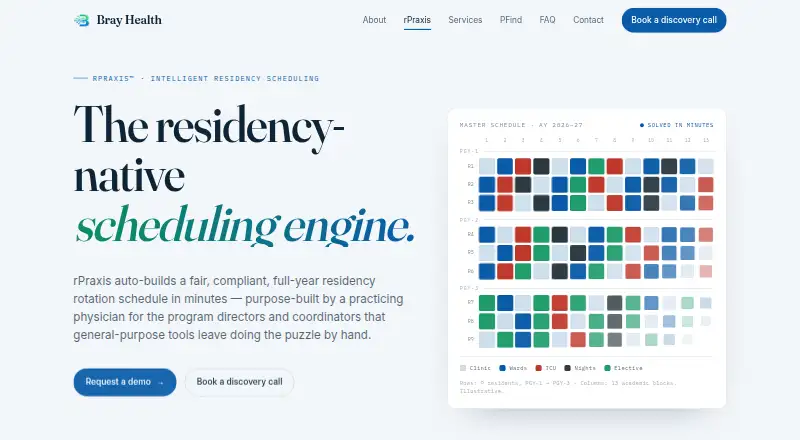
rPraxis is web-based software that builds full-year residency rotation schedules using constraint optimization. A program sets its X+Y pattern, academic-year dates, and cycle length. The scheduling process places continuity-clinic weeks first, assigns core services, then fills remaining blocks with subspecialty and elective rotations. Its scheduling engine uses Google OR-Tools CP-SAT.
Programs can maintain resident records with PGY level, cohort, and continuity group, and import records in bulk by CSV. rPraxis tracks accreditation and specialty-specific graduation requirements along with each resident’s cumulative completion history. Residents use token login to view schedules and submit rotation preferences. Access roles cover superadmins, program directors, APDs, PAs, office managers, and chief residents, with each program using its own isolated SQLite database. The product describes secure authentication and role-based access; Bray Health also describes isolated cloud infrastructure, encryption in transit and at rest, and audit logging for its solutions.
The intended audience is primarily internal medicine residencies of about 25–60 residents, though fellowships and other specialties using block or X+Y schedules are also potential users. rPraxis focuses on full-year academic rotations; call and shift scheduling are outside its focus. Pricing is arranged as a per-program annual license, scoped to the program in a discovery call, with no per-resident fees, seat calculations, or surprise add-ons. It is an independent scheduling solution, not affiliated with, accredited by, or endorsed by an accrediting body.
Who it suits
rPraxis is aimed mainly at mid-size internal medicine residency programs with about 25–60 residents. Fellowships and other specialties organized around block or X+Y schedules may also suit its rotation planning approach.
What it does well
- Builds full-year schedules with constraint optimization.
- Tracks accreditation and specialty-specific graduation requirements.
- Supports bulk resident import by CSV.
- Residents can view schedules and submit preferences through token login.
- Access roles cover program and administrative positions.
- Each program has an isolated SQLite database.
What to know first
- Pricing is provided on request and scoped to each program.
- It focuses on academic rotation schedules, not call or shift scheduling.
- The listed platform is web only.
Limits
The per-program annual license is scoped to the program, with pricing arranged on a discovery call. rPraxis focuses on full-year academic rotation schedules; call and shift scheduling are outside its focus.
Plans
| Plan | Billed and limits | Price |
|---|---|---|
| Per-program annual license | Annual; pricing scoped to your program on a short discovery call · No per-resident fees · No seat math · No surprise add-ons | On request |
As brayhealth.com lists them, read 7 Oct 2026. The maker's own page has the final word.
Getting started
- Visit the rPraxis website.
- Request a demo or book a discovery call.
- Configure the program’s X+Y pattern, academic-year dates, and cycle length.
- Add resident records or import them by CSV.
- Arrange a per-program annual license through the discovery process.
- Use the web application to manage schedules and resident access.
Verdict
Programs planning full-year residency rotations can consider rPraxis for its scheduling sequence, resident requirement tracking, and program-scoped roles. Programs primarily seeking call or shift scheduling should look elsewhere, since those tasks are outside its stated focus.
Questions
How is rPraxis priced?
It uses a per-program annual license, with pricing scoped to the program on a discovery call. The plan has no per-resident fees, seat calculations, or surprise add-ons.
Which platform does it support?
The listed platform is web.
What types of schedules does it build?
It optimizes full-year academic rotation schedules, filling continuity-clinic weeks, core services, subspecialty rotations, and electives. Call and shift scheduling are outside its focus.
Who makes rPraxis?
rPraxis is from Bray Health, headquartered in Gainesville, Florida, United States.
Is rPraxis affiliated with an accrediting body?
It is described as an independent scheduling solution that is not affiliated with, accredited by, or endorsed by an accrediting body.
How can a program get started?
Bray Health invites programs to request a demo or book a discovery call. Pricing is scoped to the program during a short discovery call.
Facts from rPraxis's own pages
- Access controls
- Role-based access is scoped for superadmins, program directors, APDs, PAs, office managers, and chief residents. · brayhealth.com, 7 Oct 2026
- Accreditation disclaimer
- rPraxis is described as an independent scheduling solution not affiliated with, accredited by, or endorsed by an accrediting body. · brayhealth.com, 7 Oct 2026
- Data isolation
- Each program has its own isolated SQLite database. · brayhealth.com, 7 Oct 2026
- Headquarters
- Gainesville, Florida, United States · brayhealth.com, 28 Sept 2026
- Intended users
- The product is aimed primarily at mid-size internal medicine residencies of about 25–60 residents, with fellowships and other block- or X+Y-scheduled specialties also identified as potential users. · brayhealth.com, 7 Oct 2026
- Notable limit
- The product page says rPraxis optimizes full-year academic rotation schedules, while call and shift scheduling are described as outside its focus. · brayhealth.com, 7 Oct 2026
- Program setup
- Programs can configure their X+Y pattern, academic-year dates, and cycle length. · brayhealth.com, 7 Oct 2026
- Purpose
- rPraxis builds full-year residency rotation schedules automatically using constraint optimization. · brayhealth.com, 7 Oct 2026
- Requirements tracking
- The product tracks accreditation and specialty-specific graduation requirements and residents’ cumulative completion history. · brayhealth.com, 7 Oct 2026
- Resident management
- Resident records include PGY level, cohort, and continuity group, with bulk CSV import. · brayhealth.com, 7 Oct 2026
- Resident portal
- Residents use token login to view schedules and submit rotation preferences. · brayhealth.com, 7 Oct 2026
- Scheduling process
- It places continuity-clinic weeks first, assigns core services next, then fills remaining blocks with subspecialty and elective rotations. · brayhealth.com, 7 Oct 2026
- Security
- The product page states that it uses secure authentication and role-based access; Bray Health’s FAQ describes isolated cloud infrastructure, encryption in transit and at rest, and audit logging for its solutions. · brayhealth.com, 7 Oct 2026
- Solver
- The scheduling engine uses Google OR-Tools CP-SAT. · brayhealth.com, 7 Oct 2026
- Support and sales
- Bray Health invites programs to request a demo or book a discovery call, and says its team builds, deploys, and supports the tools it recommends. · brayhealth.com, 7 Oct 2026