Freedom251 › User Flow Software

Rheo
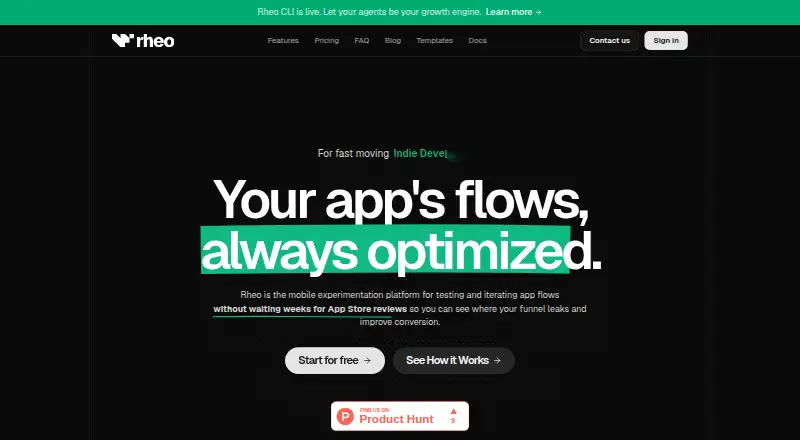
What Rheo is
Rheo is a mobile experimentation platform for teams that want to design and change app flows without waiting for App Store reviews. Its visual canvas supports onboarding, paywall, win-back, and upsell paths, including branches and targeting. Teams can compare holdouts and variants in flow structure, copy, and timing, then review conversion and revenue. Rheo says inputs, layouts, animations, and system moments render natively on iOS and Android rather than in a WebView. React Native is supported; Swift, Flutter, and Kotlin are marked as coming soon. After SDK integration, teams publish canvas-designed flows for the SDK to pick up immediately. The dashboard measures flow completion and provides funnel and cohort views. Rheo Engage supports broadcasts and automations through a customer's own SES, Resend, Postmark, or SendGrid account. Named integrations include RevenueCat, AppsFlyer, Adjust, and Superwall. The free plan includes one app, one channel per environment, 400 MAU, and no experiments. Paid plans start at $49.99/mo; Rheo says exceeding the included MAU quota pauses the SDK until the next month or a plan upgrade.
Who it suits
Rheo suits mobile app teams that want to iterate on onboarding, paywall, win-back, or upsell flows and measure their results. The homepage highlights indie developers, while its pricing page also lists plans for growth teams and enterprise customers.
What it does well
- Visual canvas supports branching and targeting.
- Teams can compare flow variants and holdouts.
- Flows render natively on iOS and Android, according to Rheo.
- Dashboard includes funnel and cohort views.
- Free plan includes 400 MAU.
What to know first
- Free plan has no experiments.
- Free plan is limited to one app.
- Exceeding the included MAU quota pauses the SDK.
- Swift, Flutter, and Kotlin are marked coming soon.
Limits
Indie includes 400 MAU, one app, one seat, and no experiments; exceeding the MAU quota pauses the SDK until the next month or a plan upgrade. Its 2,000 monthly marketing emails stop sending after the allowance. Grow starts at $49.99/mo and includes 10,000 MAU and up to two active experiments.
Plans
| Plan | Billed and limits | Price |
|---|---|---|
| Indie | Free · 1 app · 1 channel per environment · 400 MAU included · 1 seat · no experiments · 2,000 marketing emails/month, then sending pauses · 1 active automation | Free |
| Scale | $199 /mo · 10 apps · 10 channels per environment · 100,000 MAU included · 25 seats · up to 5 active experiments · 500,000 marketing emails/month, then $1 per 1,000 · additional MAU $0.01 per MAU per month | $199 a month |
| Grow | $49.99 /mo · 3 apps · 3 channels per environment · 10,000 MAU included · 5 seats · up to 2 active experiments · 50,000 marketing emails/month, then $1 per 1,000 · additional MAU $0.01 per MAU per month | $49.99 a month |
| Enterprise | Custom · Unlimited apps · unlimited channels · MAU and seats based on contract · unlimited experiments · implementation support · SSO · custom SLA | On request |
As getrheo.io lists them, read 3 Oct 2026. The maker's own page has the final word.
Getting started
- Visit getrheo.io and choose the Indie free plan or a paid plan.
- Integrate the supported React Native SDK with your app.
- Design a flow in the visual canvas using paths, branches, and targeting.
- Publish the flow for the SDK to pick up.
- Review completion, funnel, cohort, conversion, and revenue measures.
Rheo is a mobile experimentation platform for building and revising in-app journeys from a visual canvas. It is most suitable for indie developers and growth teams focused on onboarding, monetization, and retention flows. Native rendering and immediate publishing are strong advantages, while audience caps and currently limited SDK coverage should determine whether it fits your stack.
Overview
Rheo lets teams design, test, and iterate app flows without waiting for App Store reviews. Its canvas covers onboarding, paywalls, win-back journeys, and upsells, with branching and targeting for different audience paths. After the SDK is integrated, a published flow can be picked up immediately, shortening the loop between a change and its appearance in the app.
The product is aimed at fast-moving indie developers, with higher plans addressing growth teams and enterprise customers. It supports iOS and Android apps, and the supported SDK is React Native. Swift, Flutter, and Kotlin support are marked as coming soon, so teams on those stacks should treat the current integration choice as a significant limitation.
Key features
The visual builder combines interactive prototypes, reusable flow templates, and version history. Those features are useful when a team needs to sketch a journey, compare revisions, or return to an earlier version rather than manage every change as a separate release.
Experimentation supports holdouts and variants across flow structure, copy, and timing. Rheo reports conversion and revenue results, while its dashboard measures flow completion and supplies funnel and cohort views. This gives growth teams a way to connect a specific journey change with downstream outcomes. The free plan has no experiments, however, so variant testing starts with a paid subscription.
Rheo says flow inputs, layouts, animations, and system moments render natively on iOS and Android instead of inside a WebView. That approach is better suited to product teams that need app-native presentation. Named integrations include RevenueCat, AppsFlyer, Adjust, and Superwall; the developer guide specifically covers RevenueCat and Superwall paywall nodes and AppsFlyer attribution.
Rheo Engage adds broadcasts and automations, using the customer's own SES, Resend, Postmark, or SendGrid account. The privacy policy describes administrative, technical, and organizational safeguards, while acknowledging that absolute security cannot be guaranteed. Rheo says it does not sell personal information or store full payment card numbers. OAuth tokens and passwords remain with the host app and are omitted from Rheo terminal snapshots and analytics field maps.
Pricing
The freemium structure makes Rheo easy to start, but the free tier is primarily for a small single-app setup rather than experimentation.
| Plan | Price | Included | Best fit |
|---|---|---|---|
| Indie | $0.00 USD, billed Free | 1 app; 1 channel per environment; 400 MAU; 1 seat; no experiments; 2,000 marketing emails per month; 1 active automation | Individual developers validating a first flow |
| Grow | $49.99 per month | 3 apps; 3 channels per environment; 10,000 MAU; 5 seats; up to 2 active experiments; 50,000 marketing emails per month, then $1 per 1,000; additional MAU at $0.01 per MAU per month | Small growth teams running regular tests |
| Scale | $199.00 per month | 10 apps; 10 channels per environment; 100,000 MAU; 25 seats; up to 5 active experiments; 500,000 marketing emails per month, then $1 per 1,000; additional MAU at $0.01 per MAU per month | Multi-app teams with larger audiences |
| Enterprise | Custom pricing | Unlimited apps and channels; MAU and seats by contract; unlimited experiments; implementation support; SSO; custom SLA | Organizations needing negotiated capacity and controls |
Exceeding the included MAU quota pauses the SDK until the next month or a plan upgrade. On Indie, sending pauses after 2,000 marketing emails; Grow and Scale instead charge for excess sends. The one-seat Indie limit and absence of experiments make it a poor choice for collaborative optimization, while Grow is the first practical tier for a testing team.
Platforms
Rheo supports iOS, Android, and React Native. Native rendering is offered for iOS and Android flows, but teams building with Swift, Flutter, or Kotlin must wait for those SDKs to arrive.
Who it's for
Choose Rheo if your team needs to change onboarding, paywalls, win-back, or upsell journeys quickly and evaluate them with conversion, revenue, funnel, and cohort measures. Indie developers can use the free tier for a small app and modest email automation; teams that need experiments, more seats, or higher MAU capacity should budget for Grow or Scale. Enterprise buyers gain implementation support, SSO, and a custom SLA, making that tier the appropriate route for contractual requirements.
Pros and cons
Pros
- Native flow presentation: Rheo says layouts, animations, inputs, and system moments render natively instead of through a WebView.
- Focused experimentation: Holdouts and variants cover structure, copy, and timing, with conversion and revenue review.
- Useful growth integrations: RevenueCat, Superwall, AppsFlyer, and Adjust connect monetization and attribution workflows.
- Immediate publishing: Integrated SDKs can pick up flows after they are published from the canvas.
Cons
- Free tier excludes testing: Indie has no experiments and only one seat.
- Hard audience stops: Exceeding MAU pauses the SDK until renewal of the monthly allowance or an upgrade.
- SDK coverage is narrow today: React Native is supported, while Swift, Flutter, and Kotlin are still forthcoming.
- Email overages add cost: Grow and Scale charge $1 per 1,000 messages beyond their monthly allocations.
Alternatives
User Flow Software is the broader category starting point when you want to compare flow-design tools rather than commit to Rheo's mobile experimentation approach.
FlowMapp is a better fit for web, desktop, or Linux planning, with a free one-project tier and a $15 monthly Pro plan; it does not match Rheo's stated mobile flow experimentation focus.
Marvel suits teams wanting cross-platform prototyping, including web and API support, with a free one-user project and a $12 monthly Pro plan billed yearly.
Software Ideas Modeler is the alternative for UML and diagram work, including free non-commercial use, rather than mobile conversion experiments.
Zeplin Flows is preferable when design handoff and screen organization matter most; its free plan allows one project and 100 screens but has no Flow Boards.
FlowSnap offers a free canvas for up to three projects with watermarked PNG export.
BenchCanvas is aimed at browser-based flow review with comments, annotations, AI analyses, and export options.
Cairn is a macOS choice for scenario mapping, with a free project limited to two scenarios.
EVONX is a web-based option centered on repository scans, connected repositories, previews, and workspace credits.
Verdict
Rheo is a strong choice for React Native teams that need native-looking mobile flows, rapid publishing, and structured experimentation around conversion journeys. Its main reason to look elsewhere is equally clear: teams on Swift, Flutter, or Kotlin, or apps likely to exceed the MAU limits, face a constrained rollout until broader SDK support or a larger contracted allowance is available.
Verdict
Rheo offers visual flow design, experimentation, and funnel and cohort analysis for mobile apps. The free plan has no experiments, and paid plans start at $49.99/mo.
Questions
Is Rheo free?
Yes. Indie is free and includes one app, one seat, 400 MAU, and no experiments.
How much do paid plans cost?
Grow is $49.99/mo and Scale is $199/mo. Enterprise pricing is custom.
Which platforms does Rheo support?
Rheo supports iOS, Android, and React Native. Swift, Flutter, and Kotlin are marked as coming soon on the homepage.
What integrations are named?
The homepage names RevenueCat, AppsFlyer, Adjust, and Superwall. Developer documentation describes RevenueCat and Superwall paywall nodes and AppsFlyer attribution.
What happens when an app exceeds its included MAU quota?
The SDK pauses until the next month or a plan upgrade.
Can teams send email through Rheo Engage?
Engage supports broadcasts and automations using the customer's own SES, Resend, Postmark, or SendGrid account.
Facts from Rheo's own pages
- Analytics
- Rheo documentation says its dashboard measures flow completion and provides funnel and cohort views. · docs.getrheo.io, 3 Oct 2026
- Audience
- The homepage describes Rheo as serving fast-moving indie developers, while its pricing page also lists plans for growth teams and enterprise customers. · getrheo.io, 3 Oct 2026
- Authentication data
- The authentication guide says OAuth tokens and passwords are handled by the host app and omitted from Rheo terminal snapshots and analytics field maps. · docs.getrheo.io, 3 Oct 2026
- Data handling
- Rheo says it does not sell personal information and does not store full payment card numbers. · getrheo.io, 3 Oct 2026
- Rheo Engage supports broadcasts and automations using the customer's own SES, Resend, Postmark, or SendGrid account. · docs.getrheo.io, 3 Oct 2026
- Experiments
- Teams can run holdouts and variants on flow structure, copy, and timing, then review conversion and revenue. · getrheo.io, 3 Oct 2026
- Flow builder
- Its visual canvas supports onboarding, paywall, win-back, and upsell paths with branches and targeting. · getrheo.io, 3 Oct 2026
- Integrations
- The homepage names RevenueCat, AppsFlyer, Adjust, and Superwall; the developer guide describes RevenueCat and Superwall paywall nodes and AppsFlyer attribution. · getrheo.io, 3 Oct 2026
- Native rendering
- Rheo says its flow inputs, layouts, animations, and system moments render natively on iOS and Android rather than in a WebView. · getrheo.io, 3 Oct 2026
- Notable limits
- The homepage says exceeding the included MAU quota pauses the SDK until the next month or a plan upgrade. · getrheo.io, 3 Oct 2026
- Product
- Rheo is a mobile experimentation platform for designing, testing, and iterating app flows without waiting for App Store reviews. · getrheo.io, 3 Oct 2026
- Security
- The privacy policy says Rheo uses administrative, technical, and organizational measures designed to protect information, while noting it cannot guarantee absolute security. · getrheo.io, 3 Oct 2026
- Supported SDK
- The maker identifies React Native as supported; Swift, Flutter, and Kotlin are marked coming soon on the homepage. · getrheo.io, 3 Oct 2026
- Workflow
- After SDK integration, teams design flows in a visual canvas and publish them for the SDK to pick up immediately. · getrheo.io, 3 Oct 2026
Where Rheo stands on Freedom251
- User Flow Software#10 of 20