Freedom251 › Point-of-Sale Software
RetailPOS
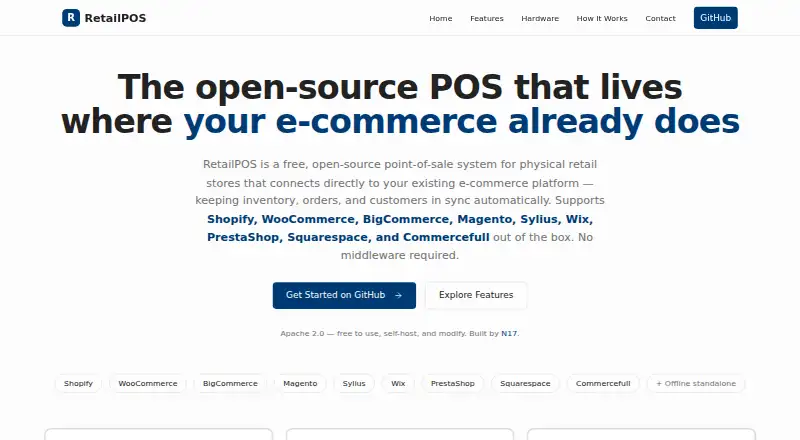
What RetailPOS is
RetailPOS is a free, open-source point-of-sale system for physical retailers that connects store operations with e-commerce platforms. It syncs inventory, orders, and customers with platforms including Shopify, WooCommerce, BigCommerce, Magento, Sylius, Wix, PrestaShop, Squarespace, and Commercefull. Checkout supports barcode scanning, receipt printing, cash drawers, and terminal payments, with hardware connections over USB, Bluetooth, camera, or network. Listed card payment options include Stripe Terminal, Stripe NFC tap-to-pay, Square, and Worldpay.
RetailPOS stores data in SQLite and can continue working offline, queueing orders until connectivity returns. Inventory tools include variants, low-stock alerts, manual adjustments, and an audit trail. Reports cover daily, weekly, and monthly sales, payment breakdowns, cashier rankings, and CSV export. Role-based access distinguishes Admin, Manager, and Cashier. In server and client mode, multiple registers connect over a local network and sync orders, inventory, and settings. The system says payment terminal SDKs handle card data rather than RetailPOS, and advises checking PCI compliance for the user’s region before launch. Security updates cover version 2.0.x; versions below 2.0 are unsupported.
Who it suits
RetailPOS may suit independent retailers, multi-register stores, developers or agencies, and shops that need offline operation. It is self-hosted software for stores seeking e-commerce synchronization and inventory tools.
What it does well
- Continues operating offline and queues orders for later sync.
- Syncs inventory with listed e-commerce platforms.
- Supports multiple registers over a local network.
- Includes sales reports and CSV export.
What to know first
- Self-hosted deployment is listed.
- Security updates cover version 2.0.x only.
- Versions below 2.0 are unsupported.
Limits
The free and open-source plan has no monthly fees and is self-hosted. Security updates support version 2.0.x; versions below 2.0 are unsupported.
Plans
| Plan | Billed and limits | Price |
|---|---|---|
| Free and open source | No monthly fees · Apache 2.0 · self-hosted | Free |
As retailpos.org lists them, read 30 Sept 2026. The maker's own page has the final word.
Getting started
- Visit retailpos.org and choose the self-hosted, free and open-source option.
- Deploy RetailPOS in the environment you manage; listed platforms include Android, iOS, Linux, macOS, web, and Windows.
- Connect the e-commerce platform you use, such as Shopify or WooCommerce.
- Set up supported checkout hardware and a listed card payment option.
- For multiple registers, use server and client mode to connect them over the local network.
- Review regional PCI compliance before launch.
RetailPOS is a free, open-source point-of-sale system for physical retailers that ties store transactions to online commerce. It is best suited to independent shops and multi-register stores prepared to self-host or arrange deployment support. Its standout advantage is offline checkout with queued syncing; version maintenance and regional PCI requirements call for careful planning.
Overview
RetailPOS connects in-store sales with e-commerce inventory, orders and customer records across platforms including Shopify, WooCommerce, BigCommerce, Magento, Sylius, Wix, PrestaShop, Squarespace and Commercefull. That makes it a stronger fit for retailers coordinating a physical shop and an online storefront than for businesses that need only a standalone till.
Offline operation is a practical resilience feature: the POS stores data in SQLite, keeps operating without connectivity and queues orders to sync when the connection returns. Retailers still need to manage the self-hosted setup and keep it on a supported release.
Key features
Checkout, payments and hardware
Barcode scanning, receipt printing, cash drawers and terminal payments cover core checkout needs. Hardware connections include USB, Bluetooth, camera and network, while the hardware itself is third-party; shops should confirm their chosen equipment works with their deployment. Card options include Stripe Terminal, Stripe NFC tap-to-pay, Square and Worldpay.
Inventory and store operations
Inventory syncs with the connected e-commerce platform and supports product variants, low-stock alerts, manual adjustments and an audit trail. These controls help shops keep online and in-store stock aligned while retaining a record of changes. Reports cover daily, weekly and monthly sales, payment breakdowns and cashier rankings, with CSV export for further analysis.
Staff and multiple registers
Six login methods and role-based access for Admin, Manager and Cashier give retailers a way to separate staff responsibilities. In server-and-client mode, registers connect over the local network and synchronize orders, inventory and settings, making the system relevant to stores with several tills rather than just a single checkout point.
Security and support
RetailPOS says card data is handled by the payment terminal SDK rather than the POS itself. Retailers remain responsible for reviewing PCI compliance requirements in their region before launch. Bug reports, feature requests and questions go through GitHub; N17 offers integration, deployment and custom-development support.
Pricing
Free and open source: free, billed with no monthly fees. The Apache 2.0 license and self-hosted model make this a no-subscription option for retailers able to handle deployment and upkeep. There is no free trial because the plan is free. Its cost advantage comes with operational responsibilities rather than a hosted service arrangement.
Version discipline matters: security updates support version 2.0.x, while versions below 2.0 are not supported. Stores should include keeping the installation on the supported branch in their maintenance plan.
Platforms
RetailPOS supports Android, iOS, Linux, macOS, Windows, web and self-hosted use. That range accommodates varied device and deployment setups, though hardware support is third-party and should be checked against the devices a shop intends to use.
Who it's for
Independent retailers benefit most when they need one system for physical checkout and e-commerce synchronization, particularly if connectivity interruptions are a concern. Multi-register stores can use local-network synchronization, while developers and agencies may value the open-source, self-hosted approach and the option of custom deployment support. It is less suitable for a retailer seeking a fully managed system without responsibility for hosting, updates or hardware compatibility.
Pros and cons
- Pros: Offline checkout queues orders for later sync, reducing reliance on a live connection at the register.
- Pros: E-commerce synchronization spans multiple named platforms and covers inventory, orders and customers.
- Pros: No monthly fees and an Apache 2.0 license keep licensing costs low for self-hosting retailers.
- Cons: Self-hosting shifts deployment and maintenance work to the retailer or its support partner.
- Cons: Hardware is third-party, so device compatibility needs confirmation before rollout.
- Cons: Security updates cover version 2.0.x only, and PCI compliance must be reviewed for the retailer's region.
Alternatives
For another free-plan option, Loyverse runs on Android, iOS and web and offers a 31-day sales-history plan; choose it if that history limit fits, or its $5 a month per store unlimited-history plan if longer retention matters.
Posnic POS is worth comparing for a free community edition and a desktop application published under AGPL-3.0-only, particularly if that licensing and platform mix better fits the deployment.
uniCenta oPOS offers a BASE subscription at £6 a year, charged yearly at £72; consider it if a subscription-based alternative is preferable.
NCR Voyix POS is another paid POS option. Runit RealTime is a cloud POS with support and upgrades included in its monthly subscription, which may suit a retailer seeking that service model.
Heartland Retail has a starting price of $89 a month and a free plan; it is an option for readers comparing a paid starting tier. NewStore is another paid alternative.
Erply is a paid alternative with a Growth Plan at $1,000 a month; its listed plan includes three stores, 100,000 queries per month, unlimited users and 2,000 AI actions per month.
Browse more options in Retail POS Software and Point-of-Sale Software.
Verdict
RetailPOS is a strong choice for independent retailers and multi-register shops that want open-source checkout linked to online inventory and need registers to keep working through connectivity loss. Its no-monthly-fee license and broad commerce synchronization are compelling, but choose another system if you want hosting and maintenance handled for you, or if your hardware and regional compliance needs do not fit its deployment model.
Verdict
RetailPOS brings checkout, inventory, reporting, and e-commerce synchronization together, with offline operation and multi-register support. Review regional PCI requirements and the supported-version policy before deployment.
Questions
Is RetailPOS free?
Yes. Its Free and open source plan is $0.00 USD, with no monthly fees, and uses the Apache 2.0 license.
Does RetailPOS require an internet connection to operate?
No. It stores data in SQLite, can continue operating offline, and queues orders for automatic synchronization when connectivity returns.
Which e-commerce platforms does it integrate with?
The site lists Shopify, WooCommerce, BigCommerce, Magento, Sylius, Wix, PrestaShop, Squarespace, and Commercefull.
What payment options are listed?
The features page lists Stripe Terminal, Stripe NFC tap-to-pay, Square, and Worldpay for card payments.
Is RetailPOS open source?
Yes. The free plan is open source under Apache 2.0 and is self-hosted.
Which versions receive security updates?
The security policy supports version 2.0.x for security updates. Versions below 2.0 are not supported.
Facts from RetailPOS's own pages
- Access control
- RetailPOS describes six login methods and role-based access for Admin, Manager, and Cashier. · retailpos.org, 30 Sept 2026
- Checkout and hardware
- It supports barcode scanning, receipt printing, cash drawers, and terminal payments; supported hardware connections include USB, Bluetooth, camera, and network. · retailpos.org, 30 Sept 2026
- E-commerce integrations
- The site lists Shopify, WooCommerce, BigCommerce, Magento, Sylius, Wix, PrestaShop, Squarespace, and Commercefull as supported platforms. · retailpos.org, 30 Sept 2026
- Free plan
- Yes · retailpos.org, 21 Sept 2026
- Intended users
- The maker describes use for independent retailers, multi-register stores, developers or agencies, and stores that need offline operation. · retailpos.org, 30 Sept 2026
- Inventory
- Inventory syncs with the e-commerce platform and includes product variants, low-stock alerts, manual adjustments, and an audit trail. · retailpos.org, 30 Sept 2026
- Inventory management
- Yes · retailpos.org, 21 Sept 2026
- Limits
- The security policy says version 2.0.x is supported for security updates and versions below 2.0 are not. · github.com, 30 Sept 2026
- Multi-register
- In server and client mode, registers connect over the local network and sync orders, inventory, and settings. · retailpos.org, 30 Sept 2026
- Offline use
- The POS stores data in SQLite, continues operating offline, and queues orders for automatic sync when connectivity returns. · retailpos.org, 30 Sept 2026
- Payments
- The features page lists Stripe Terminal, Stripe NFC tap-to-pay, Square, and Worldpay for card payments. · retailpos.org, 30 Sept 2026
- Product
- RetailPOS is an open-source point-of-sale system for physical retail that syncs inventory, orders, and customers with e-commerce platforms. · retailpos.org, 30 Sept 2026
- Reporting
- Reports include daily, weekly, and monthly sales summaries, payment breakdowns, cashier rankings, and CSV export. · retailpos.org, 30 Sept 2026
- Security and compliance
- The contact page says card data is handled by the payment terminal SDK and RetailPOS does not touch raw card data; it advises reviewing PCI compliance for the user's region before launch. · retailpos.org, 30 Sept 2026
- Support
- Bug reports, feature requests, and questions go through GitHub; N17 offers integration, deployment, and custom development support. · retailpos.org, 30 Sept 2026
Where RetailPOS stands on Freedom251
- Point-of-Sale Software#5 of 113
- Shop Management software#4 of 25
- Retail Billing Software#5 of 27
- Retail POS Software#7 of 29