Freedom251 › Point-of-Sale Software

Posnic POS
What Posnic POS is
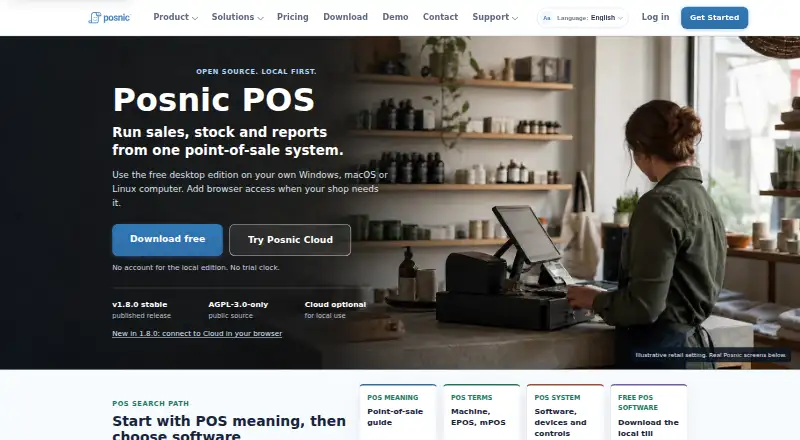
Posnic POS is point-of-sale software for retail shops and restaurants, with a free desktop edition and optional cloud services. Its documented workflows include sales, returns, customer records, taxes, reporting, stock, purchases, stock logs and price lists. The desktop database and API run on the shop computer, and local billing can continue offline after Cloud setup. Install the free edition on Windows, macOS or Linux, or self-host it on an owned Ubuntu server for browser access on a local network. Posnic Cloud adds sync, off-site backups and remote dashboards; its prices vary by country and billing period. The local edition needs no Posnic account, and the maker says it sends no analytics or business-data telemetry to Posnic. The desktop source is published under AGPL-3.0-only. The maker offers custom accounting and e-commerce integrations and free migration from Vyapar, myBillBook, Marg, Tally, GoFrugal or Excel. It has not commissioned an independent security audit, and its checks have not connected physical retail peripherals.
Who it suits
Posnic POS suits retail shops and restaurants that want local billing, including offline use, or a self-hosted setup. It may also suit businesses moving from one of the listed systems or Excel.
What it does well
- Free edition for Windows, macOS and Linux
- Local billing can continue offline after Cloud setup
- Covers sales, returns, stock and reporting
- Free data migration from listed systems or Excel
- Desktop source published under AGPL-3.0-only
What to know first
- No independent security audit has been commissioned
- No named retail device is physically certified
- Physical peripherals were not connected in published checks
- Cloud prices vary by country and billing period
Limits
The Posnic Community Edition is free for local desktop use and has no trial timer or Posnic account requirement. Optional cloud services are paid, with prices depending on country and billing period.
Plans
| Plan | Billed and limits | Price |
|---|---|---|
| Posnic Community Edition | forever · No trial timer or account · local sales and stock workflows · configurable local backups · AGPL-3.0-only source · community support | Free |
| Basic Plan | Free plan | Free |
| On-Premises License | per user, one time · Lifetime plan | ₹14,999, paid once |
| Premium Plan | per user, per year · Includes Premium features | ₹4,999 a year |
As posnic.com lists them, read 15 Oct 2026. The maker's own page has the final word.
Getting started
- Visit the Posnic website.
- Install the free desktop edition on Windows, macOS, or Linux, or self-host it on an owned Ubuntu server.
- Use the desktop database and API on the shop computer, or access a self-hosted installation through a browser on the local network.
- Set up Posnic Cloud if you want sync, off-site backups, or remote dashboards.
- Contact the maker about custom integrations or free migration from a supported system or Excel.
Posnic POS is a point-of-sale system for retail shops and restaurants, suited to operators who want checkout and shop data on local infrastructure. Its free edition covers a wide range of workflows, but hardware fit and the limits of cloud assurance make it a poor choice for buyers who need certified devices or proven hosted-service performance.
Overview
Posnic handles sales and returns alongside customer records, taxes, reporting, stock, purchases, stock logs, and price lists. That breadth can bring everyday checkout and back-office tasks into one system, rather than requiring a checkout-only tool. Employee permissions, staff management, barcode scanning, customer loyalty, and multi-location support extend its reach, though operators should confirm that the way those capabilities work fits their setup.
The desktop edition keeps its database and API on the shop computer, and local billing can continue offline after Cloud setup. That is a practical advantage where internet interruptions should not stop sales. The free edition runs on Windows, macOS, or Linux, and can also be self-hosted on an owned Ubuntu server for browser access across a local network. Posnic says the local edition needs no account and sends no analytics or business-data telemetry to the company; the desktop source is under AGPL-3.0-only. However, the maker has commissioned no independent security audit, so privacy claims should not be mistaken for independent security validation.
Key features
- Retail operations: Sales, returns, taxes, customer records, reporting, inventory, purchasing, stock logs, and price lists give shops a broad operational base.
- Local and offline operation: Keeping the database and API on the shop computer supports local control; offline billing after Cloud setup offers continuity when connectivity fails.
- Optional cloud services: Posnic Cloud is described as offering synchronization, off-site backups, and remote dashboards. These are useful for remote oversight or multiple locations, but the maker has not acceptance-tested hosted cloud, branch sync, load, recovery, or service levels.
- Integrations and migration: Custom accounting and e-commerce integrations, plus free migration from Vyapar, myBillBook, Marg, Tally, GoFrugal, or Excel, may reduce the work of switching. Custom integration scope is not guaranteed by those broad categories.
- Device compatibility: Hardware support depends on third-party devices. Posnic says no named retail device is physically certified, and its published checks did not connect physical printers, scanners, cash drawers, scales, displays, or payment terminals. Test the exact equipment before committing.
Pricing
Posnic Community Edition
free (billed ₹0 forever). It includes local desktop use, has no trial timer and requires no Posnic account; the source is AGPL-3.0-only, with a community support path. This suits cost-conscious single shops or technically capable operators comfortable managing local installation. It gives up the assurance of a certified hardware setup and does not include a published cloud price. Posnic says cloud prices load live and vary by country and billing period, so budget them separately before depending on hosted services.
Support includes phone or WhatsApp for trade-blocking incidents at any hour, and routine email help Monday through Saturday, 10:00–19:00 IST. There is no SLA or guaranteed response time, which may not satisfy shops that need predictable support coverage.
Platforms
Posnic supports API, Linux, macOS, self-hosted, web, and Windows. The free edition is installable on Windows, macOS, and Linux; Ubuntu self-hosting provides browser access on a local network. These options suit operators who want local deployment, but the hardware caveats matter regardless of platform.
Who it's for
Posnic is a strong fit for retailers and restaurants that value offline billing, local data control, and broad stock-to-sales workflows without an upfront software charge. It also suits operators willing to manage their own devices and infrastructure. Shops that require independently audited security, certified peripherals, guaranteed support response, or demonstrated cloud recovery should look elsewhere or validate those requirements before rollout.
Pros and cons
- Pro: The free edition has no trial timer or account requirement, making it possible to keep local operations running without a recurring software fee.
- Pro: Offline billing and a local database can reduce reliance on internet availability and remote data handling.
- Pro: Sales, purchasing, inventory, reporting, and customer workflows are covered in one product.
- Con: No physical retail devices are certified, and the published checks did not connect common peripherals, so checkout hardware needs careful validation.
- Con: Cloud sync, recovery, load, and service levels have not been acceptance-tested by the maker's review, limiting confidence for cloud-dependent operations.
- Con: No independent security audit and no support SLA leave assurance and response expectations to the buyer.
Alternatives
- RetailPOS is worth comparing for a free, open-source self-hosted option with Apache 2.0 licensing and broad platform coverage, including mobile.
- Loyverse may suit businesses that want Android or iOS availability and a free POS plan, with a 31-day sales history limit on the base plan and unlimited history at $5 a month ($5/month per store; $50/year).
- uniCenta oPOS is another freemium choice with broad platform support; its BASE subscription is £72 a year, billed monthly but charged yearly.
- NCR Voyix POS is a paid option to consider for grocery, convenience, fuel, department, or specialty retail; pricing requires contacting NCR Voyix.
- Runit RealTime is a paid cloud POS alternative with support and upgrades included in its monthly subscription.
- Heartland Retail is an alternative with a stated starting price of $89 a month and Android, API, iOS, and web platforms.
- NCR Counterpoint is another paid retail POS option.
- NewStore is a paid option with Android, API, iOS, and web platforms.
For broader comparisons, browse Retail POS Software or Point-of-Sale Software.
Verdict
Choose Posnic POS if you want a free, local-first system that can keep billing offline and cover stock, sales, and customer workflows. Its main advantage is broad functionality without a recurring desktop fee; its main risk is relying on unverified hardware or cloud services. Buyers who need certified peripherals, independently audited security, or guaranteed service levels should favor a more fully assured alternative.
Verdict
Posnic POS offers a free local-first option with broad retail workflows and offline billing. Before relying on specific hardware or cloud services, note the stated limits on device checks and hosted-service testing.
Questions
Is Posnic POS free?
The Posnic Community Edition is free, billed ₹0 forever, for local desktop use.
Which platforms can run the free edition?
It can be installed on Windows, macOS, or Linux, or self-hosted on an owned Ubuntu server for browser access on a local network.
Can Posnic POS work offline?
The desktop edition keeps its database and API on the shop computer, and local billing can continue offline after Cloud setup.
Is Posnic POS open source?
The desktop application source is published under the AGPL-3.0-only license.
What does Posnic Cloud provide?
Posnic Cloud is described as providing sync, off-site backups, and remote dashboards. Its prices depend on country and billing period.
Who publishes Posnic POS?
Posnic Innovations Private Limited publishes Posnic POS. The product was founded in 2016 and is headquartered in Nagapattinam, Tamil Nadu, India.
Facts from Posnic POS's own pages
- API
- The repository provides a REST API and identifies the primary API as running locally or on a server controlled by the operator. · github.com, 15 Oct 2026
- API documentation depth
- The developer page reports 7,953 passing tests in a curated API suite and a documented API inventory, while warning that it is not a generated contract. · posnic.com, 15 Oct 2026
- Branches and cloud
- Optional cloud services are described for synchronization across tills and branches, off-site backups and remote dashboards. · github.com, 15 Oct 2026
- Checkout
- The product workflow records items, quantities, prices, taxes, discounts, payment tenders and receipts. · posnic.com, 15 Oct 2026
- Cloud evidence limit
- The maker says its review did not acceptance-test hosted cloud, branch sync, load, recovery, or service levels. · posnic.com, 2 Oct 2026
- Cloud services
- Posnic Cloud is described as providing sync, off-site backups, and remote dashboards; the maker says cloud prices load live and depend on country and billing period. · posnic.com, 2 Oct 2026
- Company description
- LinkedIn describes PosnicPro as a cloud point-of-sale product with inventory management, reporting, customization and multi-outlet support. · linkedin.com, 15 Oct 2026
- Company headquarters
- LinkedIn lists the headquarters as Chennai, Tamil Nadu, India. · linkedin.com, 15 Oct 2026
- Company incorporation
- The published DPIIT record states an incorporation date of 21 July 2016 in India. · posnic.com, 15 Oct 2026
- Company legal name
- The publisher identifies itself as Posnic Innovations Private Limited. · posnic.com, 15 Oct 2026
- Company size
- LinkedIn lists Posnic as a privately held software-development company with 51–200 employees. · linkedin.com, 15 Oct 2026
- Core workflows
- The product documentation covers sales, returns, customers, taxes, reporting, stock, purchases, stock logs, and price lists. · posnic.com, 2 Oct 2026
- Deployment
- The free edition can be installed on Windows, macOS, or Linux, or self-hosted on an owned Ubuntu server for browser access on a local network. · posnic.com, 2 Oct 2026
- Developer stack
- The project uses Electron, MongoDB and a local API; source setup requires Node 22.12 or newer. · github.com, 15 Oct 2026
- Documentation
- The repository links user, contributor, developer, architecture, API, hardware, backup, disaster-recovery, support, privacy and security documentation. · github.com, 15 Oct 2026
- Download
- The download page publishes installers or packages with SHA-256 checksums for Windows, macOS and Linux. · posnic.com, 15 Oct 2026
- Founded
- 2016 · posnic.com, 28 Sept 2026
- Hardware
- Documentation describes printer, scanner, cash-drawer, weighing-scale and customer-display paths, but no named retail device is presented as physically certified. · posnic.com, 15 Oct 2026
- Hardware limits
- The maker says no named retail device is physically certified by Posnic and advises testing exact devices; its published checks did not connect physical printers, scanners, drawers, scales, displays, or payment terminals. · posnic.com, 2 Oct 2026
- Headquarters
- Nagapattinam, Tamil Nadu, India · posnic.com, 28 Sept 2026
- Integrations
- The integrations guide documents API tokens, webhooks with delivery history and owner-supplied Google Analytics measurement IDs. · posnic.com, 15 Oct 2026
- Integrations and migration
- The maker offers custom integrations with accounting and e-commerce systems and free data migration from Vyapar, myBillBook, Marg, Tally, GoFrugal, or Excel. · posnic.com, 2 Oct 2026
- Inventory
- Posnic documents stock movement history, inventory management, purchasing and low-stock monitoring. · posnic.com, 15 Oct 2026
- Licence
- Posnic-owned source is GNU AGPL-3.0-only; release packages contain separately licensed components including MongoDB Community Server under SSPL-1.0. · github.com, 15 Oct 2026
Where Posnic POS stands on Freedom251
- Point-of-Sale Software#1 of 113
- Retail POS Software#1 of 29
- Retail Billing Software#1 of 27
- Shop Management software#1 of 25