Freedom251 › Legal eDiscovery Software

RedactLaw
What RedactLaw is
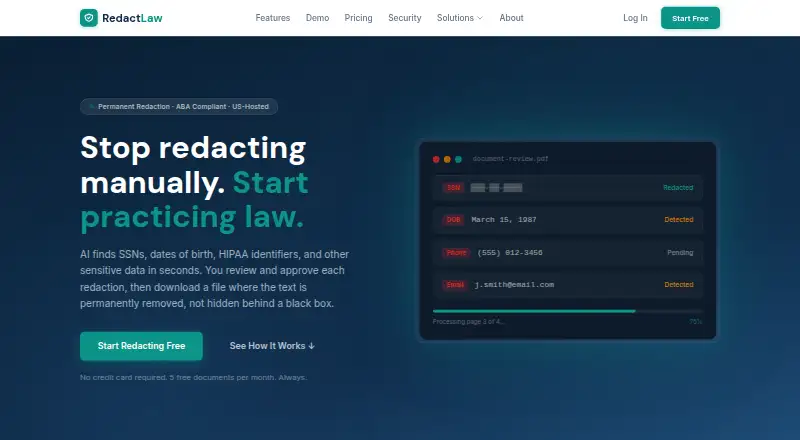
RedactLaw is an AI-powered document redaction platform made for law firms. It detects personal information and HIPAA identifiers, uses context-aware recognition, and assigns confidence scores so users can review proposed redactions. Reviewers can compare detections with the original document, approve or reject items individually, or handle flagged items in bulk. RedactLaw says it permanently removes underlying data and clears metadata and hidden layers from redacted files.
The platform accepts PDFs, DOCX, XLSX, JPEG, PNG, and TIFF files, including scanned documents through OCR, and produces redacted PDFs. Legal templates cover HIPAA medical records, FRCP 5.2 filings, FOIA responses, financial discovery, employment records, and immigration files. An audit trail records decisions, users, and timestamps, with PDF and CSV report exports.
RedactLaw is available on the web, through an API, and as self-hosted software. It offers a free plan, a free trial, and paid plans from $39/mo. The maker says files are encrypted at rest and in transit, processed in U.S. data centers, and not used to train AI models. Retention options range from 24 hours to manual deletion. Listed security controls include role-based access, SSO/SAML, audit logging, and required multi-factor authentication.
Who it suits
RedactLaw suits attorneys and law practices handling personal injury, litigation, immigration, or family law matters. Its document formats, legal templates, review workflow, and audit exports are relevant to firms that need to redact records and track decisions.
What it does well
- Detects PII and HIPAA identifiers with confidence scores.
- Supports OCR for scanned documents and six listed file formats.
- Includes legal templates for filings, records, and discovery.
- Records decisions with user attribution and timestamps.
- Offers API access and self-hosted deployment.
What to know first
- Free plan allows 5 documents monthly, up to 10 pages each.
- Free plan is limited to one user and basic PII detection.
- Listed integrations beyond API are marked coming soon.
Limits
The free plan covers 5 documents per month, up to 10 pages per document, one user, and basic PII detection. Starter costs $39 a month and allows 50 documents monthly, up to 50 pages each, and one user.
Plans
| Plan | Billed and limits | Price |
|---|---|---|
| Free | 5 documents/month · 10 pages/document · permanent redaction · basic PII detection · 1 user | Free |
| Firm | $149/mo · Unlimited documents and pages · custom rules · OCR · batch redaction · review mode · saved templates · secure sharing · up to 20 users · API · SSO · admin dashboard · priority support | $149 a month |
| Starter | $39/mo · 50 documents/month · 50 pages/document · PII + HIPAA detection · OCR · side-by-side preview · full audit trail · 1 user | $39 a month |
| Pro | $79/mo · 200 documents/month · 200 pages/document · custom rules · OCR · batch redaction · review mode · saved templates · up to 5 users · API access | $79 a month |
| Enterprise | Custom · Unlimited documents, pages and users · API · SSO · admin dashboard · dedicated support and SLA · on-premise deployment · BAA · custom integrations | On request |
As redactlaw.com lists them, read 15 Oct 2026. The maker's own page has the final word.
Getting started
- Open the RedactLaw website.
- Choose the free plan or a paid plan; a free trial is available.
- Use the web platform, API, or self-hosted option.
- Upload a supported document or scanned image for redaction.
- Review detections against the original, then approve or reject them.
RedactLaw is document redaction software built for law firms, with automated detection and attorney review for sensitive records. It is a strong fit for practices that need legal templates and traceable decisions, though its monthly document and seat caps may push growing teams to higher tiers.
Overview
RedactLaw pairs context-aware AI detection of PII and HIPAA identifiers with confidence scores and human review. Reviewers can compare each flagged item with the original, approve or reject detections individually, or handle flagged items in bulk. That combination gives legal teams a way to accelerate review while keeping a person involved in the decision.
Permanent redaction is central to the product: it says it removes underlying data and scrubs metadata and hidden layers. That matters when a file must be shared or filed without leaving sensitive information recoverable beneath a visual cover. Legal templates cover HIPAA medical records, FRCP 5.2 filings, FOIA responses, financial discovery, employment records, and immigration/A-File matters.
RedactLaw says documents are encrypted at rest with AES-256 and in transit with TLS 1.2+, with processing in U.S. data centers. It says customer documents are not used to train AI models and offers retention settings of 24 hours, 7 days, 30 days, or manual deletion. Its infrastructure uses SOC 2 Type II certified providers, HIPAA BAAs are available, and access controls include roles, SSO/SAML, audit logging, and required multi-factor authentication.
Key features
PDF, DOCX, XLSX, JPEG, PNG, TIFF, and scanned images are supported, with OCR for scanned documents. This range suits firms handling mixed evidence and office files; final redacted output is PDF. Permanent cleanup and a review workflow make it more than a simple mark-up tool, while confidence scores help direct attention to uncertain detections.
Redaction decisions are recorded with user attribution and timestamps, and audit reports can be exported as PDF or CSV. That creates a usable record of who approved what. API access is available now; Clio, MyCase, PracticePanther, iManage, NetDocuments, Dropbox, OneDrive, and Box are coming soon, so firms that depend on those connections should not assume they can connect them today.
Pricing
The Free plan costs nothing and allows 5 documents per month, up to 10 pages each, with permanent redaction, basic PII detection, one user, and community support. It is a useful way for a solo practitioner to handle occasional short documents, but the low quota and lack of OCR or full audit trails limit ongoing casework.
Starter costs $39 a month. It raises the allowance to 50 documents per month and 50 pages per document, adds all PII and HIPAA detection, OCR, and a full audit trail, and includes one user with email support. It suits a solo practice with regular scanned records; teams or heavier workloads will quickly meet its document or seat ceiling.
Pro costs $79 a month and covers 200 documents per month, up to 200 pages each, custom rules, batch redaction, API access, and up to five users. Priority email support adds a better support path, while custom rules and batch handling make this the more practical tier for a small team processing repeat or larger jobs.
Firm costs $149 a month and includes unlimited documents and pages, up to 20 users, API access, SSO, an admin dashboard, and priority support. It fits a larger practice that needs centralized administration and predictable capacity. Enterprise has custom pricing and includes unlimited documents, pages, and users, dedicated support with an SLA, on-premise deployment, BAA availability, and custom integrations.
A free trial is available. The free plan's five-document monthly cap and one-user limit are the main constraints for evaluating it on sustained team work; no trial length or paid renewal terms are stated.
Platforms
RedactLaw is offered on the web, through an API, and as a self-hosted deployment. The self-hosted option is reserved for Enterprise, making it relevant to organizations that need on-premise deployment and can use custom pricing.
Who it's for
The product is aimed at attorneys, with workflows for personal injury, litigation, immigration, and family law. Solo practitioners can start with Free or Starter, while small teams gain more room for shared work on Pro. Firms requiring SSO, more than five users, or unlimited processing will need Firm or Enterprise. Practices that need a listed practice-management or cloud-storage integration immediately should consider the forthcoming status of those connections before choosing it.
Pros and cons
- Pros: Permanent removal of underlying data, metadata, and hidden layers addresses the risk of accidental disclosure in shared files.
- Pros: Human approval, bulk review, and attributable audit exports pair automation with a record of decisions.
- Pros: Legal templates and detection for both PII and HIPAA identifiers suit common law-firm document workflows.
- Cons: Free is capped at five documents per month, ten pages per document, and one user, which is too narrow for regular team use.
- Cons: Starter is also limited to one user and 50 documents monthly; multi-user work requires Pro or above.
- Cons: Several named integrations are coming soon, so firms needing them now cannot rely on them as current connections.
Alternatives
Choose GoldFynch if you want a web-based eDiscovery option organized around cases: its free case permits one case per new account, up to 512 MB stored and 1 GB processed, and expires after 90 days; its 3 GB case costs $27 a month. Redactable is another web-based redaction option, with three free documents total and pay-as-you-go pricing of $7.50 per document after that. For broader platform coverage, Arctera eDiscovery supports web, mobile, desktop, API, and self-hosted platforms, with a free trial but no free plan.
Beagle offers paid AI document review packages. Exterro eDiscovery is a paid web option with pricing available through a demo request. iCONECT is a paid option available on web, by API, and self-hosted. KLDiscovery Nebula is a paid web and self-hosted option with an annual subscription based on data capacity, paid monthly, and multi-year discounts. redactX offers a paid yearly on-premises subscription for Windows or Linux deployments.
Browse Legal eDiscovery Software for more case-review options, or Document Redaction Software for alternatives focused on redaction.
Verdict
RedactLaw is a sound choice for legal practices that want permanent redaction, attorney review, legal templates, and an audit trail in one workflow. Its main trade-off is capacity: the lower tiers are tightly capped, and team features arrive at higher prices. Choose it when legal-specific review and traceability matter more than immediate access to its forthcoming integrations; look elsewhere if those connections or broader low-cost team capacity are essential.
Verdict
Choose RedactLaw if your law practice needs document redaction with human review, legal templates, and an audit trail. The free plan provides permanent redaction, while Starter adds OCR and full audit trails for $39/mo. Firms that need more users, custom rules, batch processing, or SSO will need a higher plan.
Questions
Is there a free plan?
Yes. Free includes 5 documents per month, up to 10 pages per document, permanent redaction, basic PII detection, and one user.
How much do paid plans cost?
Starter is $39 a month, Pro is $79 a month, and Firm is $149 a month. Enterprise has no listed price.
Which platforms does RedactLaw support?
The listed platforms are web, API, and self-hosted.
What file types can it handle?
It supports PDF, DOCX, XLSX, JPEG, PNG, TIFF, and scanned images. OCR is included in Starter and higher plans.
Which integrations are available?
API access is available now. Clio, MyCase, PracticePanther, iManage, NetDocuments, Dropbox, OneDrive, and Box are listed as coming soon.
Who makes RedactLaw?
RedactLaw describes itself as a platform built exclusively for law firms and says it was built for attorneys.
Facts from RedactLaw's own pages
- Access controls
- The security page lists role-based access, SSO/SAML, audit logging, and required multi-factor authentication. · redactlaw.com, 8 Oct 2026
- AI detection
- The service detects PII, HIPAA identifiers, SSNs, dates of birth, addresses and phone numbers using context-aware recognition and confidence scores. · redactlaw.com, 15 Oct 2026
- AI privacy and retention
- The maker says customer documents are not used to train AI models and offers retention choices of 24 hours, 7 days, 30 days, or manual deletion. · redactlaw.com, 8 Oct 2026
- AI training policy
- RedactLaw says customer documents are not used to train its AI models. · redactlaw.com, 15 Oct 2026
- API access
- REST API access is included from the Pro tier upward, but the public pages do not provide endpoint or SDK documentation. · redactlaw.com, 15 Oct 2026
- Audience
- The maker says RedactLaw was built for attorneys and describes workflows for personal injury, litigation, immigration, and family law practices. · redactlaw.com, 8 Oct 2026
- Audit trail
- Every approval, rejection and edit is timestamped, attributed to a user and exportable as PDF or CSV. · redactlaw.com, 15 Oct 2026
- Batch processing
- Batch mode applies one ruleset across hundreds of documents and provides a shared review queue. · redactlaw.com, 15 Oct 2026
- Company founding
- The about page says the company was founded by a team responding to attorneys' redaction problems but gives no founding year. · redactlaw.com, 15 Oct 2026
- Company legal entity
- The BAA identifies the maker as RedactLaw, Inc., a Delaware corporation. · redactlaw.com, 15 Oct 2026
- Compliance
- RedactLaw says its infrastructure uses SOC 2 Type II certified providers and that HIPAA BAAs are available. · redactlaw.com, 8 Oct 2026
- Compliance claims
- The maker states that its infrastructure uses SOC 2 Type II certified providers and that its practices align with ABA Rules 1.1 and 1.6 and Formal Opinion 477R. · redactlaw.com, 15 Oct 2026
- Custom rules
- Users can define names, phrases, terms and regular-expression patterns, then save and share reusable rule sets. · redactlaw.com, 15 Oct 2026
- Detection
- Its AI detects PII and HIPAA identifiers, uses context-aware recognition, and assigns confidence scores for review. · redactlaw.com, 8 Oct 2026
- Encryption and hosting
- The maker says documents are encrypted at rest with AES-256 and in transit with TLS 1.2+, and processing runs in U.S. data centers. · redactlaw.com, 8 Oct 2026
- File formats
- Supported uploads include PDF, DOCX, XLSX, JPEG, PNG and TIFF. · redactlaw.com, 15 Oct 2026
- HIPAA BAA
- A BAA is available for Pro, Firm and Enterprise plans, with stated execution typically within 48 business hours. · redactlaw.com, 15 Oct 2026
- Hosting location
- RedactLaw says processing and storage use AWS infrastructure in US-East and US-West regions and do not cross international borders. · redactlaw.com, 15 Oct 2026
- Human approval
- Users review, approve, reject or flag proposed redactions before a file can be downloaded. · redactlaw.com, 15 Oct 2026
- Human review
- Users can review detections side by side with the original, approve or reject individual items, and bulk-review flagged items. · redactlaw.com, 8 Oct 2026
- Integrations
- Clio, MyCase, PracticePanther, iManage, NetDocuments, Dropbox, OneDrive, Box and generic cloud storage are marked coming soon; REST API is marked available now. · redactlaw.com, 15 Oct 2026
- Legal templates
- Templates cover HIPAA medical records, FRCP 5.2 filings, FOIA responses, financial discovery, employment records and immigration A-Files. · redactlaw.com, 15 Oct 2026
- Limit: AI accuracy
- Terms warn that the AI can produce false positives and false negatives and require users to verify every redaction. · redactlaw.com, 15 Oct 2026
- Limit: searchable output
- The interactive demo states that rebuilt redacted PDFs are not text-searchable because output is rendered as an image. · redactlaw.com, 15 Oct 2026
Where RedactLaw stands on Freedom251
- Legal eDiscovery Software#2 of 26
- Document Redaction Software#11 of 27