Ralph
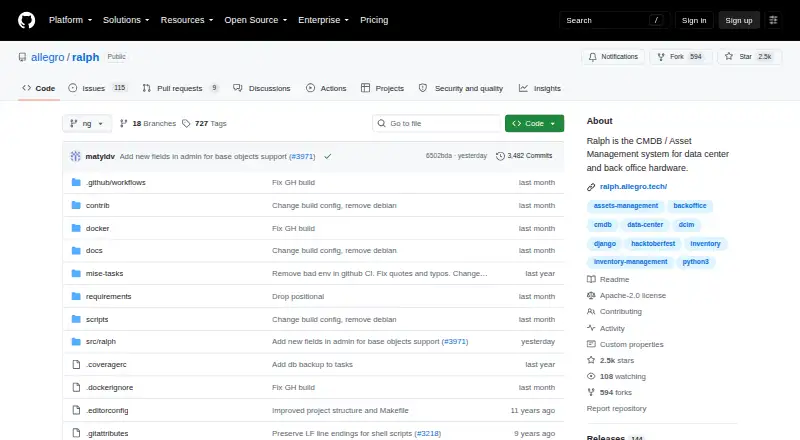
What Ralph is
Ralph is an open-source asset management, DCIM, and CMDB system for data centers and back offices handling hardware. It records purchases and tracks assets through flexible lifecycle flows, and includes data center visualization. The project also lists service mapping, discovery imports, and ownership tracking. Ralph can be self-hosted on premises and provides a REST-style web API for querying and updating its database. API resources support GET, POST, PUT, PATCH, and DELETE, with requests authenticated by a personal token in the Authorization header. Cloud asset synchronization supports OpenStack Ocata, and the documentation describes methods for connecting providers such as AWS. LDAP or Active Directory authentication can be enabled. The software is free under the Apache 2.0 license, with no free trial. Production Debian packages are provided for Ubuntu 18.04 Bionic on AMD64; Docker Compose installation is described as experimental. The maintainers publish source without guarantees, including no guarantee of responses to issues or pull request support, and point users seeking commercial support toward the community forum.
Who it suits
Ralph is intended for teams in data centers and back offices that manage hardware assets. It may suit organizations able to self-host and work within its documented installation requirements.
What it does well
- Free and open source under Apache 2.0.
- Tracks asset purchases and lifecycle flows.
- Includes built-in data center visualization.
- REST API supports GET, POST, PUT, PATCH, and DELETE.
- LDAP or Active Directory authentication can be enabled.
What to know first
- No free trial is listed.
- Production packages target Ubuntu 18.04 Bionic on AMD64.
- Docker Compose installation is experimental.
- Issue and pull request responses are not guaranteed.
Limits
Production Debian packages are provided for Ubuntu 18.04 Bionic on AMD64. Docker Compose installation is experimental, and the maintainers do not guarantee issue responses or pull request support.
Plans
| Plan | Billed and limits | Price |
|---|---|---|
| Ralph | Open-source software · Apache 2.0 license | Free |
As github.com lists them, read 7 Oct 2026. The maker's own page has the final word.
Getting started
- Open the project at https://github.com/allegro/ralph.
- Install using the production Debian packages for Ubuntu 18.04 Bionic on AMD64.
- Consider Docker Compose only as an experimental installation route.
- Configure a personal API token for API requests.
- Review the installation guide's recommendations for a separate database host, a non-default password and SSL traffic termination.
Ralph is an open-source asset management system for data centers and back offices. It is best suited to teams managing hardware that can host and maintain their own software. Its lifecycle flows, data-center visualization and REST API offer useful operational scope at no license cost, but the narrow deployment guidance and support model raise the cost of adopting it.
Overview
Ralph combines asset management with data center infrastructure management and configuration management. It can track purchases and assets through flexible lifecycle flows, with service mapping, discovery imports and ownership tracking to add structure to the inventory. That makes it more useful for ongoing hardware operations than a basic register of equipment.
The Apache 2.0 license permits use without a software fee, while leaving hosting and upkeep to the organization. The project describes its source model as “Sources only”: maintainers do not guarantee issue responses or pull request support. A community forum is available, but teams that require dependable vendor support should look elsewhere.
Key features
Lifecycle management and visualization
Flexible flows let teams represent the stages in an asset’s life, from purchase onward. Built-in data center visualization complements the records, giving infrastructure teams a way to view their environment as well as track individual assets. Those capabilities make Ralph a stronger fit for hardware-heavy settings than for organizations looking for a general-purpose business asset catalog.
API and integrations
The REST-style API can query and populate the database, with GET, POST, PUT, PATCH and DELETE operations on resources. Requests use an automatically generated personal token in the Authorization header. This is a practical foundation for connecting systems, though teams will need to manage that authentication and their own integration work.
Cloud synchronization supports OpenStack Ocata. The documentation also describes syncing assets with providers such as AWS through an HTTP endpoint and, for some providers, an adapter. LDAP or Active Directory authentication can be enabled in configuration, which may help fit Ralph into an existing identity environment.
Pricing
Ralph: free. The plan is open-source software under the Apache 2.0 license, with no free trial because the software is already free. There are no paid tiers or published seat caps in the plan. The trade-off is operational responsibility: Ralph is on-premises software, so organizations must provide deployment, maintenance and support themselves.
Platforms
Ralph is a web application with an API, designed for Linux and self-hosting. The installation guide provides production Debian packages for Ubuntu 18.04 Bionic on AMD64; Docker Compose installation is described as experimental. That specific production package target may constrain teams using newer or different server environments. The guide recommends a separate database host, a non-default password and SSL traffic termination as part of a safer deployment.
Who it's for
Ralph is aimed at data centers and back offices managing hardware assets, especially teams that need lifecycle workflows alongside configuration and infrastructure records. It makes sense when the organization can operate self-hosted software and can tolerate community rather than guaranteed support. It is less suitable for teams seeking a managed service, broad production deployment guidance or a firm support commitment.
Pros and cons
- Pros: Free Apache 2.0 software avoids license charges and permits self-hosted use.
- Pros: Lifecycle flows, service mapping, discovery imports and ownership tracking provide more context than a simple hardware inventory.
- Pros: Data-center visualization and a REST API support infrastructure views and integration work.
- Cons: Production Debian packages target Ubuntu 18.04 Bionic on AMD64, while Docker Compose remains experimental.
- Cons: Maintainers make no guarantees about issue responses or pull request support, which is a risk for teams that need reliable escalation.
- Cons: Self-hosting means the organization takes on deployment and maintenance, including security configuration.
Alternatives
For a broader comparison, see CMDB Software.
BlueKing CMDB is another free option, with a Community Edition that includes one-click deployment, automated operations, documentation and a user community; consider it if those deployment and operations provisions better fit your needs.
CMDBuild is a free, self-hosted alternative that requires server setup; choose it if its model suits your team’s infrastructure and workflow needs.
dust is a free command-line disk usage tool for Linux, macOS and Windows, rather than a data-center asset management system.
iTop offers a free Community offer with on-premise availability; it is an option to consider if that community model is a better match.
teemIP has a free community plan with open-source code, free download and installation, GitHub and wiki access, and a community forum. Consider it if those community resources matter more to your choice.
OpenIPAM is a free open-source alternative with a browser-only or self-hosted backend.
GLPI offers a free plan and a Public Cloud plan at €19 a month per IT agent, starting with one billed agent. Its cloud option may suit teams that prefer a hosted service and accept per-agent pricing.
Hornbill IT Asset Management uses personalized pricing tailored to requirements and scalable packages; consider it if that pricing approach better suits your organization.
Verdict
Choose Ralph if your data center or back office needs asset lifecycle tracking, infrastructure visualization and an API, and your team can run the software itself. Its Apache-licensed, no-cost model is compelling for capable operators. Look elsewhere if your platform needs fall outside the stated production package target or you require guaranteed support.
Verdict
Ralph offers asset lifecycle tracking, data center visualization, and an API as free self-hosted software. Check its platform requirements and support model before adopting it.
Questions
Is Ralph free?
Yes. Ralph is listed as free and uses the Apache 2.0 license.
How is Ralph deployed?
It can be self-hosted on premises. Production Debian packages are provided for Ubuntu 18.04 Bionic on AMD64, while Docker Compose installation is experimental.
What does Ralph manage?
It is an asset management, DCIM and CMDB system for data centers and back offices. It tracks hardware purchases and lifecycles and includes data center visualization.
Does Ralph have an API?
Yes. Its REST-style web API queries and populates the database and supports GET, POST, PUT, PATCH and DELETE operations. Requests use a personal token in the Authorization header.
Can Ralph synchronize cloud assets?
Cloud synchronization supports OpenStack Ocata. The documentation also describes approaches for providers such as AWS.
What support is available?
The project links to an online community forum. The maintainers do not guarantee issue responses or pull request support.
Facts from Ralph's own pages
- API authentication
- API requests use an automatically generated personal token sent in the Authorization header. · ralph-ng.readthedocs.io, 7 Oct 2026
- API operations
- The API supports GET, POST, PUT, PATCH and DELETE operations on resources. · ralph-ng.readthedocs.io, 7 Oct 2026
- Asset lifecycle
- It tracks asset purchases and lifecycles with a flexible lifecycle flow system. · github.com, 7 Oct 2026
- Authentication integration
- The configuration documentation describes enabling authentication through LDAP or Active Directory systems. · ralph-ng.readthedocs.io, 7 Oct 2026
- Cloud integrations
- Cloud synchronization supports OpenStack Ocata; the documentation also describes syncing assets with providers such as AWS using an HTTP endpoint and, for some providers, an adapter. · ralph-ng.readthedocs.io, 7 Oct 2026
- Community help
- The README links to an online forum for the Ralph community. · github.com, 7 Oct 2026
- Data center visualization
- The project lists built-in data center visualization as a feature. · github.com, 7 Oct 2026
- Demo
- The README links to a live demo and lists the login and password as ralph. · github.com, 7 Oct 2026
- Deployment
- The installation guide provides Ubuntu packages for AMD64 and describes Docker installation as experimental. · ralph-ng.readthedocs.io, 7 Oct 2026
- Intended users
- The project describes its target environments as data centers and back offices managing hardware assets. · github.com, 7 Oct 2026
- License
- The project is open source under the Apache 2.0 license. · github.com, 7 Oct 2026
- Lifecycle workflows
- It includes a flexible flow system for asset life cycles. · github.com, 7 Oct 2026
- Open source
- Ralph is provided under the Apache 2.0 license. · github.com, 7 Oct 2026
- Platform requirement
- The guide says production Debian packages are provided for Ubuntu 18.04 Bionic on AMD64. · ralph-ng.readthedocs.io, 7 Oct 2026
- Purpose
- Ralph is an asset management, DCIM and CMDB system for data centers and back offices. · github.com, 7 Oct 2026
- REST API
- Ralph exposes a REST-style web API for querying and populating its database. · ralph-ng.readthedocs.io, 7 Oct 2026
- Security configuration
- The installation guide recommends using a separate database host with a non-default password and configuring SSL traffic termination. · ralph-ng.readthedocs.io, 7 Oct 2026
- Self-hosting
- The installation guide provides Ubuntu packages and an experimental Docker Compose installation. · ralph-ng.readthedocs.io, 7 Oct 2026
- Support
- The maintainers say they publish source under a “Sources only” model without guarantees and do not guarantee issue responses or pull request support; they point users seeking commercial support to the community forum. · github.com, 7 Oct 2026
Where Ralph stands on Freedom251
- CMDB Software#10 of 39