Freedom251 › RAID Data Recovery Software
RAID-0-Recovery
What RAID-0-Recovery is
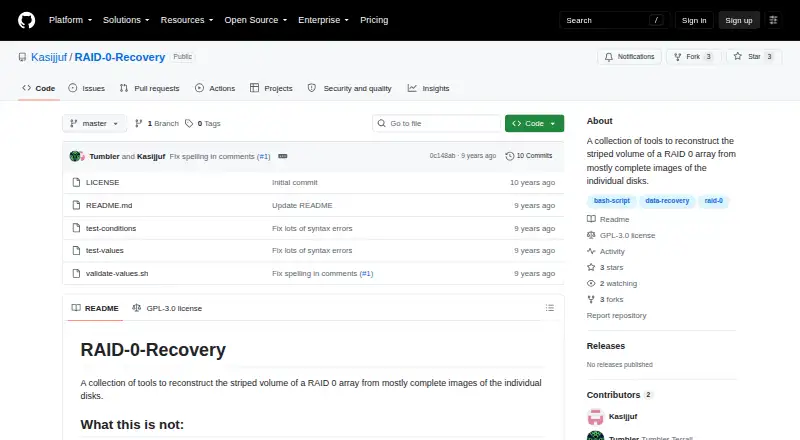
RAID-0-Recovery is a free Linux project for reconstructing a RAID 0 striped volume from mostly complete images of its individual disks. Its intended result is a single disk image assembled from those component images. The repository describes the scripts and their capabilities as planned, so the project is not yet presented as a finished recovery workflow.
The planned tools include input validation and a script that generates random stripes from disk images to help check the stripe size. Another planned capability is identifying files affected by unreadable sectors on the array disks. The project also describes a workflow for combining ddrescue logfiles from individual disks into one logfile for the reconstructed volume, suitable for specified ddrutility commands. It is intended to complement GNU ddrescue, ddrescueview, and ddrutility. The README describes the project as free/libre software under GPLv3+, and GitHub lists Bash script as a repository topic. RAID-0-Recovery focuses on RAID 0 and disk-image recovery. Its README says the tools cannot recover data if a component disk is completely unreadable, and cautions that the project does not make RAID 0 safe to use without redundancy or a backup.
Who it suits
RAID-0-Recovery is intended for Linux users who have mostly complete images of the disks in a RAID 0 array and want to reconstruct a volume image. It may suit users working alongside GNU ddrescue, ddrescueview, and ddrutility who can account for the project's planned status.
What it does well
- Free/libre software under GPLv3+.
- Targets RAID 0 disk-image reconstruction.
- Planned workflow complements GNU ddrescue and related tools.
- Planned stripe generation can help verify stripe size.
What to know first
- The README describes its scripts and capabilities as planned.
- Cannot recover data if a component disk is completely unreadable.
- Supports RAID 0 only.
- Does not replace redundancy or backups.
Limits
The project cannot recover data when a component disk is completely unreadable. Its README describes its scripts and capabilities as planned.
Getting started
- Visit the project repository on GitHub.
- Review the README's planned capabilities and recovery limitation.
- Use Linux with mostly complete images of the RAID 0 component disks.
Verdict
Consider RAID-0-Recovery if you use Linux and need a planned toolset for reconstructing a RAID 0 image from mostly complete component images. Look elsewhere for a completed recovery workflow or if a component disk is completely unreadable.
Questions
Is RAID-0-Recovery free?
Yes. The README describes it as free/libre software under GPLv3+.
What does it recover?
It is intended to reconstruct a RAID 0 striped volume from mostly complete images of its individual disks.
Which platforms does it support?
Linux.
Is the recovery workflow complete?
The README describes the scripts and capabilities as planned.
Can it recover a completely unreadable disk?
No. The README says the tools cannot recover data when a component disk is completely unreadable.
Which tools does it complement?
It is described as a complement to GNU ddrescue, ddrescueview, and ddrutility.
Facts from RAID-0-Recovery's own pages
- Affected files
- A planned capability is identifying files affected by unreadable sectors on array disks. · github.com, 4 Oct 2026
- Backup caveat
- The README says the project is not an excuse to use RAID 0 without redundancy or backup. · github.com, 4 Oct 2026
- Backup limitation
- The README says the project is not an excuse to use RAID 0 without redundancy or backup. · github.com, 10 Oct 2026
- ddrescue compatibility
- The project is described as a complement to GNU ddrescue, ddrescueview, and ddrutility. · github.com, 4 Oct 2026
- ddrescue logfiles
- The README describes a planned script to combine ddrescue logfiles from individual disks into a logfile for the reconstructed volume. · github.com, 10 Oct 2026
- Implementation
- The repository topics identify the project as a Bash script and data recovery project. · github.com, 10 Oct 2026
- Input validation
- A planned script would handle input validation for the other scripts. · github.com, 4 Oct 2026
- Integrations
- The README describes the planned logfile output as suitable for ddrutility commands ddru_findbad and ddru_ntfsfindbad. · github.com, 10 Oct 2026
- License
- The README identifies the project as free/libre software under GPLv3 or later. · github.com, 10 Oct 2026
- Logfile workflow
- A planned script would combine ddrescue logfiles from individual disks into a logfile for the reconstructed volume, suitable for specified ddrutility commands. · github.com, 4 Oct 2026
- Planned file impact analysis
- A planned function would identify files affected by unreadable sectors on RAID 0 disks. · github.com, 10 Oct 2026
- Planned output
- The planned scripts would reassemble RAID 0 disks into a single disk image. · github.com, 4 Oct 2026
- Planned reconstruction
- A planned script would combine individual disk images into one non-RAID image or disk. · github.com, 10 Oct 2026
- Project status
- The README labels the scripts and recovery functions as planned. · github.com, 10 Oct 2026
- Purpose
- The repository describes RAID-0-Recovery as tools to reconstruct a RAID 0 striped volume from mostly complete images of its individual disks. · github.com, 10 Oct 2026
- Recovery limitation
- The README says the tools cannot recover data when a component disk is completely unreadable. · github.com, 4 Oct 2026
- Related tools
- The README names GNU ddrescue, ddrescueview, and ddrutility as complementary tools. · github.com, 10 Oct 2026
- Stripe verification
- The README lists a planned script to generate random stripes from component disk images to help verify stripe size. · github.com, 10 Oct 2026
- Unreadable disks
- The README says the project is not a way to recover data if a component disk is completely unreadable. · github.com, 10 Oct 2026
Where RAID-0-Recovery stands on Freedom251
- RAID Data Recovery Software#11 of 27