Freedom251 › RAID Data Recovery Software
raid_recovery
What raid_recovery is
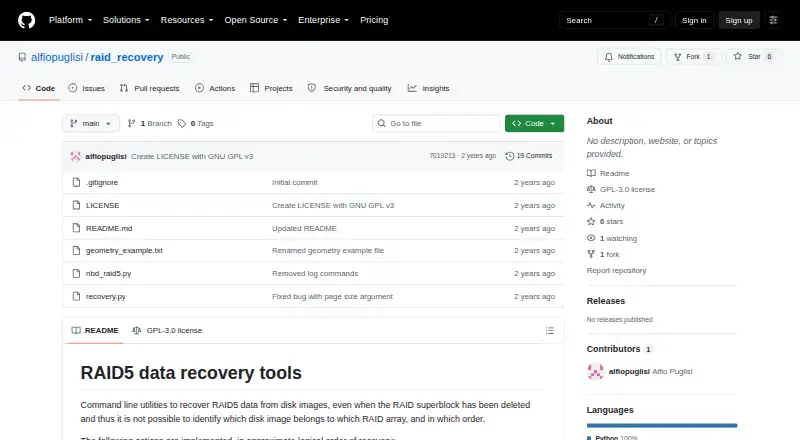
raid_recovery is a free, open-source set of Linux command-line tools for recovering RAID5 data from disk images, including situations where the superblock is gone or disk order is unclear. Its workflow includes page-size detection, image identification, parity checks, disk ordering, and reconstruction. Once page size and image order are established, the restore command writes RAID pages in sequence to a file representing the virtual drive. A Python nbdkit plugin offers another option: exporting a virtual drive from RAID5 images without a superblock when disk order and page size are known. It also handles disks split into multiple image files described by a geometry file. The tools depend on numpy and tqdm; virtual-disk setup uses nbdkit, nbd-server, and nbd-client. Detection relies on heuristics and is not guaranteed. Page-size detection needs a long ASCII or similar text file on disk. Image identification needs the array size and page size, and reconstruction may require dozens of terabytes of additional free space beyond the raw images. The repository identifies its license as GPL-3.0 and shows no releases.
Who it suits
This may suit Linux users trying to recover RAID5 data from disk images, including arrays with a missing superblock or unknown disk order. It assumes comfort with command-line utilities and the listed dependencies.
What it does well
- Free and open source under GPL-3.0
- Offers parity checking and data reconstruction
- Can export a virtual drive with nbdkit
- Supports disks split across image files
What to know first
- Detection heuristics are not guaranteed
- Page-size detection needs a long text file
- Reconstruction may need dozens of terabytes free
- Repository page shows no releases
Verdict
raid_recovery provides a defined set of RAID5 recovery steps and a virtual-drive option for Linux. Its heuristic limits, text-file requirement, and potentially large storage needs are important constraints to consider.
Facts from raid_recovery's own pages
- Array identification
- The identification algorithm tests image file combinations against RAID5 parity and can report multiple matches. · github.com, 9 Oct 2026
- Dependencies
- The recovery utilities list numpy and tqdm as dependencies. · github.com, 9 Oct 2026
- Heuristic limitation
- Page-size detection and disk-order detection use heuristics, and the README says their results are not guaranteed. · github.com, 9 Oct 2026
- Heuristic limits
- The README says page size and sequence detection use heuristics, so their results are not guaranteed. · github.com, 9 Oct 2026
- Identification limitation
- Disk-image identification requires the array size and page size, and the selected page range should contain data rather than only zeroes for reliable identification. · github.com, 9 Oct 2026
- Integration
- The virtual-disk setup uses nbdkit, nbd-server, and nbd-client; the README gives Ubuntu package installation instructions for the latter two. · github.com, 9 Oct 2026
- Integrity check
- The parity check examines the full image length and returns a pass or fail result. · github.com, 9 Oct 2026
- License
- The repository identifies its license as GPL-3.0. · github.com, 9 Oct 2026
- Linux setup
- The README gives Ubuntu installation instructions for nbd-server and nbd-client and describes building nbdkit. · github.com, 9 Oct 2026
- Page size detection
- Page size detection uses ASCII file statistics and requires a long ASCII or similar text file on disk; one disk image is sufficient. · github.com, 9 Oct 2026
- Page-size detection requirement
- The page-size heuristic needs a long ASCII file on disk, ideally a few megabytes, and examines one disk image. · github.com, 9 Oct 2026
- Purpose
- Command-line utilities recover RAID5 data from disk images, including when the RAID superblock has been deleted and disk order is unknown. · github.com, 9 Oct 2026
- Reconstruction
- After page size and image order are known, the restore command extracts RAID pages into one output file containing the virtual drive content. · github.com, 9 Oct 2026
- Reconstruction output
- Reconstruction extracts RAID pages in sequence into one output file containing the virtual drive content. · github.com, 9 Oct 2026
- Recovery steps
- The tools support page-size detection, disk-image identification, parity checking, disk ordering, and data reconstruction. · github.com, 9 Oct 2026
- Release availability
- The repository page shows no releases. · github.com, 9 Oct 2026
- Resource requirement
- The README says file reconstruction may require dozens of terabytes of free disk space in addition to space occupied by raw disk images. · github.com, 9 Oct 2026
- Split images
- The virtual-disk plugin supports disks split into multiple image files, described by a geometry file. · github.com, 9 Oct 2026
- Storage requirement
- Reconstruction into an output file may require dozens of terabytes of free disk space in addition to the raw disk images. · github.com, 9 Oct 2026
- Virtual disk option
- A Python nbdkit plugin can export a virtual drive from RAID5 disk images without a RAID superblock, provided disk order and page size are known. · github.com, 9 Oct 2026
Where raid_recovery stands on Freedom251
- RAID Data Recovery Software#12 of 27