Freedom251 › Kubernetes Monitoring
Radar
What Radar is
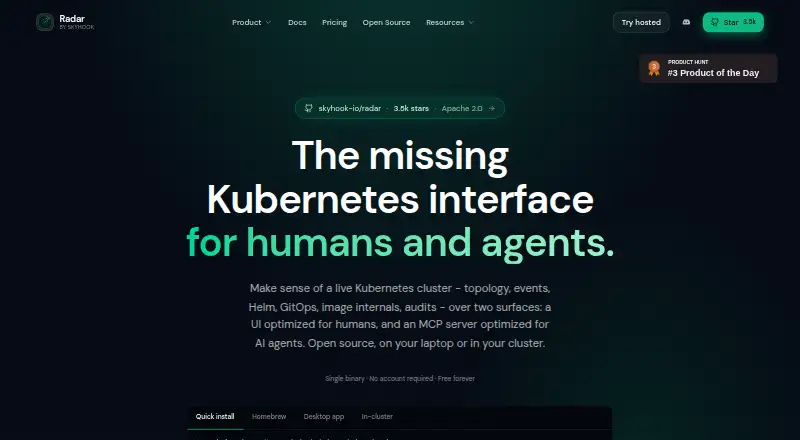
Radar is an open-source Kubernetes interface for platform engineering teams and AI agents. It brings cluster topology, events, Helm, GitOps, image internals, and audits into one interface. Its live graph maps Deployments, Services, and Ingresses with traffic, TLS health, and cross-namespace dependencies. Radar runs locally as a single binary with a kubeconfig or in-cluster through Helm, and desktop apps are available for macOS, Linux, and Windows. Radar OSS is free forever with unlimited clusters and nodes; it sends no cluster data out and makes one anonymous version check that can be blocked. Cloud Free supports up to three clusters and includes 100 hosted investigations per month. Paid plans start at $149 per cluster per month for Team; Enterprise is $299 per cluster per month. Cloud provides AI root-cause investigations and alerts to Slack or webhooks with per-cluster routing. It streams viewed resources, events, and logs through its control plane without storing them. Event timeline retention is 24 hours on Free, three days on Team, and 30 days on Enterprise.
Who it suits
Radar suits platform engineering teams and AI agents that need centralized Kubernetes visibility. The local or in-cluster options may suit teams choosing between OSS and Cloud workflows.
What it does well
- Live topology includes traffic and TLS health.
- OSS supports unlimited clusters and nodes.
- Cloud Free includes 100 investigations monthly.
- Alerts route to Slack or webhooks.
- Desktop apps cover macOS, Linux, and Windows.
What to know first
- Cloud Free is limited to three clusters.
- Free event timeline retention is 24 hours.
- Kubernetes logs are not supported.
- Team starts at $149 per cluster monthly.
Limits
Radar OSS is free forever with unlimited clusters and nodes. Cloud Free supports up to three clusters, 100 hosted investigations per month, and 24-hour event timeline retention; Team starts at $149 per cluster per month and has three-day timeline retention.
Plans
| Plan | Billed and limits | Price |
|---|---|---|
| Radar OSS | Free forever · Unlimited clusters & nodes · Full topology and resource views · Helm, image filesystem, audit, MCP/AI · Community GitHub + Discord support | Free |
| Cloud Free | $0 forever · Up to 3 clusters · Unlimited users · 100 hosted investigations/month · 24-hour timeline retention | Free |
| Team | $149 per cluster / month · starting price · Unlimited clusters and users · 100 investigations per cluster/month, then $1 each if enabled · 3-day timeline · 30-day audit retention | $149 a month |
| Enterprise | $299 per cluster / month · Unlimited clusters and users · SAML/OIDC SSO + SCIM 2.0 · 200 investigations per cluster/month, then $1 each if enabled · 30-day timeline · 1-year audit retention | $299 a month |
| Custom | Let's talk · annual contract · Volume pricing · Custom IdP and data residency · Custom retention · Air-gapped deployment · 99.9% uptime SLA | On request |
As radarhq.io lists them, read 3 Oct 2026. The maker's own page has the final word.
Getting started
- Choose Radar OSS for local use or a Cloud plan for hosted features.
- For local deployment, run the single binary with a kubeconfig.
- For in-cluster deployment, use Helm.
- Install a desktop app for macOS, Linux, or Windows if you want the desktop interface.
- For Cloud Free, connect up to three clusters to access hosted investigations.
Radar is an open-source Kubernetes interface for platform engineering teams that need topology, resource context, and operational investigations in one place. It suits teams choosing between a data-contained local tool and hosted AI-assisted operations; Cloud pricing per cluster and limited event history are the key trade-offs.
Overview
Radar brings topology, events, Helm, GitOps, image filesystems, audits, and MCP/AI functions into a single interface for engineers and AI agents. It runs as one binary with a kubeconfig or in-cluster through Helm. Desktop applications are available for macOS, Linux, and Windows, while the product also supports web, API, self-hosted, and Windows deployments.
Radar OSS keeps cluster data local: it sends no cluster data out and makes one anonymous, blockable version check. Cloud streams viewed resources, events, and logs through its control plane without storing them. That makes the hosted service more practical for investigations while leaving data-governance teams a clear boundary to evaluate.
Key features
Topology and integrations
The live graph connects Deployments, Services, and Ingresses, showing traffic, TLS health, and dependencies across namespaces. It is valuable when a platform team needs to trace relationships rather than inspect resources one at a time. Built-in integrations cover Argo, Flux, Cilium, Istio, Karpenter, KEDA, Crossplane, cert-manager, OpenCost, Kubecost, Prometheus, Trivy, and Velero without plugins, giving teams broad Kubernetes context without assembling an extension stack.
Investigations and alerting
Radar Cloud adds AI root-cause investigations with evidence. Alerts can route to Slack or any webhook, with routing set per cluster; the broader channel list also includes PagerDuty, Opsgenie, and Microsoft Teams. Cloud Free includes 100 hosted investigations each month, while paid plans meter investigations per cluster. Radar is not a replacement for a full log or tracing platform: Kubernetes logs and distributed tracing are not provided.
Security and support
SOC 2 Type 2 applies to every Cloud plan. Enterprise and Custom add SAML/OIDC SSO and SCIM 2.0. OSS support is through GitHub and Discord; Enterprise provides priority support, and Custom adds a dedicated CSM and phone support.
Pricing
Radar uses a freemium model, with paid plans from $149 per month and a 14-day trial.
| Plan | Price and limits |
|---|---|
| Radar OSS | free, free forever. Unlimited clusters and nodes, full topology and resource views, Helm, image filesystem, audit, and MCP/AI; community GitHub and Discord support. This is the strongest choice for teams requiring local data handling and willing to operate the software themselves. |
| Cloud Free | free, $0 forever. Up to three clusters, unlimited users, 100 hosted investigations per month, and 24-hour timeline retention. It is a useful way to evaluate hosted workflows, but the one-day event window limits historical incident review. |
| Team | $149 a month, billed at $149 per cluster per month. Unlimited clusters and users, 100 investigations per cluster monthly, then $1 each if enabled, three-day timeline retention, and 30-day audit retention. It fits growing teams, although per-cluster billing can rise quickly and three days is still a short event history. |
| Enterprise | $299 a month, billed at $299 per cluster per month. Unlimited clusters and users, SAML/OIDC SSO, SCIM 2.0, 200 investigations per cluster monthly, then $1 each if enabled, 30-day timeline retention, one-year audit retention, and priority support. Choose it when identity controls and longer audits outweigh the higher cluster cost. |
| Custom | Custom pricing on an annual contract. It adds volume pricing, a custom identity provider and data residency, custom retention, air-gapped deployment, and a 99.9% uptime SLA, plus a dedicated CSM and phone support. |
Platforms
Radar supports API, Linux, macOS, self-hosted, web, and Windows use. The desktop application covers macOS, Linux, and Windows, while deployment can remain local or run in-cluster through Helm.
Who it's for
Radar is a strong fit for platform engineering teams standardizing Kubernetes visibility across clusters, especially those that want topology, GitOps context, and integrations in one interface. OSS suits organizations that cannot send cluster data to a hosted service. Cloud suits teams that want evidence-backed investigations and routed alerts without running the control plane, provided three-day-or-less event history is acceptable on Team and per-cluster charges fit the budget.
It is less suitable as a standalone observability suite for teams that need retained logs or distributed tracing, or for organizations whose many clusters make per-cluster Cloud billing uneconomical.
Pros and cons
- Pros: Live dependency topology includes traffic and TLS health; broad integrations require no plugins; OSS supports unlimited clusters and nodes; Cloud adds evidence-based AI investigations and per-cluster alert routing; Enterprise provides SSO, SCIM, and one-year audit retention.
- Cons: Cloud event retention is only 24 hours on Free, three days on Team, and 30 days on Enterprise; Team and Enterprise charge per cluster; investigation overages cost $1 each when enabled; logs and distributed tracing are absent.
Alternatives
For a broad comparison, see Kubernetes Monitoring.
- Middleware is a freemium, multi-platform observability option with a free tier capped at 100GB of data, 1,000 RUM sessions, and 20,000 synthetic checks.
- Netdata is preferable when a free community deployment capped at five active connected nodes and one custom dashboard per room meets your needs.
- Datadog Kubernetes Monitoring suits teams that prefer container-hour pricing, starting at $0.002 per container hour.
- Dynatrace Kubernetes Monitoring is a paid alternative billed at $0.002 per pod hour.
- Grafana Cloud Application Observability offers a free allowance of 2,232 host hours and usage-based Pro pricing.
- Checkmk fits infrastructure monitoring with 2,000-plus integrations and a community tier for roughly 100 hosts.
- Honeycomb is aimed at event and metrics analysis, with a free tier of up to 20 million events monthly.
- New Relic Kubernetes Monitoring offers annual Pro commitments with 100GB of included data ingest.
Verdict
Choose Radar when your platform team wants Kubernetes topology, integrations, and AI-assisted investigations in a local OSS tool or a focused hosted service. Look elsewhere if you need durable logs and tracing, or if per-cluster Cloud pricing and short event retention do not match your operating model.
Verdict
Radar combines Kubernetes topology, events, and operational views, with a free OSS option and Cloud plans for hosted investigations and alerting. Check cluster limits and event retention against your needs before choosing a Cloud tier.
Questions
Is Radar free?
Radar OSS is free forever and includes unlimited clusters and nodes. Cloud Free is also $0 forever and supports up to three clusters with 100 hosted investigations per month.
How much do the paid plans cost?
Team is $149 per cluster per month, starting price. Enterprise is $299 per cluster per month; Custom uses an annual contract with price discussed with the maker.
Which platforms are available?
The listed platforms are API, Linux, macOS, self-hosted, web, and Windows. Desktop apps are available for macOS, Linux, and Windows.
How can I deploy Radar?
Radar runs as a single binary locally with a kubeconfig or in-cluster through Helm.
What data does Radar Cloud handle?
Cloud streams viewed resources, events, and logs through its control plane without storing them. Radar OSS sends no cluster data out and makes one anonymous version check that can be blocked.
How long does Cloud keep event timeline data?
Event timeline retention is 24 hours on Free, three days on Team, 30 days on Enterprise, and custom on Custom.
Facts from Radar's own pages
- AI investigations
- Radar Cloud offers AI root-cause investigations with evidence, and its pricing page includes 100 investigations per month on Cloud Free. · radarhq.io, 3 Oct 2026
- Data handling
- Radar OSS sends no cluster data out and makes one anonymous, blockable version check; the pricing page says Cloud streams viewed resources, events, and logs through its control plane without storing them. · radarhq.io, 3 Oct 2026
- Deployment
- Radar runs as a single binary locally with a kubeconfig or in-cluster through Helm. · radarhq.io, 3 Oct 2026
- Desktop apps
- The desktop app is available for macOS, Linux, and Windows. · radarhq.io, 3 Oct 2026
- Integrations
- Built-in integrations include Argo, Flux, Cilium, Istio, Karpenter, KEDA, Crossplane, cert-manager, OpenCost, Kubecost, Prometheus, Trivy, and Velero, with no plugins required. · radarhq.io, 3 Oct 2026
- Intended users
- Radar describes itself as centralized Kubernetes visibility for platform engineering teams. · radarhq.io, 3 Oct 2026
- Maker
- Radar is the open-source Kubernetes UI from the platform team at Skyhook. · radarhq.io, 3 Oct 2026
- Notifications
- Radar Cloud alerts can be sent to Slack or any webhook, with per-cluster routing. · radarhq.io, 3 Oct 2026
- Product
- Radar is an open-source Kubernetes interface for people and AI agents, with topology, events, Helm, GitOps, image internals, and audits. · radarhq.io, 3 Oct 2026
- Retention limits
- Cloud event timeline retention is 24 hours on Free, 3 days on Team, 30 days on Enterprise, and custom on Custom; audit log retention is 30 days on Team and one year on Enterprise. · radarhq.io, 3 Oct 2026
- Security
- The pricing page states SOC 2 Type 2 applies to every Cloud plan; SAML/OIDC SSO and SCIM 2.0 are included on Enterprise and Custom. · radarhq.io, 3 Oct 2026
- Support
- Radar OSS support is through GitHub and Discord; Enterprise includes priority support, while Custom lists a dedicated CSM and phone support. · radarhq.io, 3 Oct 2026
- Topology
- The topology view displays Deployments, Services, and Ingresses as a live graph with traffic, TLS health, and cross-namespace dependencies. · radarhq.io, 3 Oct 2026
Where Radar stands on Freedom251
- Kubernetes Monitoring#18 of 54