Freedom251 › AI Video Search Tools
QMedia
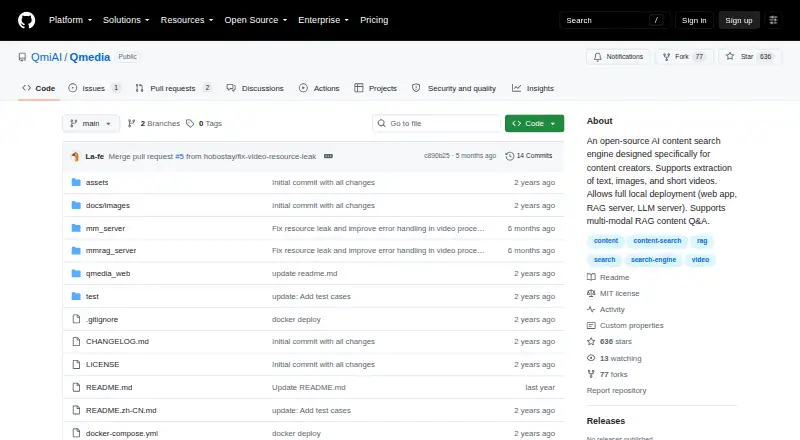
What QMedia is
QMedia is an open-source multimedia search engine aimed at content creators. It searches and extracts information from text, images, and short videos, then combines those formats in a multimodal system for search and question answering. Its web service displays content and sources as cards, including separate breakdowns of image, text, and short-video information.
The project can be deployed locally for offline search and Q&A over private data. Its web service, RAG search and Q&A service, and image, text, and video model service can be deployed separately; the RAG service depends on the separate mm_server service. The model service offers an API for image and text encoding, video transcription, and image OCR. Documented model options include CLIP, BGE, Qanything OCR, LLaVA, and Faster Whisper, with local Ollama model switching also documented. Google content search is configurable and disabled by default, as is video service use in the RAG server configuration. QMedia is MIT-licensed and free, with a listed price of $0.
Who it suits
QMedia suits content creators who want to search and ask questions across text, images, and short videos. Its local deployment option may suit people working with private data offline, provided they can run the separate RAG and mm_server services.
What it does well
- Searches text, images, and short videos.
- Supports local offline search over private data.
- Model service exposes image and text encoding APIs.
- MIT-licensed and free to use.
What to know first
- The RAG service depends on the separate mm_server.
- Google content search is disabled by default.
- Video service use is off by default.
Plans
| Plan | Billed and limits | Price |
|---|---|---|
| QMedia | Open-source software · MIT license | Free |
As github.com lists them, read 8 Oct 2026. The maker's own page has the final word.
Getting started
- Open the QMedia project website on GitHub.
- Choose the web service, RAG service, or model service deployment arrangement.
- For RAG search and Q&A, arrange for the separate mm_server service to run.
- Configure Google content search if you want it; it is disabled by default.
- Enable video service use in the RAG server configuration if needed.
- Use the model service API for image and text encoding, video transcription, or image OCR.
QMedia is an open-source search and question-answering system for creators managing text, images, and short videos. It suits teams willing to deploy services and models themselves, especially when private, mixed-media collections matter. Its breadth is valuable, but operating the separate RAG dependency and enabling video processing require deliberate setup.
Overview
QMedia combines multimedia retrieval with question answering rather than treating each format as a separate library. It searches and extracts information from text, images, and short videos through a multimodal RAG system, allowing a question to draw on more than one kind of source.
The web interface presents results as cards containing source references and separate breakdowns of image, text, and short-video information. That presentation is useful for creators who need to inspect the material behind a result, not merely receive a generated response. QMedia can also be deployed locally for offline search and Q&A over private data. Local operation provides control over processing location, but it is not a stated security certification or compliance status.
The project is released under the MIT License. Its README directs users to issue reporting and requests and points to Discord and WeChat communities for discussion.
Key features
- Multimedia search and extraction: Text, images, and short videos can be searched in one system. This is a stronger fit for creator archives with mixed media than a product limited to video or image indexing.
- Multimodal Q&A: The RAG layer combines information across supported formats for questions and answers. The RAG service requires the separate mm_server service, so deployment is not a single-component installation.
- Inspectable content cards: Cards show sources and break down image, text, and short-video information. That gives users a way to follow the evidence and understand which media contributed to a result.
- Separable services: The web service, RAG search and Q&A service, and image/text/video model service can be deployed independently. This supports architectures that separate user interface, retrieval, and model workloads, while adding operational coordination.
- Model choices: Documentation covers local Ollama model switching and names CLIP, BGE, Qanything OCR, LLaVA, and Faster Whisper among the options. The range spans visual embeddings, OCR, vision-language work, and speech transcription, giving self-hosters room to match models to their collection.
- Model-service API: The standalone multimodal model service exposes image and text encoding, video transcription, and image OCR through an API. It can therefore serve other applications as well as QMedia's own search workflow.
- Configurable external search: The RAG service supports Google content search, which is configurable and disabled by default. Teams can leave that integration off when they want a purely local workflow.
- Video control: Video-service use is configurable and off by default in the RAG server configuration. That avoids enabling video processing until it is needed, but video-focused deployments must change the setting.
Pricing
QMedia — free: The software is free and open source under the MIT License. There are no paid tiers, seat charges, quotas, trial period, or renewal terms stated. This is the natural choice for creators and technical teams that can provide their own deployment and model-service resources. The trade-off is that the free offering is the project itself: it does not describe a hosted plan that removes service administration.
Platforms
QMedia is offered through a web interface, an API, and self-hosted deployment. The self-hosted route supports local, offline work over private data; the API route is aimed at integrating the multimodal model capabilities into another system. Because the services can be deployed separately, platform planning includes the web, RAG, and model-service components rather than just a client install.
Who it's for
QMedia is for content creators, archives, and development teams with text, image, and short-video material that they want to search together and question conversationally. It is particularly appropriate when keeping private data on local infrastructure is important, or when an API for encoding, OCR, and transcription is useful. It is less suitable for users seeking a managed, ready-to-run hosted search product, or for teams unwilling to operate the required mm_server dependency and configure video services.
Pros and cons
Pros
- One workflow for three media types: Text, images, and short videos are searchable and available to the same Q&A system.
- Evidence-oriented results: Source-linked cards and media breakdowns make answers easier to examine.
- Local privacy control: Offline deployment supports private-data workflows without requiring a hosted service.
- Flexible integration: Separate services, Ollama switching, and a model API accommodate custom deployments.
- No software fee: MIT-licensed open-source software avoids subscription pricing.
Cons
- More deployment work: The RAG service depends on mm_server, and the architecture separates three service areas.
- Video is not automatic: Video-service use is off by default and must be configured for video processing.
- Self-hosting responsibility: The project does not provide a stated security certification or compliance status, so those controls remain the deployer's responsibility.
Alternatives
Choose FrameQuery instead if you want freemium access across API, macOS, web, and Windows, with a free tier that includes metadata search but no monthly indexing hours; indexed video is required for its face, voice, and AI-tag searches.
VGG Image Annotator is the simpler free, cross-platform option when annotation is the priority rather than multimodal RAG and Q&A; it has no paid tiers or stated usage limits.
Pick DISKO when a macOS/web production workflow with screenwriting, shot lists, review links, and a 2 GB free cloud tier is more relevant than self-hosted multimedia search.
Cinestar is another free, Linux/macOS choice with an MIT open-source core, while its local AI services require Ollama.
For a hosted API with explicit video quotas, Twelve Labs offers a free plan with 600 minutes of video, 90-day index access, and defined per-index limits.
Verdict
Choose QMedia if you need open-source, local-capable search and Q&A across text, images, and short videos, with model APIs and deployment control. Look elsewhere if you want a managed experience or cannot accommodate the separate RAG dependency and video configuration.
Verdict
QMedia brings multimodal search and Q&A together, with local deployment and a model-service API. Account for the separate service dependency and configurable features when planning a deployment.
Questions
How much does QMedia cost?
QMedia is free. The listed plan is free, and the project is open source under the MIT License.
Can QMedia run locally?
Yes. The project describes local deployment for offline search and question answering over private data.
What kinds of content can it search?
It supports searching and extracting information from text, images, and short videos.
Does QMedia provide an API?
Yes. Its standalone multimodal model service can provide image and text encoding, video transcription, and image OCR through an API.
Does it support Google search?
The RAG service supports Google content search. It is configurable and disabled by default.
What service dependency does a RAG deployment have?
The RAG service depends on the separate mm_server service to run.
Facts from QMedia's own pages
- API
- The standalone multimodal model service can provide image and text encoding, video transcription, and image OCR through an API. · github.com, 8 Oct 2026
- API use case
- The model server can operate independently for image and text encoding, video transcription and OCR through an API. · github.com, 15 Oct 2026
- Changelog
- The changelog identifies version 0.1.0 and lists multimodal model deployment, API calls, Ollama, image, video and embedding models. · github.com, 15 Oct 2026
- Content cards
- The interface presents image, text and video material as content cards containing sources and extracted breakdowns. · github.com, 15 Oct 2026
- Content types
- It supports searching and extracting information from text, images, and short videos. · github.com, 8 Oct 2026
- Custom results
- Search results can be tailored to the user's interests and needs. · github.com, 15 Oct 2026
- Dependencies
- The RAG service depends on the separate mm_server service to run. · github.com, 8 Oct 2026
- Deployment
- Its web service, RAG search and Q&A service, and image/text/video model service can be deployed separately. · github.com, 8 Oct 2026
- Documentation
- Documentation consists of a top-level README plus separate installation and configuration guides for each service. · github.com, 15 Oct 2026
- Frontend requirements
- The web frontend requires Node.js, pnpm, dependency installation and an environment file before running pnpm dev. · github.com, 15 Oct 2026
- Google integration
- Google content search is supported and can be enabled through the mmrag_server configuration. · github.com, 15 Oct 2026
- Image embeddings
- Images are embedded with a CLIP encoder. · github.com, 15 Oct 2026
- Independent deployment
- The three services can be deployed separately according to available resources and embedded into other systems. · github.com, 15 Oct 2026
- Installation requirements
- The model and retrieval services require separate Python 3.11 Conda environments and pip dependency installation. · github.com, 15 Oct 2026
- Integration
- The RAG service supports Google content search, which the installation guide says is configurable and disabled by default. · github.com, 8 Oct 2026
- Language models
- Local Ollama switching is supported, with llama3 8B and 70B models documented. · github.com, 15 Oct 2026
- License
- The repository is released under the MIT License. · github.com, 15 Oct 2026
- Limit: deployment complexity
- DEV.co says each service needs its own environment and that production use requires substantial infrastructure and dependency coordination. · dev.co, 15 Oct 2026
- Limit: hardware guidance
- DEV.co and SourcePulse note that hardware requirements and performance baselines for local multimodal models are not documented. · dev.co, 15 Oct 2026
- Limit: ingestion workflow
- DEV.co says initial ingestion relies on manually prepared asset files and database cleanup, with no bulk-import tooling shown. · dev.co, 15 Oct 2026
- Limit: operational readiness
- DEV.co reports that authentication, encryption, health checks, retry logic and vulnerability-disclosure procedures are not documented. · dev.co, 15 Oct 2026
- Limit: release packaging
- GitHub shows that QMedia has no published releases to pin or download. · github.com, 15 Oct 2026
- Limit: unfinished analysis
- Hysen Labs reports that visual understanding and several short-video analysis entries are marked unfinished in the repository. · hysenlabs.com, 15 Oct 2026
- Local use
- The project says it can be deployed locally for offline search and Q&A over private data. · github.com, 8 Oct 2026
Where QMedia stands on Freedom251
- AI Video Search Tools#2 of 24