qEndpoint
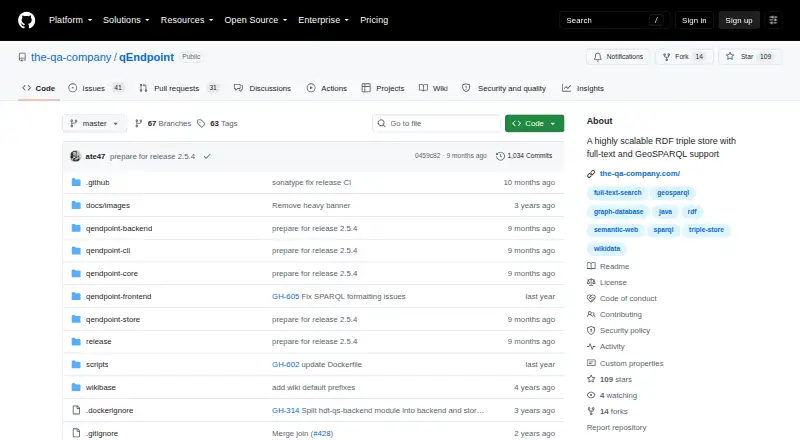
What qEndpoint is
qEndpoint is a free, open-source RDF triple store for hosting and querying datasets. It supports full-text search, GeoSPARQL and SPARQL 1.1, and can run as a standalone SPARQL endpoint or be added to another application as a dependency. Users can write and run SPARQL queries through its GUI or send HTTP queries through its RESTful API. Datasets can be uploaded in RDF4J-supported formats, including RDF/XML, Turtle, N-Triples, N-Quads, JSON-LD, TriG and TriX. Results are available as JSON, XML or Binary RDF.
Deployment is self-hosted. The project provides Docker images for qEndpoint and for a version with a Wikidata index; the latter can download Wikidata Truthy or Wikidata-all statements. Memory needs depend on the dataset: the Docker configuration defaults to 6G, large datasets are discouraged below 4G, and Wikidata-all needs at least 10G. Installation routes include Scoop, Homebrew and a CLI ZIP release. The project describes using qEndpoint with Wikibase and says it is used by Kohesio and QAnswer. Its listed technologies include Spring, RDF-HDT and RDF4J. The project is licensed under GNU GPL v3 with a notice.
Who it suits
qEndpoint suits teams and developers who need a self-hosted RDF store with SPARQL querying, full-text search or GeoSPARQL. It can also fit projects that want to use it as a dependency or work with Wikidata datasets through its Docker image.
What it does well
- Free and open source under GNU GPL v3 with a notice
- Supports SPARQL 1.1, full-text search and GeoSPARQL
- Offers both a query GUI and a RESTful HTTP API
- Accepts multiple RDF formats and returns three result formats
- Docker images include an option with a Wikidata index
What to know first
- Deployment is self-hosted
- Wikidata-all needs at least 10G of memory
- Java 17 and Maven are listed prerequisites for backend and benchmark
Limits
The Docker configuration defaults to 6G of memory, and the README advises against less than 4G for large datasets. The Wikidata image requires at least 6G for Wikidata Truthy and 10G for Wikidata-all.
Getting started
- Open the qEndpoint project website on GitHub
- Choose a deployment or installation route, including Docker, Scoop, Homebrew or the CLI ZIP release
- For a Docker setup, select the standard image or the Wikidata-index image
- Check the memory requirements for the dataset you plan to use
- Upload a dataset in a supported RDF4J format and query it through the GUI or RESTful API
Verdict
Choose qEndpoint if you need a free RDF triple store that can run as a standalone SPARQL endpoint or be included as a dependency. Its GUI, HTTP API and Docker options support different ways to query and deploy it. Look elsewhere if you need a hosted deployment rather than self-hosting, or cannot meet the memory requirements of your chosen dataset.
Questions
Is qEndpoint free?
Yes. It is free and open source under GNU GPL v3 with a notice.
What query interfaces does it provide?
It provides a GUI for writing and executing SPARQL queries and a RESTful HTTP API for queries. It supports SPARQL 1.1.
Which data formats does qEndpoint support?
Datasets can be uploaded in formats supported by RDF4J, including RDF/XML, Turtle, N-Triples, N-Quads, JSON-LD, TriG and TriX. Results can be returned as JSON, XML or Binary RDF.
Can I use qEndpoint with Wikidata?
A Docker image with a Wikidata index supports Wikidata Truthy and Wikidata-all datasets.
How can I install or deploy qEndpoint?
Deployment is self-hosted, with Docker images available. The project also documents Scoop and Homebrew installation and provides a CLI ZIP release asset.
What memory does the Wikidata image need?
The stated minimum is 6G for Wikidata Truthy and 10G for Wikidata-all.
Facts from qEndpoint's own pages
- Compatibility
- The project lists Spring, RDF-HDT, and RDF4J under “Built With.” · github.com, 4 Oct 2026
- Data formats
- The README says datasets can be uploaded in formats supported by RDF4J and lists JSON, XML, and Binary RDF result formats. · github.com, 4 Oct 2026
- Data loading
- Datasets can be uploaded to a running endpoint, and the README says it supports formats used by RDF4J. · github.com, 8 Oct 2026
- Deployment
- The project provides preconfigured Docker images for qEndpoint and qEndpoint with Wikidata data. · github.com, 8 Oct 2026
- Features
- The project describes support for full-text search and GeoSPARQL. · github.com, 8 Oct 2026
- Installation
- The README documents installation through Scoop and Homebrew and offers the CLI as a ZIP release asset. · github.com, 4 Oct 2026
- Integrations
- The project lists Spring, RDF-HDT, and RDF4J under “Built With.” · github.com, 8 Oct 2026
- Interfaces
- It provides a GUI for writing and executing SPARQL queries and a RESTful API for HTTP queries. · github.com, 8 Oct 2026
- License
- The project is licensed under GNU General Public License v3 with a notice. · github.com, 8 Oct 2026
- Memory requirements
- The Docker README sets MEM_SIZE to 6G by default, advises against less than 4G for large datasets, and says Wikidata-all needs at least 10G. · github.com, 4 Oct 2026
- Platforms
- Endpoint installers are available for Linux, macOS, and Windows; the installers do not include the CLI. · github.com, 8 Oct 2026
- Product
- qEndpoint is a highly scalable RDF triple store with full-text and GeoSPARQL support. · github.com, 4 Oct 2026
- Purpose
- qEndpoint is a highly scalable RDF triple store with full-text and GeoSPARQL support. · github.com, 8 Oct 2026
- Query interface
- The project provides a GUI for writing and executing SPARQL queries and a RESTful HTTP API for queries. · github.com, 4 Oct 2026
- Release
- The releases page lists version 2.5.4 as the latest release shown. · github.com, 4 Oct 2026
- Requirements
- The backend and benchmark prerequisites listed are Java 17 and Maven. · github.com, 8 Oct 2026
- Security
- The project says it follows security practices but that 100% security cannot be assured, and is provided as is without warranty. · github.com, 8 Oct 2026
- Support
- The README directs users to GitHub issues, the maintainer’s profile contact options, or The QA Company website for support. · github.com, 8 Oct 2026
- Use
- It can run as a standalone SPARQL endpoint or be used as a dependency. · github.com, 8 Oct 2026
- Wikidata
- The Wikidata Docker image can download either Wikidata Truthy or Wikidata-all statements. · github.com, 8 Oct 2026
- Wikidata datasets
- The Wikidata Docker image supports wikidata_truthy and wikidata_all datasets, with stated minimum memory of 6G and 10G respectively. · github.com, 4 Oct 2026
Where qEndpoint stands on Freedom251
- RDF Databases#18 of 26