Mulgara
What Mulgara is
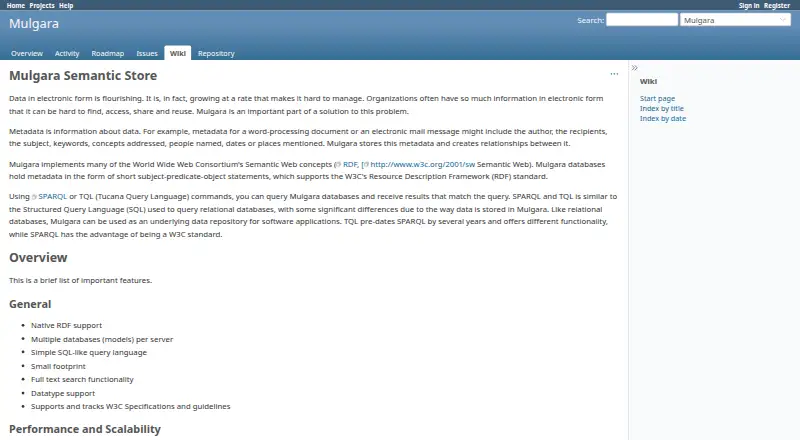
Mulgara is a semantic store for saving metadata and connecting related information. It records data as RDF subject-predicate-object statements, which users can query with SPARQL or TQL. Listed capabilities include native RDF support, reasoning, federated queries, full-text search, datatype support, and multiple databases on one server. Supported RDF formats are RDF/XML, N-Triples, and N3.
It can run as a standalone server or as a WAR in a Java web server. A default standalone setup includes a web interface, SPARQL and TQL HTTP services, web services, and a tutorial; REST interfaces are also available. TQL supports create, read, update, and delete operations, while SPARQL is query-only. Other listed capabilities include streamed query results, on-disk joins, large storage capacity, low memory requirements, clustering, fail-over, and transaction support. Mulgara is free and open source under Open Software License v. 3.0. Downloads include binary and source archives, with v2.1.13 named as the latest release.
Who it suits
Mulgara suits teams and developers working with RDF metadata who need SPARQL or TQL queries, reasoning, or federated queries. It is also relevant when a self-hosted server, web interface, and multiple deployment options fit the environment.
What it does well
- Stores RDF statements and supports SPARQL and TQL queries.
- Supports RDF/XML, N-Triples, and N3.
- Includes full-text search, datatype support, and reasoning.
- Offers standalone and Java web-server deployment.
- Lists clustering, fail-over, and transaction support.
What to know first
- SPARQL REST access is query-only; CRUD operations use TQL.
- The project warns that development Subversion files may be unstable.
Getting started
- Open the Mulgara project website.
- Choose a binary or source archive from the downloads page.
- Run Mulgara as a standalone server or deploy its WAR in a Java web server.
- Use the standalone web interface or connect through its SPARQL or TQL interfaces.
Verdict
Choose Mulgara for a free, self-hosted RDF store with SPARQL and TQL, reasoning, and federated query support. Look elsewhere if you need CRUD operations through SPARQL rather than TQL.
Questions
How much does Mulgara cost?
Mulgara is listed as free and open source.
Which RDF formats does it support?
The supported formats listed are RDF/XML, N-Triples, and N3.
Can it perform create, update, and delete operations?
Yes. The TQL REST interface permits CRUD operations; the SPARQL REST interface is query-only.
How can Mulgara be deployed?
It can run as a standalone server or as a WAR deployed in a Java web server.
What license does Mulgara use?
The project says its source code is licensed under Open Software License v. 3.0, compatible with the MPL license under which it was originally released.
Facts from Mulgara's own pages
- Administration
- The overview describes near-zero administration and web-based configuration and monitoring tools. · code.mulgara.org, 8 Oct 2026
- Connectivity
- Listed connectivity options include Sesame SAIL API, JRDF, SOAP, HTTP, and an SDK. · code.mulgara.org, 8 Oct 2026
- Deployment
- Mulgara can be run as a standalone server or deployed as a WAR in a Java web server. · code.mulgara.org, 7 Oct 2026
- Download
- The downloads page names v2.1.13 as the latest release and offers binary and source archives. · code.mulgara.org, 7 Oct 2026
- Downloads
- The downloads page names v2.1.13 as the latest release and offers binary, full binary, and source archives. · code.mulgara.org, 8 Oct 2026
- Features
- The overview lists native RDF support, full-text search, datatype support, and multiple databases per server. · code.mulgara.org, 8 Oct 2026
- Import and export
- The TQL export command supports RDF/XML and N-Triples, while load supports compressed ZIP and gzip files as well as uncompressed files. · code.mulgara.org, 8 Oct 2026
- License
- The project page says Mulgara source code is licensed under the Open Software License, version 3.0. · code.mulgara.org, 8 Oct 2026
- Notable limitation
- The downloads page says development Subversion files may not be stable and should be accessed only by people actively developing the code. · code.mulgara.org, 8 Oct 2026
- Platforms
- The overview lists Windows NT, Windows 2000 and XP, UNIX, Linux, Solaris, Mac OS X, and IRIX. · code.mulgara.org, 8 Oct 2026
- Purpose
- Mulgara stores metadata and creates relationships between it. · code.mulgara.org, 8 Oct 2026
- RDF and queries
- It stores metadata as RDF subject-predicate-object statements and supports SPARQL and TQL queries. · code.mulgara.org, 8 Oct 2026
- Reliability
- The overview lists full transaction support, clustering, store-level fail-over, and permanent integrity. · code.mulgara.org, 7 Oct 2026
- REST interfaces
- A standalone server provides SPARQL and TQL REST interfaces, and the TQL interface permits CRUD operations while SPARQL is query-only. · code.mulgara.org, 7 Oct 2026
- Scale
- The overview lists large storage capacity, multi-processor support, low memory requirements, on-disk joins, and streamed query results. · code.mulgara.org, 8 Oct 2026
- Support
- The project site invites users to create an account to log tickets and interact with developers, and asks registrants to message the mailing list afterward. · code.mulgara.org, 7 Oct 2026
- Support and community
- The project home invites users to create an account to log tickets and interact with developers, then asks them to message the mailing list after registering. · code.mulgara.org, 8 Oct 2026
- Transactions
- The overview lists full transaction support, clustering, store-level fail-over, and permanent integrity. · code.mulgara.org, 8 Oct 2026
- Web interface
- A default standalone server configuration includes a Web UI, SPARQL HTTP service, TQL HTTP service, web services, and a tutorial. · code.mulgara.org, 8 Oct 2026
- Web services
- A default standalone server configuration provides a SPARQL HTTP service, TQL HTTP service, web services, user interface, and tutorial. · code.mulgara.org, 7 Oct 2026
Where Mulgara stands on Freedom251
- RDF Databases#17 of 26