Freedom251 › Transactional email services

Postmark
by Postmark
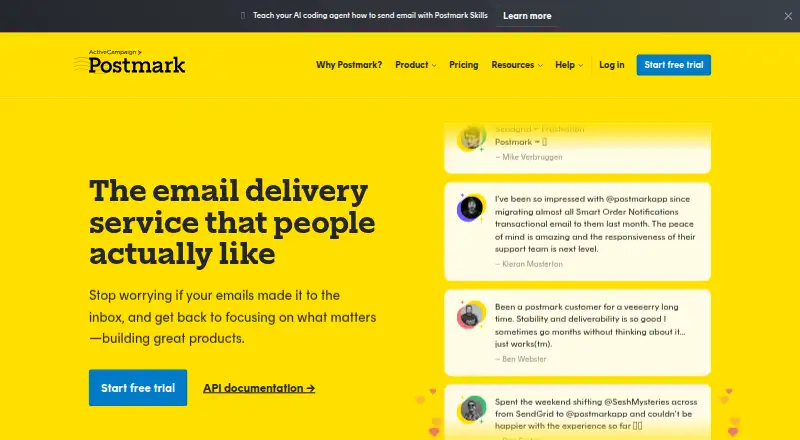
What Postmark is
Postmark delivers and tracks application email as an alternative to SMTP or Sendmail. It separates transactional and broadcast messages into different Message Streams and IP infrastructure. Developers can send through a REST API, SMTP, or multi-region SMTP routing, and official libraries cover Node.js, Python, Rails, Ruby, PHP, and .NET. Postmark can also process inbound email into JSON and send it to a webhook URL. Tracking covers delivery, bounces, spam, opens, and links, with event webhooks. Editable responsive templates are available for transactional messages such as password resets, receipts, and invitations. The free Developer plan provides 100 emails per month, has no overages, and never expires. Basic starts at $15.00 per month, billed monthly, and includes 10,000 emails per month; additional email costs $1.80 per 1,000. Unused emails do not carry into the next billing period, and extra paid-plan emails are calculated at the billing-cycle end. Postmark supports web and API access. Basic allows up to four users, while Pro permits up to six and Platform has unlimited users.
Who it suits
Postmark suits developers who need to send and track application email through an API or SMTP. Its inbound processing, templates, and webhooks may also suit teams building email into application workflows.
What it does well
- Free plan never expires and allows 100 emails monthly.
- Supports REST API, SMTP, and multi-region SMTP routing.
- Separates transactional and broadcast email infrastructure.
- Inbound email can be delivered to a webhook as JSON.
- Customer success support is included without a premium fee.
What to know first
- The free plan does not allow overages.
- Unused emails do not carry into the next billing period.
- Annual plans are not currently offered.
- Email messages are limited to 10 MB and 50 recipients.
Limits
The free plan is limited to 100 emails per month and does not allow overages. Basic starts at 10,000 emails per month; additional email costs $1.80 per 1,000, and full message history is retained for 45 days.
Plans
| Plan | Billed and limits | Price |
|---|---|---|
| Free | 100 emails/month · no overages · never expires | Free |
| Basic | monthly · 10,000 emails/month · extra emails $1.80 / 1,000 · 5 custom sending domains · unlimited emails/day · 45-day data retention | $15 a month |
| Pro | monthly · 10,000 emails/month · extra emails $1.30 / 1,000 · 10 custom sending domains · unlimited emails/day · retention up to 365 days · inbound email processing | $16.50 a month |
| Platform | monthly · 10,000 emails/month · extra emails $1.20 / 1,000 · unlimited custom sending domains · unlimited emails/day · retention up to 365 days · inbound email processing | $18 a month |
| DMARC monitoring | Starts at $14 /month per domain | $14 a month |
| Custom activity retention | Starts at $5 /month | $5 a month |
| Dedicated IP | Starts at $50 /month per IP | $50 a month |
| High-volume plans | — | On request |
As postmarkapp.com lists them, read 28 Sept 2026. The maker's own page has the final word.
Getting started
- Open the Postmark website and create an account.
- Start with the free Developer plan or select a paid plan.
- Connect using the REST API, SMTP or multi-region SMTP routing.
- Use an official library for a supported development platform.
- Configure event webhooks for delivery updates, if needed.
- Use an editable responsive template or create one in the editor.
Overview
Postmark is application email infrastructure for developers who need to send and track product messages, process incoming email, or keep promotional mail apart from transactional traffic. Its clearest advantage is that separation, paired with API and SMTP delivery; the trade-off is a small free allowance and extra charges when paid-plan volume runs over quota.
Key features
Teams can send through a REST API, SMTP, or multi-region SMTP routing. Official libraries cover Node.js, Python, Rails, Ruby, PHP, and .NET, with additional support for TypeScript, Java, Craft, WordPress, Grunt, and Zapier Actions. Migration guides, dynamic API documentation, and event webhooks support integration work, while official connections include Slack, Zapier, Stripe, WordPress, Supabase, Bubble, Craft CMS, Netlify, and Gravity Forms.
Separate Message Streams and IP infrastructure keep transactional email apart from broadcast campaigns. That is useful when password resets and receipts need a distinct sending path from promotional messages. Postmark also turns incoming email into JSON and posts it to a webhook, making inbound handling part of the same service.
Responsive templates cover common transactional messages, including welcome emails, password resets, receipts, invoices, and invitations; an editor and import tool are provided. Tracking covers delivery, bounces, spam, opens, and links, with event webhooks for downstream workflows. Message content is retained for 45 days by default; custom retention starts at $5 per month and is available on Pro or higher.
The documented ceiling is 10 MB per message, including headers, content, and attachments, and 50 recipients across To, CC, and BCC. Those limits matter for applications sending large attachments or distributing one message to many recipients. Postmark claims transactional messages can send up to four times faster than other providers, but that is its own performance claim rather than a guarantee.
Security measures include TLS and HTTPS, DKIM, SPF, DMARC, two-factor authentication, API permissions, penetration testing, and DDoS protection. Postmark says its primary data and servers use Deft and AWS, with redundant API, SMTP, inbound, and web servers; its Deft data center is SOC 2 Type 2 accredited. Support is offered by email, live chat, and one-on-one calls, without a separate premium-support fee. The company reports a 95% customer happiness rating and says it has delivered billions of emails since 2010.
Pricing
The free Developer plan costs nothing and provides 100 emails per month, with no overages and no expiration. It is a lasting option for a small integration or low-volume use, not a trial of production-scale sending: once the allowance is used, extra messages cannot be purchased on this tier. The free trial requires no credit card.
Paid plans start at $15 a month, billed monthly, for Basic. Basic starts at 10,000 emails per month, charges $1.80 per additional 1,000, and includes five custom sending domains, unlimited emails per day, 45-day retention, and up to four users. It suits a small team that needs a modest monthly allowance and standard retention, but extra volume costs more than on higher tiers.
Pro costs $16.50 a month, billed monthly, and starts at 10,000 emails per month; extra emails cost $1.30 per 1,000. It raises the domain allowance to ten, supports up to six users, extends retention to as much as 365 days, and adds inbound email processing. For only $1.50 more than Basic at the starting price, it is the more compelling fit when inbound handling or longer history matters.
Platform costs $18 a month, billed monthly, with 10,000 emails included and extra emails at $1.20 per 1,000. It adds unlimited custom sending domains and unlimited users while keeping up to 365-day retention and inbound processing. It is the tier for organizations needing broader team or domain capacity; smaller teams may not need those allowances. All paid plans allow unlimited emails per day, but unused monthly emails do not roll over and overage charges are calculated at the billing cycle's end.
Dedicated IPs start at $50 per month per IP, require Pro or higher, and are available to customers sending at least 300,000 emails monthly. DMARC monitoring starts at $14 per month per domain. High-volume plans use custom pricing. Annual billing is not offered.
Platforms
Postmark is available through web and API access. Its iOS app was sunset in June 2025 and is no longer supported.
Who it's for
Postmark is a strong fit for developers building application email workflows who value separate transactional and promotional streams, inbound webhook processing, and detailed delivery events. The free tier is suitable for a small-volume start, while teams sending beyond 100 emails monthly need to budget for a paid plan. It is less attractive for cost-sensitive senders with highly variable volume, since unused quota expires monthly and overages are billed.
Pros and cons
- Pro: Separate infrastructure for transactional and broadcast traffic helps keep product-critical mail apart from promotions.
- Pro: API, SMTP, inbound JSON webhooks, templates, and event tracking cover several stages of an application's email workflow.
- Pro: Pro adds inbound processing and extended retention for just $1.50 more than Basic at the starting monthly price.
- Con: The permanent free tier stops at 100 emails monthly and does not allow overages, limiting its usefulness beyond evaluation or very small workloads.
- Con: Paid-plan quotas reset each billing period, and extra emails incur per-1,000 charges rather than carrying unused volume forward.
- Con: Messages are limited to 10 MB and 50 recipients, which constrains large attachments and broad one-message distribution.
Alternatives
For teams focused on domain authentication monitoring rather than application email delivery, EasyDMARC offers a free tier with 1,000 emails per month, one domain, 14 days of history, and one invited user.
Folderly is another option for inbox insights and real-time alerts, with free entries for two tests per month and alerting.
Choose GlockApps when spam tests and DMARC monitoring are the priority; its free tier includes two spam-test credits, 10,000 DMARC messages, unlimited DMARC domains, five uptime monitors, one IP reputation monitor, and one user.
Microsoft SNDS is a free web service for senders who need to view IP data and manage feedback-loop settings.
Suped offers a free monitoring option with 1,000 emails per month, one domain, 14-day data retention, unlimited users, and email support.
TrueSend is an alternative with a stated free plan allowance of 6,000 emails per month and two sending domains.
Unspam.email offers no-account spam tests, inbox placement checks, and device previews with 24-hour data retention.
Warmforge is an alternative for email warm-up, with a paid Email Warm Up plan starting at $10.00 per month, billed quarterly.
Explore more options in Email Deliverability Software and Transactional Email Software.
Verdict
Choose Postmark if your product needs developer-oriented email delivery with clear separation between transactional and promotional sending, useful inbound processing, and event-level tracking. The main reason to look elsewhere is cost sensitivity at scale: the free allowance is narrow, paid usage can incur overages, and monthly quota does not carry forward.
Verdict
Postmark offers application email delivery, tracking, and inbound processing with a permanent but limited free tier. Compare paid-plan email allowances and overage rates, and account for the stated message size and recipient limits.
Questions
Is Postmark free?
Yes. Its free Developer plan includes 100 emails per month, has no overages and does not expire.
How much does Basic cost?
Basic costs $15 a month and starts at 10,000 emails per month. Extra emails cost $1.80 per 1,000.
Which sending methods does Postmark support?
It supports REST API, SMTP and multi-region SMTP routing.
Can Postmark process inbound email?
Yes. It converts inbound email into a JSON object and posts it to a webhook URL. Inbound processing is included in Pro and Platform.
Which developer libraries are supported?
Official libraries cover Node.js, Python, Rails, Ruby, PHP and .NET.
Does Postmark have an iOS app?
Its iOS app was sunset in June 2025 and is no longer supported.
Facts from Postmark's own pages
- Annual billing
- Annual plans are not currently offered. · postmarkapp.com, 27 Sept 2026
- Overage billing
- Paid-plan extra emails are calculated at the end of the billing cycle. · postmarkapp.com, 27 Sept 2026
- Company history
- Postmark says it has delivered billions of emails since 2010. · postmarkapp.com, 27 Sept 2026
- Customer support
- Customer success support is included without an extra premium-support fee. · postmarkapp.com, 27 Sept 2026
- Dedicated IP option
- Yes · postmarkapp.com, 23 Sept 2026
- Sending methods
- Postmark supports REST API, SMTP, and multi-region SMTP routing. · postmarkapp.com, 27 Sept 2026
- Activity retention
- Full message content history is retained for 45 days by default, with customization available. · postmarkapp.com, 27 Sept 2026
- Delivery speed
- Postmark says it sends transactional emails up to four times faster than other providers. · postmarkapp.com, 28 Sept 2026
- Developer libraries
- Postmark officially supports TypeScript, Python, Rails, Ruby, .NET, Java, PHP, Craft, Node.js, WordPress, Grunt, and Zapier Actions. · postmarkapp.com, 28 Sept 2026
- Email types
- Postmark separates transactional and broadcast email into different Message Streams and IP infrastructure. · postmarkapp.com, 28 Sept 2026
- Certifications encryption
- The provided text does not state encryption details or security certifications. · postmarkapp.com, 27 Sept 2026
- Founded
- 2010 · postmarkapp.com, 23 Sept 2026
- Free tier
- Every new account starts with a free Developer plan offering 100 emails per month. · postmarkapp.com, 27 Sept 2026
- Free plan
- Yes · postmarkapp.com, 23 Sept 2026
- Free tier duration
- The free plan does not expire or run out. · postmarkapp.com, 27 Sept 2026
- Free tier limit
- The free plan does not allow overages. · postmarkapp.com, 27 Sept 2026
- Inbound processing
- Postmark turns inbound email into a JSON object and posts it to a webhook URL. · postmarkapp.com, 28 Sept 2026
- Infrastructure
- Postmark says its primary data and servers use Deft and AWS, with redundant API, SMTP, inbound, and web servers; its Deft data center is SOC 2 Type 2 accredited. · postmarkapp.com, 28 Sept 2026
- Integrations
- Official integrations include Slack, Zapier, Stripe, WordPress, Supabase, Bubble, Craft CMS, Netlify, and Gravity Forms. · postmarkapp.com, 28 Sept 2026
- Integration support
- Postmark provides official SDKs, migration guides, dynamic API documentation, and event webhooks. · postmarkapp.com, 27 Sept 2026
- iOS availability
- Postmark states that its iOS app was sunset in June 2025 and is no longer supported. · postmarkapp.com, 28 Sept 2026
- Message limit
- The developer documentation states a maximum of 10 MB per email, including content, headers, and attachments. · postmarkapp.com, 28 Sept 2026
- Message streams
- Promotional and transactional emails use separate sending infrastructure. · postmarkapp.com, 27 Sept 2026
- Monthly send limit
- 10000 · postmarkapp.com, 23 Sept 2026
Where Postmark stands on Freedom251
- Transactional email services#2 of 41
- Notification Infrastructure Software#3 of 15
- Email Analytics#2 of 10
- Transactional Email Software#17 of 41
- Email Deliverability Software#13 of 31
- Proactive Notification Software#10 of 21
- Email APIs#18 of 31