Freedom251 › Transactional email services

Plunk
What Plunk is
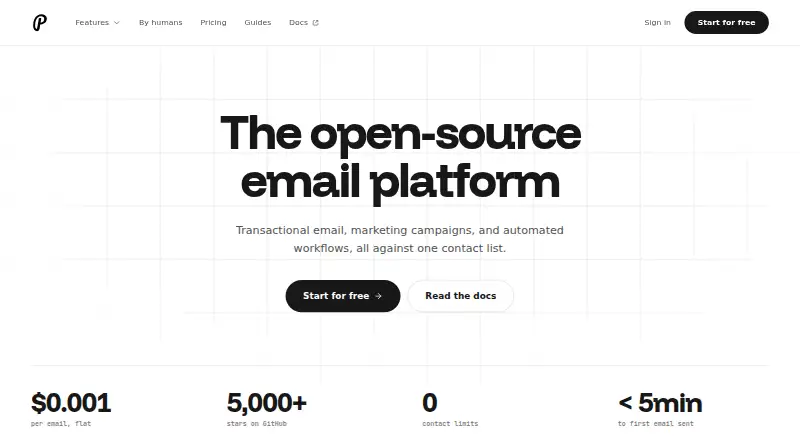
Plunk is an open-source email platform for transactional messages, marketing campaigns and automated workflows built around one contact list. Developers can send event-driven email, such as receipts or password resets, through its API or SMTP. Workflows can respond to product events with delays, conditions, branches, email steps and outbound webhooks. Campaigns can address a full list or a segment, with tracking for opens, clicks, bounces and unsubscribes.
Plunk also supports inbound email: an MX record can route parsed message content as JSON to an endpoint, and inbound messages can trigger workflows. Its integration options include a REST API, Node.js and Python SDKs, SMTP, webhooks and an MCP server compatible with clients such as Claude Code, Claude Desktop and Cursor. The AGPL-3.0 platform can be deployed on customer infrastructure using Docker Compose, or used as a hosted service. The free plan allows 1,000 emails per month; the Pay as you grow option is $0.00 per month, bills for usage and has no monthly fees or commitments. The maker describes Plunk as an independent SaaS run by one person, with a Discord community for users.
Who it suits
Plunk suits developers sending transactional messages or building event-driven email workflows, as well as marketers running campaigns and teams sharing templates. Its self-hosting option may fit customers who want to deploy the AGPL-3.0 platform on their own infrastructure.
What it does well
- Transactional email delivery through API and SMTP
- Workflows support conditions, branches, delays and webhooks
- Campaigns include engagement and delivery tracking
- Inbound email can trigger workflows or reach an endpoint as JSON
- Self-hosting available with Docker Compose
What to know first
- Free plan is limited to 1,000 emails per month
- Rendered email bodies are deleted after 90 days
- Hosted-service DPA does not cover self-hosted deployments
Limits
The Free plan includes 1,000 emails per month and Plunk branding on emails. Rendered email bodies are deleted after 90 days, while stats and activity are kept.
Plans
| Plan | Billed and limits | Price |
|---|---|---|
| Free | 1,000 emails per month | Free |
| Free forever | 1,000 emails / mo · unlimited contacts · Plunk branding on emails | Free |
| Pay as you grow | per email · Unlimited emails · unlimited contacts · no Plunk branding · monthly spend cap | Free |
As useplunk.com lists them, read 23 Sept 2026. The maker's own page has the final word.
Getting started
- Visit the Plunk website
- Choose the hosted service or deploy the AGPL-3.0 platform on your infrastructure with Docker Compose
- Connect through the REST API, an SDK, SMTP, webhooks or the MCP server
- Start with the Free plan or choose Pay as you grow
Verdict
Choose Plunk if you want transactional email, campaigns and event-based workflows in one platform, with API, SMTP and self-hosting options. Look elsewhere if you need rendered email bodies retained beyond 90 days or the hosted-service DPA to cover a self-hosted deployment.
Questions
Is Plunk open source?
Yes. It is licensed under AGPL-3.0 and can be deployed on customer infrastructure with Docker Compose.
What does the free plan include?
The Free plan includes 1,000 emails per month. The Free forever listing also specifies unlimited contacts and Plunk branding on emails.
How much does Pay as you grow cost?
It is listed at $0.00 per month, with usage-based billing, no monthly fees or commitments, unlimited emails, no Plunk branding and a monthly spend cap.
Can I use Plunk through an API or SMTP?
Yes. Plunk offers a REST API, SDKs including Node.js and Python, SMTP support, webhooks and an MCP server.
Where is hosted-service data stored?
The DPA says primary data storage is in the EU/EEA on Hetzner infrastructure. Email delivery may transit non-EU regions through AWS SES.
Does the DPA cover self-hosted Plunk?
No. The DPA applies to Plunk's hosted service and says self-hosted deployments are not covered.
Facts from Plunk's own pages
- Campaigns and analytics
- Campaigns can target a full list or segment, with tracking for opens, clicks, bounces, and unsubscribes. · useplunk.com, 8 Oct 2026
- Compliance scope
- The DPA applies to Plunk's hosted service and says self-hosted deployments are not covered by it. · useplunk.com, 8 Oct 2026
- Data residency
- The DPA states that primary data storage is in the EU/EEA on Hetzner infrastructure, while email delivery may transit non-EU regions through AWS SES. · useplunk.com, 8 Oct 2026
- Data security
- The DPA describes HTTPS-only API access using TLS 1.2+, encrypted database connections, limited-expiry authentication tokens, rate limiting, and project-level data isolation. · useplunk.com, 8 Oct 2026
- Free plan
- Yes · useplunk.com, 23 Sept 2026
- Inbound email
- One MX record enables inbound email at the domain, with parsed message content delivered to an endpoint as JSON and inbound messages able to trigger workflows. · useplunk.com, 8 Oct 2026
- Integrations
- Plunk offers a REST API, SDKs including Node.js and Python, SMTP support, webhooks, and an MCP server that works with MCP clients such as Claude Code, Claude Desktop, and Cursor. · useplunk.com, 8 Oct 2026
- Notable limit
- Rendered email bodies are deleted after 90 days, while stats and activity are kept. · useplunk.com, 8 Oct 2026
- Product
- Plunk is an open-source email platform for transactional email, marketing campaigns, and automated workflows against one contact list. · useplunk.com, 8 Oct 2026
- Self-hosting
- The AGPL-3.0 licensed platform can be deployed on the customer's infrastructure using Docker Compose. · useplunk.com, 8 Oct 2026
- Support
- The maker invites customer feedback and lists a Discord community on its site. · useplunk.com, 8 Oct 2026
- Transactional email
- It supports API and SMTP delivery for receipts, password resets, and other event-driven email. · useplunk.com, 8 Oct 2026
- Who it is for
- The maker describes Plunk as an independent SaaS run by a person, and its editor page describes use by developers, marketers, and teams sharing templates. · useplunk.com, 8 Oct 2026
- Workflows
- Workflows start from product events and can include delays, conditions, branches, email steps, and outbound webhooks. · useplunk.com, 8 Oct 2026
Where Plunk stands on Freedom251
- Transactional email services#1 of 41
- Transactional Email Software#9 of 41
- Email APIs#13 of 31