Freedom251 › Infrastructure Policy as Code Tools
PolicyForge
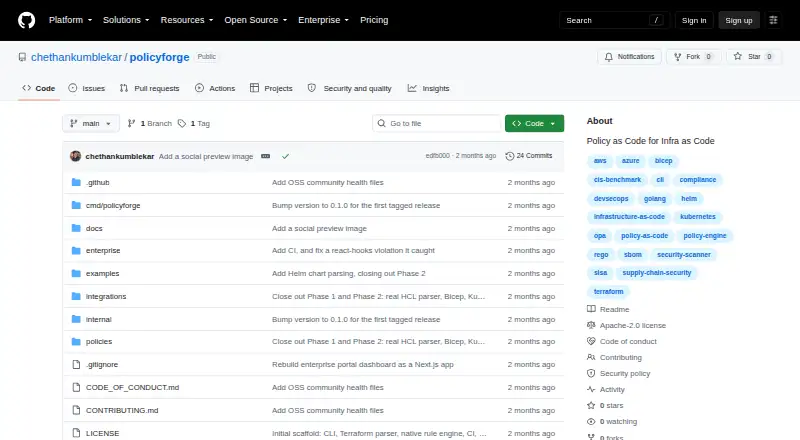
What PolicyForge is
PolicyForge is an open-source scanner that checks infrastructure-as-code against policy rules. It accepts Terraform, Bicep, Kubernetes manifests, and Helm charts through one resource model, with OPA/Rego policies evaluated by OPA. The policy engine is embedded at build time, so scans do not require a network connection. Teams can provide additional .rego files at scan time with --policy-dir, avoiding a fork or rebuild. The project lists 11 built-in rules covering Azure CIS Foundations, AWS, and Kubernetes Pod Security. Every scan generates a software bill of materials, and the project supports SLSA provenance predicates plus cosign signing and attestations. For Azure, drift checks compare declared code with live Resource Graph state, limited to resource types and attributes understood by its rules. CI/CD integrations include a GitHub Action that uploads SARIF to GitHub code scanning and an Azure DevOps task that publishes SARIF as a build artifact. An optional self-hosted portal adds dashboards, audit trails, organization-wide policy management, and SOC2/PCI rollups. Portal ingestion uses HTTP Basic Auth, with per-user OIDC or Entra ID SSO when configured. The scanner, rule packs, and integrations are Apache 2.0; the portal is source-available under that license.
Who it suits
It is aimed at teams enforcing policy across infrastructure-as-code, especially organizations using Azure and Bicep alongside Terraform, Kubernetes, or Helm. Security and platform teams can integrate scans into GitHub or Azure DevOps pipelines and optionally run the self-hosted portal.
What it does well
- Open-source Apache 2.0 core
- Supports Terraform, Bicep, Kubernetes, and Helm
- Offline scans with embedded OPA evaluation
- Add Rego rules without rebuilding
- Generates an SBOM on every scan
- GitHub Actions and Azure DevOps integrations
What to know first
- Helm charts require locally installed Helm
- Azure drift checks cover only understood resources and attributes
- Portal retention, attestation verification, and real multi-tenancy remain unresolved
Limits
Helm charts are warned about and skipped when the local Helm executable is unavailable. Azure drift detection is limited to resource types and attributes covered by the rules, while the portal lists retention, attestation verification, and real multi-tenancy as unresolved.
Plans
| Plan | Billed and limits | Price |
|---|---|---|
| Open source | Core scanner, rule packs, and CI/CD integrations are open source under Apache 2.0 | Free |
As github.com lists them, read 9 Oct 2026. The maker's own page has the final word.
Getting started
- Clone or install the PolicyForge project from GitHub
- Prepare Terraform, Bicep, Kubernetes, or Helm files
- Install Helm locally if charts need rendering
- Run scans with the built-in policies
- Add extra .rego files through --policy-dir when needed
- Connect the GitHub Action or Azure DevOps task
- Deploy the optional self-hosted portal if required
Verdict
Pick PolicyForge when you need an open scanner for several infrastructure-as-code formats, custom Rego rules, supply-chain outputs, and CI/CD reporting. Plan for a local Helm installation when scanning charts, and assess the portal's unresolved questions before relying on it for enterprise governance.
Questions
What does PolicyForge scan?
It scans Terraform, Bicep, Kubernetes manifests, and Helm charts through a unified resource model.
Which policy language does it use?
Policies are written in OPA/Rego and evaluated by OPA.
Is PolicyForge free and open source?
The core scanner, rule packs, and CI/CD integrations are free and open source under Apache 2.0. The self-hosted portal is source-available under the same license.
Does it work in CI/CD systems?
Yes. A GitHub Action uploads SARIF to GitHub code scanning, and an Azure DevOps task publishes SARIF as a build artifact.
What does the portal provide?
The optional self-hosted portal offers a dashboard, audit trail, organization-wide policy management, and SOC2/PCI compliance rollups. It supports HTTP Basic Auth for ingestion and configurable OIDC or Entra ID SSO per user.
What happens without Helm?
PolicyForge warns and skips Helm charts it finds when Helm is not installed locally.
Facts from PolicyForge's own pages
- Built-in policies
- The project lists 11 built-in rules covering Azure CIS Foundations, AWS, and Kubernetes Pod Security. · github.com, 9 Oct 2026
- CI/CD integrations
- The repository describes a GitHub Action that uploads SARIF to GitHub code scanning and an Azure DevOps task that publishes SARIF as a build artifact. · github.com, 9 Oct 2026
- Custom rules
- Users can add `.rego` rules at scan time with `--policy-dir` without forking or rebuilding. · github.com, 9 Oct 2026
- Drift detection
- It compares declared infrastructure code with live Azure state through Resource Graph, limited to resource types and attributes its rules understand. · github.com, 9 Oct 2026
- Enterprise portal
- An optional self-hosted portal provides a dashboard, audit trail, org-wide policy management, and SOC2/PCI compliance rollups. · github.com, 9 Oct 2026
- Intended users
- The project is aimed at teams scanning infrastructure-as-code, with Azure and Bicep given first-class support alongside Terraform, Kubernetes, and Helm. · github.com, 9 Oct 2026
- License and availability
- The core scanner, rule packs, and CI/CD integrations use Apache 2.0, and the self-hosted enterprise portal is source-available under the same license. · github.com, 9 Oct 2026
- Policy engine
- Policy rules are Rego evaluated by OPA and embedded at build time; scans have no network dependency. · github.com, 9 Oct 2026
- Portal authentication
- The portal uses HTTP Basic Auth for ingestion and supports per-user OIDC or Entra ID SSO when configured. · github.com, 9 Oct 2026
- Portal limitations
- The repository lists retention policy, attestation verification, and real multi-tenancy as unresolved portal questions. · github.com, 9 Oct 2026
- Purpose
- PolicyForge is an open-source policy-as-code scanner for infrastructure-as-code. · github.com, 9 Oct 2026
- Runtime requirements
- Helm charts are rendered through a locally installed `helm template`; without Helm, PolicyForge warns and skips charts it finds. · github.com, 9 Oct 2026
- Supply chain
- It generates an SBOM on every scan and supports SLSA provenance predicates and cosign signing and attestations. · github.com, 9 Oct 2026
- Supported formats
- It scans Terraform, Bicep, Kubernetes manifests, and Helm charts through a unified resource model. · github.com, 9 Oct 2026
Where PolicyForge stands on Freedom251
- Infrastructure Policy as Code Tools#15 of 25