Freedom251 › Infrastructure Policy as Code Tools
KubeLinter
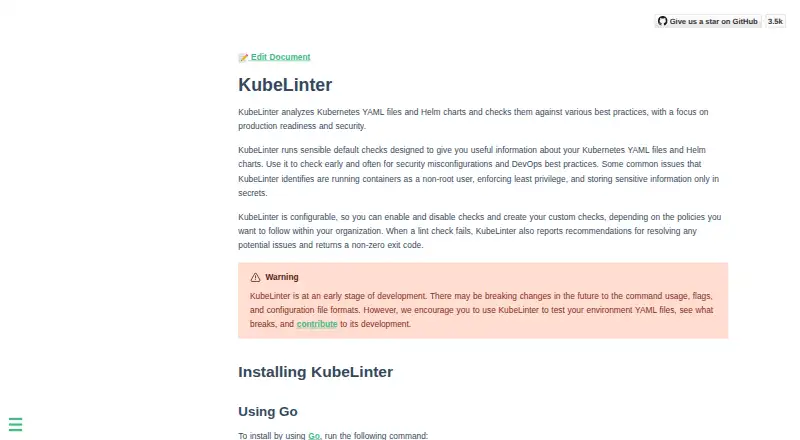
What KubeLinter is
KubeLinter checks Kubernetes configuration files for practices tied to production readiness and security. It analyzes Kubernetes YAML, Helm chart directories, and Kustomize directories, with default checks that include whether containers run as non-root, least privilege is enforced, and sensitive information is kept in secrets. Teams can turn checks on or off and define custom checks to reflect their own policies, using YAML configuration and CEL expressions.
When a check fails, KubeLinter provides remediation recommendations and returns a non-zero exit code, so its findings can feed into automated workflows. Results can be written as plain text, JSON, or SARIF, with more than one format produced in a single run. The project documents use with pre-commit hooks, a Docker-based pre-commit hook, and a GitHub Action for CI. Installation routes include Go, release binaries, Homebrew or LinuxBrew, nix-shell, and Docker. Its container images are signed with cosign, and a public key is available for verification. KubeLinter is an Apache License 2.0 project created by StackRox and now powered by Red Hat.
Who it suits
KubeLinter suits teams that maintain Kubernetes YAML, Helm charts, or Kustomize manifests and want checks for security and production practices. It can fit workflows using pre-commit hooks or GitHub Actions, as well as teams that need custom policies and machine-readable reports.
What it does well
- Checks Kubernetes YAML, Helm, and Kustomize inputs.
- Default checks cover non-root containers and least privilege.
- Custom checks can reflect organizational policies.
- Outputs plain text, JSON, and SARIF.
- Failed checks include remediation advice and a non-zero exit code.
- Apache License 2.0; free plan.
What to know first
- Command usage, flags, and configuration formats may change.
- Runs on Linux and macOS, or as self-hosted software.
Limits
The project notes that command usage, flags, and configuration file formats may change. The listed plan is free under the Apache License 2.0.
Plans
| Plan | Billed and limits | Price |
|---|---|---|
| KubeLinter | Apache License 2.0 | Free |
As docs.kubelinter.io lists them, read 5 Oct 2026. The maker's own page has the final word.
Getting started
- Open the KubeLinter documentation website.
- Choose an installation route: Go, release binary, Homebrew or LinuxBrew, nix-shell, or Docker.
- Point it at Kubernetes YAML files, a Helm chart directory, or a Kustomize directory.
- Choose or configure checks, then select plain text, JSON, or SARIF output.
- Add it to a documented pre-commit hook or GitHub Action workflow if useful.
Verdict
Choose KubeLinter if you want configurable checks for Kubernetes manifests and findings that can be used in CI. Consider the documented possibility of changes to commands, flags, and configuration formats when building workflows around it.
Questions
How much does KubeLinter cost?
The listed plan is free, under the Apache License 2.0.
What files can it check?
It can lint Kubernetes YAML files, Helm chart directories, and Kustomize directories.
What platforms does it support?
The listed platforms are Linux, macOS, and self-hosted.
Can teams customize its checks?
Yes. Users can enable or disable checks and create custom checks using YAML configuration and CEL expressions.
What report formats are available?
Plain text, JSON, and SARIF are supported, including multiple formats in one run.
Who created KubeLinter?
The repository says StackRox created it and Red Hat now powers it.
Facts from KubeLinter's own pages
- Custom policies
- Users can enable or disable checks and create custom checks to match organizational policies. · github.com, 5 Oct 2026
- Default checks
- Its default checks cover issues such as running containers as non-root, enforcing least privilege, and storing sensitive information only in secrets. · github.com, 5 Oct 2026
- Findings
- When a lint check fails, KubeLinter reports remediation recommendations and returns a non-zero exit code. · github.com, 5 Oct 2026
- Image verification
- KubeLinter container images are signed with cosign, and the project provides a public key for verification. · github.com, 5 Oct 2026
- Input types
- KubeLinter can lint Kubernetes YAML files, Helm chart directories, and Kustomize directories. · github.com, 5 Oct 2026
- Installation
- The project documents installation using Go, release binaries, Homebrew or LinuxBrew, nix-shell, and Docker. · github.com, 5 Oct 2026
- Integrations
- The project documents use with pre-commit hooks, a Docker-based pre-commit hook, and a GitHub Action for CI. · github.com, 5 Oct 2026
- License
- KubeLinter is licensed under the Apache License 2.0. · github.com, 5 Oct 2026
- Maker
- The repository says KubeLinter was created by StackRox and is now powered by Red Hat. · github.com, 5 Oct 2026
- Notable limitation
- The project notes that command usage, flags, and configuration file formats may change in the future. · github.com, 5 Oct 2026
- Report formats
- It supports plain text, JSON, and SARIF output, including writing multiple formats in one run. · github.com, 5 Oct 2026
- Security reporting
- The security policy directs people reporting vulnerabilities to Red Hat's Product Security team for confidential disclosure. · github.com, 5 Oct 2026
- Support and community
- The project points users to its Slack workspace to engage with maintainers and other users. · github.com, 5 Oct 2026
- What it does
- KubeLinter statically analyzes Kubernetes YAML, Helm charts, and Kustomize manifests for best practices, production readiness, and security. · github.com, 5 Oct 2026
Where KubeLinter stands on Freedom251
- Infrastructure Policy as Code Tools#11 of 25