Freedom251 › Podcast Transcription Software
Podlog
What Podlog is
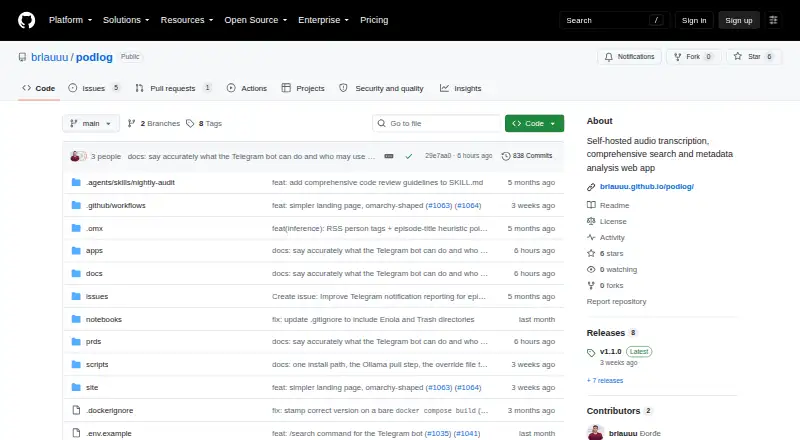
Podlog is a self-hosted web app for building a searchable audio transcript library and examining podcast metadata. It accepts podcast episodes from RSS feeds and audio files uploaded through its web interface. WhisperX transcribes audio, and speaker diarization can run locally; an optional paid pyannote.ai cloud model is also available for diarization. Search combines full-text keyword matching with pgvector semantic similarity. Ask AI streams answers with citations drawn from the transcript library, using local Ollama by default or optional Fireworks inference. Listeners can play audio from transcript timestamps, then export transcripts or search results as Markdown or plain text. Its Meta-Analysis dashboard reports speaker minutes, word counts, and host-versus-guest talking-time differences across feeds. Podlog can send Telegram and email notifications, and an optional Telegram bot supports searches, questions, transcript access, queue checks, and adding sources. The project describes its default setup as local-first, with no accounts, cloud, or telemetry by default. It is free and open source, and the repository credits @brlauuu as its builder. Installation requires Docker Compose V2 and a Hugging Face access token; using diarization also requires accepting the pyannote model license.
Who it suits
Podlog suits people who want to collect podcast audio, search its transcripts, and review speaker and episode metadata in a self-hosted library. It can also suit users who want transcript-based AI answers or Telegram and email notifications, provided they can meet its deployment requirements.
What it does well
- Ingests episodes from RSS feeds or uploaded audio files.
- Combines keyword search with pgvector semantic similarity.
- Provides timestamp playback and Markdown or plain-text exports.
- Reports speaker minutes, word counts, and host-versus-guest time.
- Local-first defaults include no accounts, cloud, or telemetry.
- Free and open source.
What to know first
- Installation requires Docker Compose V2 and a Hugging Face access token.
- Published container images support linux/amd64; other architectures require a source build.
- Processing is CPU-only and sequential; GPU is not required.
- The O'Saasy License bars offering it as a competing hosted or SaaS product.
Limits
The hardware guide lists 4-core x86-64 and 8 GB RAM as minimums and says processing is CPU-only and sequential. Published container images support linux/amd64; other architectures require building from source. The O'Saasy License bars offering Podlog as a competing hosted or SaaS product.
Getting started
- Open the Podlog GitHub repository.
- Prepare a system meeting the stated minimum of 4-core x86-64 and 8 GB RAM.
- Install Docker Compose V2 and obtain a Hugging Face access token.
- Accept the pyannote model license if using diarization.
- Deploy the self-hosted web app, then add podcast RSS feeds or upload audio through its web UI.
Verdict
Choose Podlog if you want a self-hosted podcast transcript library with hybrid search, speaker analysis, and cited AI answers. It is a better fit for users who can manage its Docker Compose setup and hardware requirements; other architectures require building from source, and its license bars competing hosted or SaaS offerings.
Questions
Is Podlog free?
Yes. Its pricing model is free, and the project is open source.
Where can I use Podlog?
Podlog is a self-hosted web app. Published container images support linux/amd64; other architectures require building from source.
Does Podlog support speaker labels?
Yes. It supports local speaker diarization, and an optional paid pyannote.ai cloud model is available. Users must accept the pyannote model license for diarization.
How does search work?
Hybrid search combines full-text keyword search with pgvector semantic similarity.
Does Podlog send transcript data to a cloud service?
The project describes its default setup as local-first, with no accounts, cloud, or telemetry by default. Fireworks inference is optional, as is the paid pyannote.ai cloud model for diarization.
Who built Podlog?
The repository credits @brlauuu as the builder.
Facts from Podlog's own pages
- Analytics
- The Meta-Analysis dashboard reports speaker minutes, word counts, and host-versus-guest talking-time differences across feeds. · github.com, 4 Oct 2026
- Ask AI
- Ask AI provides streamed, citation-backed answers from the transcript library, using local Ollama by default or optional Fireworks inference. · github.com, 9 Oct 2026
- Audio input
- It can ingest episodes from RSS feeds or accept audio uploads, including MP3, M4A, WAV, OGG, FLAC, OPUS, AAC, WMA, WEBM, and MP4 files. · github.com, 9 Oct 2026
- Deployment limits
- Published images support linux/amd64 only; other architectures require building from source. · github.com, 9 Oct 2026
- Deployment requirements
- Installation requires Docker Compose V2 and a Hugging Face access token; users must accept the pyannote model license for diarization. · github.com, 4 Oct 2026
- Exports
- Users can download search results or transcripts as Markdown or plain text, or use a print-friendly view. · github.com, 9 Oct 2026
- Exports and playback
- Users can play audio from transcript timestamps and export transcripts or search results as Markdown or plain text. · github.com, 4 Oct 2026
- Hardware limits
- The hardware guide lists 4-core x86-64 and 8 GB RAM as minimums, says GPU is not required, and notes processing is CPU-only and sequential. · github.com, 4 Oct 2026
- Integrations
- Podlog supports Telegram and email notifications and an optional Telegram bot for search, questions, transcripts, queue checks, and adding sources. · github.com, 4 Oct 2026
- License
- Podlog uses the O'Saasy License, which permits use and distribution but bars offering the software as a hosted service that directly competes with the licensor. · github.com, 9 Oct 2026
- Local model storage
- The README says pulling all three local Ask AI models takes about 12 GB, and the first run downloads about 3 GB of Whisper and pyannote model weights. · github.com, 9 Oct 2026
- Maker
- The repository credits the project to @brlauuu; the linked GitHub profile identifies the maker as Đorđe. · github.com, 9 Oct 2026
- Notifications
- Podlog supports Telegram and email alerts for episode completion or failure, with optional daily or weekly digests. · github.com, 9 Oct 2026
- Platform constraint
- Published container images support linux/amd64; other architectures require building from source. · github.com, 4 Oct 2026
- Privacy
- The project describes itself as local-first, with no accounts, cloud, or telemetry, while offering optional Fireworks remote inference. · github.com, 9 Oct 2026
- Purpose
- Podlog is a self-hosted web app for audio transcription, search, and metadata analysis. · github.com, 9 Oct 2026
- Requirements
- The documented prerequisites include Docker with Compose V2, a free Hugging Face account and access token, and accepting the pyannote model license for diarization. · github.com, 9 Oct 2026
- Search
- Hybrid search combines full-text keyword search with pgvector semantic similarity. · github.com, 9 Oct 2026
- Speaker labels
- Local pyannote diarization assigns speaker labels, and the UI lets users rename or merge speakers. · github.com, 9 Oct 2026
- Telegram bot
- The optional Telegram bot can search, ask questions, fetch transcripts, check the queue, and add sources; it responds only to accounts on the configured allowlist. · github.com, 9 Oct 2026
- Transcription
- Speech-to-text uses WhisperX with large-v3-turbo by default, configurable down to tiny for low-RAM machines. · github.com, 9 Oct 2026
- Transcription and speakers
- It uses WhisperX for transcription and supports local speaker diarization, with an optional paid pyannote.ai cloud model. · github.com, 4 Oct 2026
Where Podlog stands on Freedom251
- Podcast Transcription Software#16 of 25