Freedom251 › Progressive Delivery Software
Plural
What Plural is
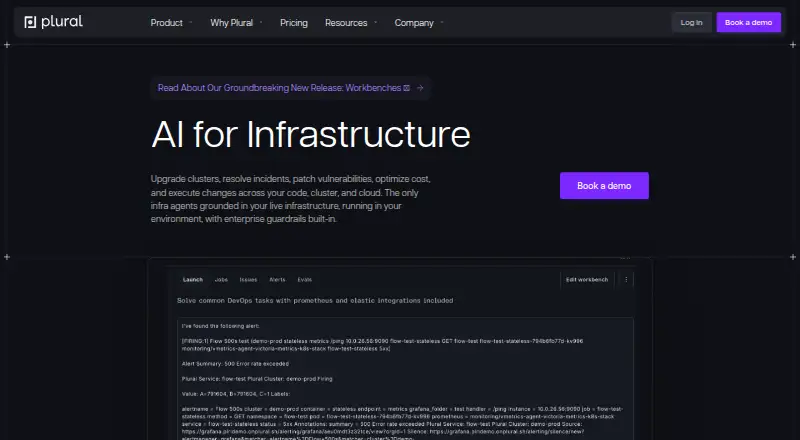
Plural is an AI infrastructure product for platform and DevOps leaders and engineers. It is designed to upgrade clusters, resolve incidents, patch vulnerabilities, optimize costs and execute changes across code, clusters and cloud. Its project-scoped Workbenches bundle an AI agent's prompt, capabilities, tools and automation triggers for infrastructure operations. Plural also maintains a live semantic graph of clusters, stacks, services and changes across an estate for agents to use as context.
Workbench integrations include Prometheus, Datadog, Loki, Elastic, Tempo, Jaeger, GitHub, GitLab, Bitbucket, Slack, Microsoft Teams, Jira and Linear. Cloud tools provide SQL-queryable access to AWS, GCP and Azure data, including billing and infrastructure services. Plural says each change reaches an existing repository as a pull request for human review. Actions are logged, permissions are bounded, tool calls and decisions are inspectable, and changes can be reviewed before confirmation.
Sandbox is free and offers a 14-day platform trial. Pro starts at $450/mo for one cluster, with each additional cluster at $250/mo, and includes a 30 day free trial. Pro uses Plural shared infrastructure. Enterprise supports shared, dedicated or on-prem hosting. Plural supports Kubernetes and offers API, Linux, macOS, self-hosted, web and Windows platforms.
Who it suits
Plural is aimed at platform and DevOps leaders and engineers who want to automate infrastructure work. It may suit teams seeking agent operations with pull requests for human review and connections to observability, code, communication and project tools.
What it does well
- Automates cluster upgrades, incident response and vulnerability patching
- Workbench integrations span monitoring, code and collaboration tools
- SQL-queryable AWS, GCP and Azure data
- Changes go through pull requests for human review
- Supports Kubernetes and multiple hosting options
What to know first
- Pro starts at $450/mo for one cluster
- Each additional Pro cluster costs $250/mo
- Pro hosting uses Plural shared infrastructure
Limits
Sandbox is free and provides a 14-day platform trial. Pro starts at $450/mo for one cluster, supports up to 10 clusters and charges $250/mo for each additional cluster; it includes a 30 day free trial.
Plans
| Plan | Billed and limits | Price |
|---|---|---|
| Sandbox | 14-day trial · Essential platform components · Upgrade anytime | Free |
| Pro | Starting at $450/mo for 1 cluster +$250/mo per additional cluster · Up to 10 clusters · Plural cloud hosting · 30 day free trial · No commitment | $450 a month |
| Enterprise | Pricing based on number of clusters and support requirements · Unlimited clusters · Shared, dedicated, or on-premises hosting · 1-hour SLA response · Dedicated success team · Customized training | On request |
As plural.sh lists them, read 15 Oct 2026. The maker's own page has the final word.
Getting started
- Visit plural.sh
- Start with the free Sandbox plan and its 14-day platform trial, or choose Pro
- For Pro, select the number of clusters; the plan starts at $450/mo for one cluster
- Choose Plural shared hosting with Pro, or discuss Enterprise hosting options
Plural is an AI platform for automating infrastructure operations across code, clusters, and cloud. It is aimed at platform and DevOps teams that want agents to handle repeatable operational work while keeping operators involved in approving changes. Its breadth and review controls make it a considered choice for infrastructure teams, though the per-cluster cost and shared Pro hosting may rule it out for some.
Overview
Plural organizes work into project-scoped Workbenches, each combining an agent’s prompt, capabilities, tools, and automation triggers. Agents can take on cluster upgrades, incident resolution, vulnerability patching, and cost optimization. That range suits teams looking to reduce operational toil across an estate; teams seeking only a focused incident-response product may find the scope broader than they need.
A live semantic graph of clusters, stacks, services, and changes gives agents context across an infrastructure estate. Plural sends each change to an existing repository as a pull request for operator review. That workflow gives teams a familiar checkpoint before changes are confirmed, while bounded permissions, action logs, and inspectable tool calls and decisions add visibility into agent activity.
Key features
Configurable operational agents
Workbench prompts, tools, capabilities, and triggers let teams shape agents around project workflows. Integrations include Prometheus, Datadog, Loki, Elastic, Tempo, Jaeger, GitHub, GitLab, Bitbucket, Slack, Microsoft Teams, Jira, and Linear. This breadth can connect infrastructure signals and team workflows in one operating environment, particularly for teams already using several of these services.
Cloud data and oversight
Plural’s cloud tools provide SQL-queryable access to AWS, GCP, and Azure data, including billing and infrastructure services. This gives agents a way to work with both operational and cost information across the major cloud providers. Changes remain reviewable before confirmation, and Plural says permissions are bounded and actions logged. The combination favors teams that want automation with a clear operator checkpoint.
Pricing
The free Sandbox plan costs nothing and provides 14 days to try the platform, with essential platform components and the option to upgrade at any time. It is a time-limited evaluation rather than a continuing free tier, so teams should expect to move to a paid plan for ongoing use.
Pro starts at $450/mo for 1 cluster, with each additional cluster costing +$250/mo. It includes up to 10 clusters, Plural shared cloud hosting, a 30 day free trial, and no commitment. Email support has a one-business-day response SLA. The cluster-based price makes the entry point easier to assess, but costs rise with each additional cluster and hosting is shared.
Enterprise has custom pricing based on cluster count and support requirements. It includes unlimited clusters, shared, dedicated, or on-prem hosting, a one-hour guaranteed response SLA, and a dedicated success team. It is the fit for organizations that need a larger cluster allowance or control over hosting, while the custom price calls for a direct pricing discussion.
Platforms
Plural supports API, Linux, macOS, self-hosted, web, and Windows environments, and supports Kubernetes. Its deployment model includes both hosted and self-hosted options: Pro uses Plural shared infrastructure, while Enterprise can be hosted on shared, dedicated, or on-prem infrastructure.
Who it's for
Plural is best suited to platform and DevOps leaders and engineers who want to automate infrastructure work across multiple systems without removing human review. Its broad integrations, cloud data access, and estate-wide context are most relevant to teams coordinating operational work across clusters and cloud services. A small team with a narrow task or a strict low-cost requirement may be better served by a focused or free alternative.
Pros and cons
- Pro: Pull requests put proposed changes into existing repositories for human review, giving operators a checkpoint before confirmation.
- Pro: Workbenches combine prompts, tools, capabilities, and triggers, supporting repeatable workflows across infrastructure tasks.
- Pro: SQL access to AWS, GCP, and Azure data brings billing and infrastructure information into the agent’s working context.
- Con: Pro starts at $450/mo for one cluster, with an additional $250/mo per cluster, which can make broader adoption costly as estates grow.
- Con: Pro is limited to 10 clusters and shared hosting; teams needing unlimited clusters or dedicated and on-prem hosting must consider Enterprise.
- Con: Sandbox is a 14-day trial, so it does not provide a continuing free plan.
Alternatives
Hermes Agent has a free plan with free models, standard rate limits, and no monthly credits, plus a $20 a month Plus plan. Consider it when a lower-cost agent plan and support for Android matter more than Plural’s infrastructure-specific Workbenches and cloud operations.
incident.io offers a free Basic plan with native Slack or Microsoft Teams incident response, single-team on-call, a status page, and essential incident automation. Choose it when incident response is the primary need and those capabilities suit the team better than a broader infrastructure operations platform.
TalkOps is free and open source, with no license, seat, or feature fees; LLM API tokens and cloud infrastructure are billed separately by their providers. It may suit teams seeking an open-source option with those cost terms.
UniDeploy offers 10 free AI requests, bring-your-own-model support, full CLI access, and community support on its free plan. Consider it when a small free request allowance and CLI access are the priority.
K8sGPT is free and open source under Apache 2.0. It is an alternative for readers seeking an open-source option.
Aerol has a free plan for up to 50 monitors with basic features and monitoring every five minutes. Consider it when that monitoring allowance fits the need.
Akmatori is free and open source under Apache 2.0, with self-hosted deployment. It is an alternative for readers seeking a self-hosted open-source option.
FireHydrant has a free plan for up to 10 responders, two runbooks, Slack and Teams chatbot, one public status page, and three integrations. Consider it when those incident-management limits match the team’s needs.
Explore AI DevOps Assistants, Progressive Delivery Software, GitOps Tools, and Kubernetes Deployment Tools to compare products by category.
Verdict
Plural is a strong fit for platform and DevOps teams that want agents to take on infrastructure work across clusters, code, and cloud while routing changes through pull requests for operator review. Its operational breadth and cloud context are the main reasons to choose it. Look elsewhere if the $450/mo starting price, per-cluster charges, or Pro’s shared hosting do not fit your team; Enterprise provides more hosting choice and unlimited clusters at custom pricing.
Verdict
Plural suits platform and DevOps teams looking to automate infrastructure operations while keeping changes reviewable by human operators. Pro is the listed paid entry point, while teams that need unlimited clusters or dedicated and on-prem hosting should consider Enterprise.
Questions
How much does Plural cost?
Sandbox is free. Pro starts at $450/mo for one cluster, with an additional $250/mo per cluster. Enterprise pricing depends on cluster count and support requirements.
Does Plural have a free plan or trial?
Sandbox is free and offers a 14-day platform trial. Pro includes a 30 day free trial.
Which platforms does Plural support?
Listed platforms are API, Linux, macOS, self-hosted, web and Windows. Plural also supports Kubernetes.
What hosting does Plural offer?
Pro uses Plural shared infrastructure. Enterprise offers shared, dedicated or on-prem hosting.
Which tools does Plural integrate with?
Workbench integrations include Prometheus, Datadog, Loki, Elastic, Tempo, Jaeger, GitHub, GitLab, Bitbucket, Slack, Microsoft Teams, Jira and Linear.
What support comes with the paid plans?
Pro includes email support with a one-business-day response SLA. Enterprise includes dedicated Slack or Teams communication and a one-hour guaranteed response SLA.
Facts from Plural's own pages
- AI troubleshooting
- The product analyzes live Kubernetes state, Terraform state, metadata, and code to produce root-cause findings and recommended fixes. · plural.sh, 15 Oct 2026
- Architecture
- Plural uses a pull-based agent architecture in which each workload cluster runs an agent that polls the control plane for changes. · docs.plural.sh, 15 Oct 2026
- Certifications
- The site displays SOC and GDPR certificates and lists SOC 2 compliance and GDPR compliance in its plan comparison. · plural.sh, 7 Oct 2026
- Cloud and cluster integrations
- Plural documents Cluster API support and integrations for EKS, AKS, GKE, Rancher, and other Kubernetes distributions. · docs.plural.sh, 15 Oct 2026
- Cloud data
- Plural's cloud tools provide SQL-queryable access to AWS, GCP, and Azure data, including billing and infrastructure services. · docs.plural.sh, 7 Oct 2026
- Cluster upgrades
- Plural checks Kubernetes manifests and add-on compatibility to help plan standardized cluster upgrades. · plural.sh, 15 Oct 2026
- Company mission
- Plural says its mission is to democratize elite DevOps capabilities by simplifying tooling complexities and accelerating software development. · plural.sh, 7 Oct 2026
- Company profile
- LinkedIn lists Plural as a privately held software-development company founded in 2021, headquartered in New York, with 11–50 employees. · linkedin.com, 15 Oct 2026
- Continuous deployment
- Services can be targeted across clusters with tags and dynamically templated configuration from Git repositories. · plural.sh, 15 Oct 2026
- Documentation depth
- The documentation covers CLI setup, cloud and self-hosted installation, cluster onboarding, GitOps, CRDs, APIs, observability, AI, policy, and multi-tenancy. · docs.plural.sh, 15 Oct 2026
- Funding
- TechCrunch reported a $6 million seed round led by Primary Venture Partners with Capital One Ventures and Company Ventures participating. · techcrunch.com, 15 Oct 2026
- Headquarters
- New York, New York, United States · plural.sh, 28 Sept 2026
- Hosting
- The Enterprise plan offers shared, dedicated, or on-prem infrastructure hosting; the Pro plan uses Plural shared infrastructure. · plural.sh, 7 Oct 2026
- Human review
- Plural says every change lands as a pull request in existing repositories for review by human operators. · plural.sh, 7 Oct 2026
- Independent pricing evidence
- TrustRadius lists no Plural pricing plans but says a free trial is available. · trustradius.com, 15 Oct 2026
- Infrastructure as code
- Plural manages Terraform, Pulumi, and Ansible stacks through Kubernetes-oriented GitOps workflows and PR-based approvals. · plural.sh, 15 Oct 2026
- Installation
- The CLI is installable through Homebrew or downloadable binaries for Linux, macOS, and Windows. · docs.plural.sh, 15 Oct 2026
- Integrations
- Workbench integrations include Prometheus, Datadog, Loki, Elastic, Tempo, Jaeger, GitHub, GitLab, Bitbucket, Slack, Microsoft Teams, Jira, and Linear. · docs.plural.sh, 7 Oct 2026
- Intended users
- Plural presents the product for platform and DevOps leaders and engineers seeking to automate infrastructure work and reduce operational toil. · plural.sh, 7 Oct 2026
- Legal entity
- An SEC Form D identifies the issuer as Plural Labs, Inc., incorporated in Delaware in 2020, with a New York principal business address. · sec.gov, 15 Oct 2026
- License
- Compiled Plural platform versions from Plural Labs are licensed under MIT; source-code use may be AGPLv3, commercial, or app.plural.sh licensed, while admin tools and configuration files use Apache 2.0. · raw.githubusercontent.com, 15 Oct 2026
- Limit: incomplete console coverage
- The G2 reviewer said the console was still developing and lacked some resource views, including volumes and service accounts. · g2.com, 15 Oct 2026
- Limit: limited review evidence
- G2 states that Plural has too few reviews to provide meaningful buying insight. · g2.com, 15 Oct 2026
- Live infrastructure context
- Plural says it maintains a live semantic graph of clusters, stacks, services, and changes across an estate for agents to use as context. · plural.sh, 7 Oct 2026
Where Plural stands on Freedom251
- Progressive Delivery Software#2 of 29
- AI DevOps Assistants#2 of 26
- GitOps Tools#3 of 35
- Kubernetes Deployment Tools#3 of 28