Freedom251 › On-Call Scheduling Software
Piro
What Piro is
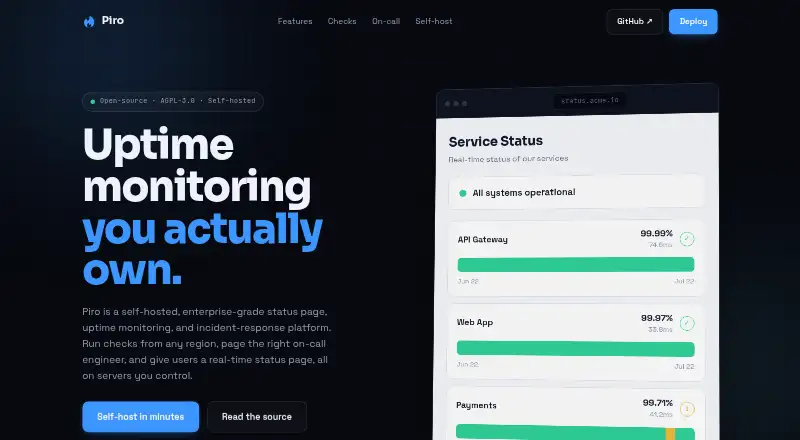
Piro is a self-hosted platform for engineering teams that need uptime checks, public status pages, and incident response in one system. It monitors HTTP, DNS, SSL, TCP, Ping, gRPC, sandboxed JavaScript, and inbound heartbeats. Public pages can present uptime history, latency trends, incidents, and scheduled maintenance. For response work, teams can set on-call rotations and escalation policies, verify paging channels, track incidents, and record postmortems.
Services, checks, and alert rules can be written in YAML and managed through the Piro CLI or REST API. Checks can run in-process for a single-region deployment, or standalone workers can monitor from multiple regions. Listed integrations include Google Chat, Jira, GCP Cloud Monitoring, email, Telegram, Twilio SMS, ntfy, and outbound webhooks. Android and iOS apps send end-to-end encrypted push notifications. Piro supports OIDC and SAML 2.0 single sign-on, with Owner, Admin, Member, and Viewer roles. The maker says it encrypts integration credentials and secret fields at rest and has no product telemetry, tracking, or phone-home. It is free and open source under AGPL-3.0; hosting it as a paid or public managed service for others requires making modifications available under that license.
Who it suits
Piro suits engineering teams that want to operate their own monitoring, status pages, and incident response tooling. Its multi-region workers, configurable alert channels, and single sign-on and role controls also fit teams managing monitoring across regions and users.
What it does well
- Checks cover HTTP, DNS, SSL, TCP, Ping, gRPC, JavaScript, and heartbeats.
- Status pages can show uptime history, latency, incidents, and maintenance.
- Includes on-call rotations, escalation policies, verified channels, and postmortems.
- YAML, CLI, and REST API support configuration and management.
- Android and iOS apps provide end-to-end encrypted push alerts.
- Free, open source, and supports single-region or multi-region monitoring.
What to know first
- Self-hosting requires running and managing the deployment.
- Paid or public managed hosting requires sharing modifications under AGPL-3.0.
Limits
Piro is free and open source under AGPL-3.0. If you host it as a paid or public managed service for others, modifications must be made available under the same license.
Getting started
- Open the Piro website.
- Choose a self-hosted deployment.
- Run checks in-process for a single-region setup or use standalone workers for multi-region monitoring.
- Declare services, checks, and alert rules in YAML.
- Manage the configuration with the Piro CLI or REST API.
- Configure integrations and verified paging channels.
- Use the Android or iOS app for encrypted push notifications.
Verdict
Choose Piro if your team wants a free, self-hosted system combining uptime checks, public status pages, and incident response. Its broad checks, alerting options, mobile apps, and regional deployment choices cover several operational needs. Teams seeking a paid or public managed service should account for the AGPL-3.0 requirement to make modifications available under the same license.
Questions
Is Piro free?
Yes. It is listed as free and open source under AGPL-3.0.
Who makes Piro?
The repository identifies heva Inc. as the maker.
Which platforms does Piro support?
Listed platforms are Android, API, iOS, Linux, macOS, self-hosted, web, and Windows.
Can Piro monitor from multiple regions?
Yes. Standalone workers can run in different regions; single-region deployments can run checks in-process.
What integrations are listed?
Google Chat, Jira, GCP Cloud Monitoring, email, Telegram, Twilio SMS, ntfy, and outbound webhooks.
What does the AGPL-3.0 license mean for managed hosting?
Hosting Piro as a paid or public managed service for others requires making modifications available under the same license.
Facts from Piro's own pages
- Access controls
- Piro lists OIDC and SAML 2.0 single sign-on and Owner, Admin, Member, and Viewer roles. · github.com, 8 Oct 2026
- Alert channels
- Personal paging channels include email, Telegram, Twilio SMS, and ntfy, with channel verification before paging. · github.com, 8 Oct 2026
- Configuration
- Services, checks, and alert rules can be declared in YAML and managed with the piro CLI, which supports plan, apply, and export commands. · github.com, 8 Oct 2026
- Deployment
- Piro can run checks in-process for single-region setups or use standalone workers for multi-region monitoring. · github.com, 7 Oct 2026
- Headquarters
- New York, NY, USA · heva-co.github.io, 28 Sept 2026
- Incident response
- The platform supports on-call schedules, escalation policies, incidents, postmortems, and maintenance windows. · github.com, 8 Oct 2026
- Integrations
- Listed integrations include Google Chat, Jira, generic outbound webhooks, and Google Cloud Monitoring. · github.com, 8 Oct 2026
- License
- Piro is released under the GNU Affero General Public License v3.0. · github.com, 7 Oct 2026
- License and hosting limit
- Piro is AGPL-3.0 software; hosting it as a paid or public managed service for others requires making modifications available under the same license. · github.com, 8 Oct 2026
- Maker
- The repository identifies heva Inc. as Piro's maker and shows a 2025 copyright notice. · github.com, 8 Oct 2026
- Mobile alerts
- Piro offers Android and iOS apps with end-to-end encrypted push notifications. · github.com, 7 Oct 2026
- Mobile push
- The maker says its Android and iOS apps support end-to-end encrypted push notifications. · github.com, 8 Oct 2026
- Monitoring
- Checks include HTTP, DNS, SSL certificate expiry, TCP, Ping, gRPC, sandboxed JavaScript, and inbound heartbeats. · github.com, 8 Oct 2026
- Product
- Piro is a self-hosted status page, uptime monitoring, and incident-response platform for engineering teams. · github.com, 8 Oct 2026
- Purpose
- Piro is a self-hosted status page, uptime monitoring, and incident response platform for engineering teams. · github.com, 7 Oct 2026
- Regions
- Standalone workers can run in different regions, while single-region setups can run checks in-process. · github.com, 8 Oct 2026
- Security
- The maker says integration credentials and secret fields are encrypted in the database and that the self-hosted product has no telemetry, tracking, or phone-home. · github.com, 8 Oct 2026
- Status pages
- Its branded public status page includes uptime history, latency trends, incidents, and scheduled maintenance. · github.com, 8 Oct 2026
- Support
- The security policy asks users to report vulnerabilities by email and says the team aims to respond within 48 hours. · github.com, 8 Oct 2026
Where Piro stands on Freedom251
- On-Call Scheduling Software#23 of 25