Freedom251 › Data Modeling Software
pgModeler
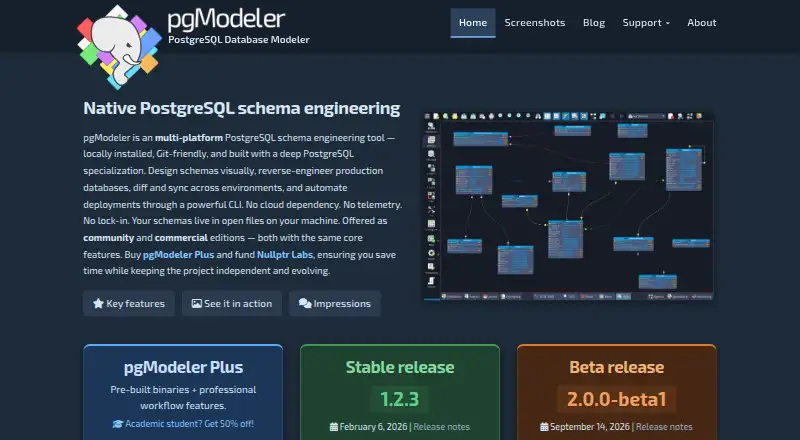
What pgModeler is
pgModeler is a locally installed PostgreSQL schema engineering tool for Linux, macOS, and Windows. It supports visual design, reverse engineering, schema comparison and synchronization, and command-line deployment automation. The relationship engine can propagate foreign-key columns, constraints, and indexes when tables are linked, and the tool supports more than 30 PostgreSQL object types. Models can be exported as SQL, PNG, SVG, HTML data dictionaries, or directly to a PostgreSQL server. Its command-line interface can export DDL, compare and validate models, and automate deployments in CI/CD workflows. Models use human-readable XML; Plus adds a Git-powered versioning workflow. The software runs on the user's machine without an account, cloud dependency, or mandatory internet connection. The community edition is GPL v3 and free forever. A listed Plus single-user six-month plan costs $59.90 per month, billed from $59.90/6 months. The documentation warns that connection passwords are stored in plain text in the settings directory.
Who it suits
pgModeler suits PostgreSQL users who want local schema design, comparison, synchronization, or deployment automation. Plus includes a Git-based workflow and SSH tunneling for remote connections.
What it does well
- Supports more than 30 PostgreSQL object types.
- Exports models as SQL, images, and HTML data dictionaries.
- CLI supports validation and deployment automation.
- Runs locally without an account or cloud dependency.
What to know first
- Connection passwords are stored in plain text in settings.
- Plus single-user six-month plan is $59.90 per month.
- The listed database support is PostgreSQL.
Limits
The Community edition is free forever. The listed Plus single-user six-month plan covers one seat and one platform at $59.90 per month, billed from $59.90/6 months; no other plan prices are provided here.
Plans
| Plan | Billed and limits | Price |
|---|---|---|
| Single user · 6 months | 1 seat · 1 platform | On request |
| Single user · 12 months | 1 seat · 1 platform | On request |
| Team lifetime · Perpetual | 2 seats | On request |
| pgModeler Community | source code · free forever | Free |
| pgModeler Plus · Single user · 6 months | from $59.90/6 months · 1 seat · single platform | $59.90 a month |
| pgModeler Plus · Single user · 12 months | 12 months · 1 seat · single platform | On request |
| pgModeler Plus · Team lifetime | Perpetual · 2 seats | On request |
As pgmodeler.io lists them, read 20 Sept 2026. The maker's own page has the final word.
Getting started
- Visit the pgModeler website.
- Choose the Community edition or a Plus plan.
- Install the desktop application for Linux, macOS, or Windows.
- Create a PostgreSQL model or connect to a live server with Plus.
- Export the model or use the CLI for validation and deployment tasks.
pgModeler is a desktop schema-engineering application for PostgreSQL, best suited to developers who want visual modeling alongside SQL and deployment workflows. It keeps work on the local machine, while live-server engineering and integrated Git versioning sit in its Plus tier.
Overview
pgModeler concentrates on PostgreSQL rather than trying to model multiple database systems. That focus shows in its support for more than 30 object types, from domains and custom types to event triggers, foreign data wrappers, and extensions. It is a strong fit for detailed PostgreSQL schemas, but not the right choice for teams that need one modeling tool across different database platforms.
When tables are linked, the relationship engine propagates foreign-key columns, constraints, and indexes. That reduces repetitive modeling work and helps carry relationships into the generated schema. Models are stored as open, human-readable XML, making them usable in version-control workflows; Plus adds Git-powered versioning inside the interface.
The application runs locally without an account, cloud dependency, mandatory internet connection, or hosted schema infrastructure. That suits users who want control over where their schema work resides, though it does not provide a hosted workspace. The community software is GPL v3; Plus adds pre-built binaries and professional workflow features.
Key features
Models can be exported as SQL, PNG, SVG, or HTML data dictionaries, or sent directly to a PostgreSQL server. The range covers both engineering outputs and shareable visual or reference material, so the model can serve more than a diagramming purpose.
Plus can connect to a live PostgreSQL server to reconstruct a full schema model. It can also compare a model with a live server and generate ALTER, DROP, and CREATE statements for synchronization. These capabilities make Plus the more appropriate edition for maintaining an existing database; the free edition is better suited to model work that does not depend on those live-server workflows.
The command-line interface can export DDL, run diffs, validate models, and automate deployments in CI/CD workflows. That makes pgModeler relevant beyond desktop design for teams incorporating PostgreSQL changes into automated delivery. Connections support SSL modes, client certificates, Kerberos server settings, and GSSAPI authentication. Plus also includes SSH tunneling for remote connections without VPN configuration. One security caveat matters: connection passwords are stored in plain text in the settings directory, so users should account for that when configuring access.
Support for feature requests and bug reports is directed to the project's GitHub issues page.
Pricing
pgModeler uses a freemium model, with a free plan and a 3-day trial. The Community edition costs nothing, is free forever, and provides the source code. It is the natural starting point for individuals who want the local modeling tool without a subscription, but Plus is the tier for live-server reverse engineering, synchronization, and the integrated Git workflow.
Plus Single user · 6 months costs $59.90 a month, billed from $59.90/6 months, for one seat on a single platform. It suits an individual who needs Plus workflows on one operating system; the price is tied to a six-month term, not a monthly cancellation period. Single user · 12 months is one seat on a single platform, billed 12 months, with custom pricing. Team lifetime is billed Perpetual with two seats and custom pricing. The longer-term and team options may fit users seeking those terms or seat counts, but the listed prices do not allow a direct cost comparison.
Platforms
pgModeler is available for Linux, macOS, and Windows. Its desktop deployment and local operation suit developers working on those systems who prefer not to depend on a browser-hosted database design service.
Who it's for
Choose pgModeler if PostgreSQL is your database and you want one local tool for visual design, schema exports, and deployment automation, with Plus available for live-server comparison and synchronization. It is especially relevant to developers who use less common PostgreSQL object types or want to validate and deploy models through CI/CD. Look elsewhere if you need support for other database systems or a hosted collaboration environment.
Pros and cons
- Pros: Broad PostgreSQL object support makes it useful for schemas beyond routine tables and relationships.
- Pros: SQL, image, and HTML exports pair visual modeling with practical engineering and documentation outputs.
- Pros: CLI validation, diffing, and deployment automation connect desktop modeling to CI/CD workflows.
- Pros: Local operation and human-readable XML keep models independent of a hosted service.
- Cons: PostgreSQL-only support rules it out for teams modeling across different database systems.
- Cons: Live-server reverse engineering and synchronization are Plus features, not part of the free Community edition.
- Cons: Plain-text password storage in the settings directory calls for care when managing connection credentials.
Alternatives
For a broader selection, browse Database Design Tools. Consider Hackolade Studio if its cross-platform availability, including web, better suits your setup; its Community Edition has a 50-model-object limit per model. MySQL is an alternative to consider when you want a database product with a free GPL-licensed Community Edition, rather than a PostgreSQL-specific modeling tool.
DbSchema may suit readers who need save-and-load design files or schema synchronization in its Pro plan, with additional capabilities in Architect. If browser-based design and link sharing are more important, Schemity has a free Lite plan with those features. SQL Power Architect is another free option; its Community Edition is GPL v.3 licensed and the listed downloads require Java Runtime 8.
ChartDB may fit a web or self-hosted workflow: its free plan is limited to one user, one database, 10 tables per diagram, and two private diagrams. Database Workbench is another freemium alternative for Linux and Windows. For a web-based option, DB Designer has a free Starter plan limited to two models and 10 tables per model.
Verdict
pgModeler is a compelling choice for PostgreSQL developers who want detailed local modeling and a path from schema design to automated deployment. Its clearest advantage is the combination of broad PostgreSQL support and engineering workflows; choose another tool if your work spans database systems, and weigh the plain-text password storage before saving connection credentials.
Verdict
pgModeler brings visual modeling and deployment workflows to a local PostgreSQL tool, with a free community edition and Plus features. Consider its documented plain-text password storage when configuring connections.
Questions
Is pgModeler free?
Yes. The pgModeler Community plan is free and is described as free forever. Plus plans are also available.
What does the listed Plus plan cost?
The single-user six-month Plus plan is $59.90 a month, billed from $59.90/6 months, for one seat and one platform.
Which operating systems does it support?
The listed platforms are Linux, macOS, and Windows.
Which database does pgModeler support?
Its supported database is PostgreSQL.
Is pgModeler open source?
The Community software is distributed under GPL v3. Plus supplies pre-built binaries and professional workflow features.
Can it reverse engineer and synchronize a live database?
pgModeler Plus can connect to a live PostgreSQL server to reconstruct a schema model and generate statements to synchronize a model with that server.
Facts from pgModeler's own pages
- CLI
- The command-line interface can export DDL, run diffs, validate models, and automate deployments in CI/CD workflows. · pgmodeler.io, 30 Sept 2026
- Diff and sync
- pgModeler Plus compares a model with a live server and generates the required ALTER, DROP, and CREATE statements for synchronization. · pgmodeler.io, 30 Sept 2026
- Exports
- Models can be exported as SQL, PNG, SVG, HTML data dictionaries, or directly to a PostgreSQL server. · pgmodeler.io, 30 Sept 2026
- Founded
- 2006 · pgmodeler.io, 28 Sept 2026
- Headquarters
- Palmas, Tocantins, Brazil · pgmodeler.io, 28 Sept 2026
- License
- The community software is distributed under GPL v3, while Plus supplies pre-built binaries and professional workflow features. · pgmodeler.io, 30 Sept 2026
- Local operation
- pgModeler runs entirely on the user's machine with no account, cloud dependency, mandatory internet connection, or hosted schema infrastructure. · pgmodeler.io, 30 Sept 2026
- Modeling
- The relationship engine automatically propagates foreign-key columns, constraints, and indexes when tables are linked. · pgmodeler.io, 30 Sept 2026
- PostgreSQL scope
- It supports more than 30 PostgreSQL object types, including domains, custom types, operators, collations, procedural languages, event triggers, foreign data wrappers, and extensions. · pgmodeler.io, 30 Sept 2026
- Purpose
- pgModeler is a locally installed, multi-platform PostgreSQL schema engineering tool for visual design, reverse engineering, schema diff and synchronization, and CLI deployment automation. · pgmodeler.io, 30 Sept 2026
- Remote access
- pgModeler Plus includes SSH tunneling for secure remote PostgreSQL connections without VPN configuration. · pgmodeler.io, 30 Sept 2026
- Reverse engineering
- pgModeler Plus can connect to a live PostgreSQL server and reconstruct a full schema model. · pgmodeler.io, 30 Sept 2026
- Security
- Connections support SSL modes, client certificates, Kerberos server settings, and GSSAPI authentication. · pgmodeler.io, 30 Sept 2026
- Security limitation
- The documentation warns that connection passwords are stored in plain text in the settings directory. · pgmodeler.io, 30 Sept 2026
- Support
- The project directs feature requests and bug reports to its GitHub issues page. · pgmodeler.io, 30 Sept 2026
- Version control
- The tool stores models as open, human-readable XML and Plus provides a Git-powered versioning workflow inside the interface. · pgmodeler.io, 30 Sept 2026
Where pgModeler stands on Freedom251
- Data Modeling Software#8 of 27
- Database Design Tools#12 of 35