Freedom251 › Executable Packers
papaw
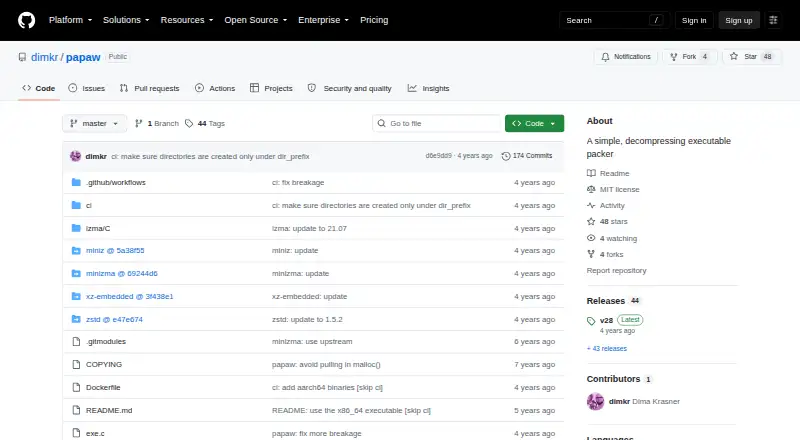
What papaw is
papaw is a permissively licensed Linux packer for executables that include statically linked third-party components. It is intended for devices with limited disk space: it compresses executables and packages them with a small decompressor of about 15–40 KB. Supported compression algorithms are LZMA2, LZMA1, Zstandard, and Deflate. A packed executable can replace itself on disk when it runs.
The project is free and unencumbered software under the MIT license, and can be self-hosted. It uses Meson as its build system and can be included as a Meson subproject; its README recommends `custom_target()` for running `papawify`. Prebuilt static binaries are available through GitHub releases, with example release assets for aarch64, arm, armeb, i386, mips, mipsel, and x86_64. papaw aims to be portable across devices by avoiding machine-specific assembly and newer system calls such as `fexecve()`. It can optionally provide very basic anti-debugging protection intended to discourage trivial reverse-engineering techniques. The payload is extracted to a temporary file; when run as root, papaw mounts a tmpfs filesystem and lazily unmounts it before extraction.
Who it suits
papaw suits Linux developers who need to compress executables with statically linked third-party components for devices with limited disk space. Its Meson integration and prebuilt static binaries may also suit projects targeting the listed architectures.
What it does well
- Free and unencumbered under the MIT license.
- Supports LZMA2, LZMA1, Zstandard, and Deflate.
- Packages executables with a 15–40 KB decompressor.
- Can be included as a Meson subproject.
- Release assets cover several listed architectures.
What to know first
- Linux is the only supported platform listed.
- The optional anti-debugging protection is described as very basic.
- Payloads are extracted to a temporary file when run.
Plans
| Plan | Billed and limits | Price |
|---|---|---|
| papaw | Free and unencumbered software under the MIT license | Free |
As github.com lists them, read 8 Oct 2026. The maker's own page has the final word.
Getting started
- Visit the papaw GitHub repository.
- Download a prebuilt static binary from GitHub releases, or use Meson to build it.
- Include papaw as a Meson subproject if needed.
- Use `custom_target()` to run `papawify` in a Meson build.
papaw is a free, MIT-licensed Linux packer for executables that contain statically linked third-party components. It best suits developers shipping software to storage-constrained devices and maintaining their own build and deployment pipeline. The main trade-off is focused Linux portability: compression is useful, while execution through temporary files and only basic anti-debugging make it unsuitable for stronger protection requirements.
Overview
papaw wraps a compressed executable with a decompressor of roughly 15–40 KB. That runtime cost means the result is not automatically smaller, but programs with enough compressible content can occupy less disk space overall. This is a practical fit for embedded or otherwise capacity-limited Linux systems where reclaiming storage matters more than broad desktop compatibility.
A packed program can replace itself on disk when launched, which supports deployments that want the packed binary to become the installed copy. At runtime, papaw extracts the payload to a temporary file. If it runs as root, it mounts a temporary filesystem and lazily unmounts it before extraction, so administrators should account for that behavior in systems with strict temporary-storage policies.
Key features
Compression choices
papaw supports LZMA2, LZMA1, Zstandard, and Deflate. Multiple algorithms let a build owner choose an approach appropriate to the executable and deployment constraints instead of adopting a single fixed method. The project describes its compression level as advanced, but it does not promise a particular size reduction for every binary.
Meson integration
Meson is papaw's build system, and the packer can be added as a Meson subproject. The recommended custom_target() arrangement for invoking papawify makes it a sensible addition to an existing Meson pipeline; projects using another build ecosystem will need their own integration step.
Portability and distribution
The design avoids machine-specific assembly and newer system calls such as fexecve(), aiming to run across varied devices. Prebuilt static binaries are distributed through GitHub releases, and the v28 assets include examples for aarch64, ARM and armeb, i386, MIPS and MIPS little-endian, and x86_64. That multi-architecture coverage helps teams target mixed hardware without making papaw a non-Linux solution.
Protection
Optional anti-debugging is intended only to discourage trivial reverse-engineering techniques. It is a modest deterrent, not a substitute for a dedicated protection product or a security boundary. Teams choosing papaw primarily for concealment should set expectations accordingly.
Pricing
papaw has one free plan at no cost. The software is free and unencumbered under the MIT license, with no paid tier, seat charge, quota, or trial term stated. It is therefore suited to individual developers and teams that can operate a Linux-focused, self-hosted tool without commercial support or additional service packaging.
Platforms
papaw supports Linux and is self-hosted. Its architecture examples span aarch64, ARM, i386, MIPS, and x86_64, which is valuable for device fleets, but it does not provide a Windows, macOS, Android, or iOS edition.
Who it's for
Choose papaw for Linux developers distributing statically linked programs to devices where every megabyte matters, especially when Meson is already part of the build. It is also a reasonable fit for teams needing a permissively licensed packer they can build and deploy themselves across several Linux architectures.
Look elsewhere if you need cross-platform packaging, stronger anti-debugging, or an execution model that avoids temporary extraction. papaw's self-replacement feature helps certain update workflows, but it does not turn the tool into a general application virtualization platform.
Pros and cons
- Pros: free MIT licensing removes purchase and redistribution costs; four compression algorithms provide choice; a 15–40 KB decompressor keeps packing overhead small; multi-architecture static releases support varied Linux hardware; Meson subproject support fits native Meson builds.
- Cons: Linux-only support excludes other operating systems; payloads are extracted to temporary files during execution; root execution involves tmpfs mounting and lazy unmounting; anti-debugging is explicitly basic; the decompressor adds overhead, so savings depend on the executable.
Alternatives
For a wider operating-system and browser-extension reach, consider Obsidian, a freemium option covering Android, iOS, Linux, macOS, Windows, and extensions, with a free plan without limits and no sign-up required.
StarForce Reader is another free choice spanning Android, iOS, Linux, macOS, and Windows. Pick UPX instead when you want a free packer targeting Linux, macOS, and Windows. Crinkler is the focused alternative for small 32-bit Windows executables, while MPRESS targets macOS and Windows executable formats. Windows PE Packer, AlushPacker, and Enigma Virtual Box are Windows-oriented free options; choose among them when Windows packaging is the requirement rather than Linux device compression.
Browse more tools in Executable Packers.
Verdict
papaw is the right choice for developers who need a free, self-hosted Linux executable packer for statically linked software and want meaningful storage savings across constrained, multi-architecture devices. Its compression options, small decompressor, and Meson integration are practical strengths. Look elsewhere for non-Linux targets, stronger anti-reverse-engineering protection, or a solution that does not extract the payload to temporary storage.
Verdict
Choose papaw if you need a free Linux executable packer for statically linked components, especially when disk space is limited. Look elsewhere if you need a platform beyond Linux or stronger anti-debugging protection than the basic option described.
Questions
Is papaw free?
Yes. It is free and unencumbered software under the MIT license.
Which platforms does papaw support?
Linux is listed as its supported platform. It can be self-hosted.
Which compression algorithms does papaw support?
LZMA2, LZMA1, Zstandard, and Deflate.
Can I get prebuilt binaries?
Yes. Prebuilt static binaries are available through GitHub releases.
Which architectures have example release assets?
The v28 release lists aarch64, arm, armeb, i386, mips, mipsel, and x86_64 assets.
How does papaw fit into a Meson build?
It uses Meson and can be included as a Meson subproject. The README recommends `custom_target()` for running `papawify`.
Facts from papaw's own pages
- Anti-debugging
- It can optionally provide very basic anti-debugging protection intended to discourage trivial reverse-engineering techniques. · github.com, 8 Oct 2026
- Architecture coverage
- The v28 release lists example executable assets for aarch64, arm, armeb, i386, mips, mipsel, and x86_64. · github.com, 8 Oct 2026
- Build
- papaw uses Meson as its build system and can be used as a Meson subproject. · github.com, 8 Oct 2026
- Build integration
- papaw uses Meson and can be included as a Meson subproject, with custom_target() recommended for running papawify. · github.com, 8 Oct 2026
- Compression
- Supported algorithms are LZMA2, LZMA1, Zstandard, and Deflate. · github.com, 8 Oct 2026
- Download
- The README says prebuilt static binaries are available from the project's GitHub releases. · github.com, 8 Oct 2026
- Downloads
- The README says prebuilt static binaries are available through GitHub releases. · github.com, 8 Oct 2026
- Intended use
- The README describes papaw as designed for portability across devices and says it avoids machine-specific assembly and newer system calls such as fexecve(). · github.com, 8 Oct 2026
- License
- The project is released as free and unencumbered software under the MIT license. · github.com, 8 Oct 2026
- Maintainer
- The GitHub profile identifies the repository owner as Dima Krasner and describes his work as low-level development specializing in C, Go, porting, *nix, and distro development. · github.com, 8 Oct 2026
- Portability
- The project avoids machine-specific assembly and newer system calls such as fexecve() to support portability across devices. · github.com, 8 Oct 2026
- Purpose
- papaw is a permissively licensed packer for executables with statically linked third-party components, intended for devices with limited disk space. · github.com, 8 Oct 2026
- Release assets
- The v28 release lists example binaries for architectures including aarch64, ARM, i386, MIPS, and x86_64. · github.com, 8 Oct 2026
- Replacement
- Packed executables can replace themselves on disk when run. · github.com, 8 Oct 2026
- Security
- papaw can optionally provide very basic anti-debugging protection intended to discourage trivial reverse-engineering techniques. · github.com, 8 Oct 2026
- Self replacement
- Packed executables can replace themselves on disk when run. · github.com, 8 Oct 2026
- Size reduction
- papaw compresses executables and packages them with a small decompressor executable of about 15–40 KB. · github.com, 8 Oct 2026
- Temporary files
- The payload is extracted to a temporary file; when run as root, papaw mounts a tmpfs filesystem and lazily unmounts it before extraction. · github.com, 8 Oct 2026
Where papaw stands on Freedom251
- Executable Packers#7 of 28