Freedom251 › Whistleblower Hotline Software
OpenWhistle
What OpenWhistle is
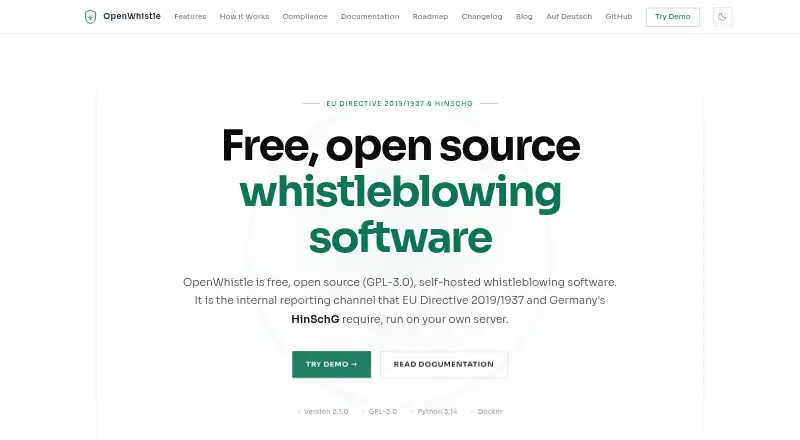
OpenWhistle is open-source software for organisations that need an internal whistleblowing channel. It is designed for companies and public bodies covered by EU Directive 2019/1937 and Germany’s HinSchG, including companies from 50 employees and financial firms. The organisation runs it on its own server with Docker Compose or a Helm chart; OpenWhistle does not offer hosted service. It is free under the GNU General Public License v3.0, with no paid tier or subscription, though the organisation provides its own server. Reporters can submit information without an account or email address and use a case number and UUID4 PIN to return to the status page, read replies and send messages. Confidential mode encrypts names and contact details, which case handlers see only after an audited reason. Admin sign-in supports passwords, LDAP or OIDC and always requires TOTP. The maker says it does not store IP addresses at any layer and keeps outbound requests off unless enabled. Closed reports are deleted after 1,095 days by default. The interface supports English, German, French and Brazilian Portuguese; optional attachment scanning uses ClamAV.
Who it suits
It suits companies and public bodies that need an internal reporting channel for EU Directive 2019/1937 or HinSchG coverage. Organisations must be prepared to host and maintain it on their own server.
What it does well
- Free, open-source software with no subscription
- Reporters need no account or email address
- Encrypted confidential mode with audited disclosure
- Supports LDAP and OIDC admin sign-in
- Available in four listed languages
What to know first
- No hosted service; organisations provide a server
- No paid support tier is offered
- Closed reports delete after 1,095 days by default
Limits
The free plan has no paid tier or subscription, but organisations provide their own server. Closed reports are deleted after 1,095 days by default.
Plans
| Plan | Billed and limits | Price |
|---|---|---|
| Free | No paid tier or subscription · you pay for your own server | Free |
As openwhistle.net lists them, read 4 Oct 2026. The maker's own page has the final word.
Getting started
- Visit the OpenWhistle website.
- Provide an organisation-owned server.
- Deploy using Docker Compose or a Helm chart.
- Configure admin sign-in with a password, LDAP or OIDC; TOTP is required.
- Use the reporting channel and status page with case numbers and PINs.
Overview
OpenWhistle is open-source whistleblowing software for organisations that need an internal reporting channel aligned with EU Directive 2019/1937 and Germany’s HinSchG. It best suits teams able to operate software on their own infrastructure and manage reporting without paid vendor support. Its privacy-focused reporting and follow-up are compelling; the self-hosting requirement makes it a poor fit for organisations seeking a ready-hosted service.
Key features
Reporters submit a case without creating an account or providing an email address, then receive a case number and UUID4 PIN. They use those credentials to return to a status page, read replies and send follow-up messages. That creates a two-way channel without tying a report to a reporter’s account.
Confidential mode adds a controlled route for identifying a reporter: their name and contact details are encrypted and become visible to the case handler only after an audited reason. This is useful when a process needs a way to contact or identify a reporter while limiting routine access to that information.
Admin sign-in supports passwords, LDAP or OIDC, and always requires TOTP. LDAP and external OIDC can connect authentication to an organisation’s existing identity provider. Attachments can optionally be scanned with ClamAV. The interface supports English, German, French and Brazilian Portuguese.
The maker says no IP address is stored at any layer, and outbound requests are opt-in and off by default. Closed reports are deleted after 1,095 days by default. Those defaults support a privacy-conscious setup, but organisations still need to assess whether the retention period and their own configuration suit their obligations.
Pricing
Free: free. There is no paid tier or subscription; the organisation pays for its own server. The free plan includes anonymous reporting, workflow automation and single sign-on. It is the natural fit for organisations that can supply and maintain hosting themselves. There is no free trial because the software is free, but there is also no hosted option or paid support tier to turn to for vendor-operated service.
The main cost trade-off is operational rather than a subscription: deployment and server costs sit with the organisation. Support is through GitHub Issues, so teams that need a paid support commitment should look elsewhere.
Platforms
OpenWhistle supports Linux and web use and is self-hosted. Deployment is on an organisation’s own server using Docker Compose or a Helm chart; the project does not provide a hosted service. That suits teams with infrastructure capacity, but rules it out for buyers who require a managed cloud product.
Who it's for
The maker targets companies and public bodies covered by EU Directive 2019/1937 and Germany’s HinSchG, including companies with 50 employees and financial firms. Its open-source GPL v3.0 licence and self-hosting model make it a reasonable candidate for organisations that want control over deployment and can operate the system internally. Smaller teams without server administration capacity, or organisations that require contracted support, may find the operating model a more significant burden than the free price suggests.
Pros and cons
- Pros: Anonymous submission and PIN-based follow-up allow two-way reporting without requiring reporter accounts or email addresses.
- Pros: Confidential mode encrypts identity details and gates case-handler access behind an audited reason.
- Pros: LDAP/OIDC authentication, mandatory TOTP, optional ClamAV scanning and four interface languages address concrete operational needs.
- Pros: The free, open-source plan has no subscription, and the maker says IP addresses are not stored at any layer.
- Cons: Organisations must host and maintain the service themselves; there is no hosted service.
- Cons: There is no paid support tier, leaving GitHub Issues as the maker’s support route.
- Cons: Closed reports are deleted after 1,095 days by default, a retention setting organisations should assess against their own requirements.
Alternatives
For a broader comparison, see Whistleblower Hotline Software.
GlobaLeaks is another free, self-hosted open-source option for Linux and web, with API support. Its default attachment limit is 30MB per file and can be configured higher; consider it if that attachment limit and deployment profile better match your needs.
BoardEffect is a paid alternative for buyers seeking Android, iOS, web and API platforms; pricing is available by demo request.
NotMe offers Android, iOS, web and API platforms. Its NotMe Platform costs $99 a month based on employee count and includes unlimited reports with up to 5–10 admin licenses; choose it if those terms suit your team and a paid platform is preferable.
iVoiceUp is a paid web alternative with plans that specify different admin-account counts and, at Professional, automated routing and escalation paths.
NAVEX One is a paid web and API option with pricing tailored to organisation size, selected solutions, program scope and requirements; bundled NAVEX solutions can save up to 30%.
Ethics Suite is a paid web alternative.
Rezilens is a paid alternative.
WrightLine is a paid web alternative.
Verdict
Choose OpenWhistle if your organisation needs an internal whistleblowing channel, values anonymous two-way reporting and confidential identity handling, and has the capacity to host and maintain open-source software. Its strongest case is the combination of privacy controls and a free, self-hosted model. Look elsewhere if you need vendor-hosted deployment or paid support.
Verdict
OpenWhistle provides a self-hosted reporting channel with anonymous submission, follow-up messaging and confidential mode. Its own-server deployment and community-only support are important considerations.
Questions
How much does OpenWhistle cost?
The Free plan costs nothing, with no paid tier or subscription. The organisation pays for its own server.
Is OpenWhistle open source?
Yes. It is licensed under GNU General Public License v3.0.
Does OpenWhistle offer hosted service?
No. Organisations run it on their own server using Docker Compose or a Helm chart.
Can reporters submit anonymously?
Yes. Reporters do not need an account or email address, and receive a case number and UUID4 PIN for follow-up.
Which platforms does OpenWhistle support?
The listed platforms are Linux, self-hosted and web.
What identity and attachment integrations are available?
Admin authentication can use LDAP or an external OIDC identity provider. Attachments can optionally be scanned with ClamAV.
Facts from OpenWhistle's own pages
- Authentication
- Admin sign-in supports a password, LDAP or OIDC, and always requires TOTP. · openwhistle.net, 4 Oct 2026
- Confidential mode
- In confidential mode, the reporter’s name and contact details are encrypted and shown to the case handler only after an audited reason. · openwhistle.net, 4 Oct 2026
- Follow-up
- Reporters can read replies and send messages at the status page using their case number and PIN. · openwhistle.net, 4 Oct 2026
- Hosting
- It runs on an organisation’s own server using Docker Compose or a Helm chart; the project offers no hosted service. · openwhistle.net, 4 Oct 2026
- Integrations
- Admin authentication can use LDAP or an external OIDC identity provider; attachments can optionally be scanned with ClamAV. · openwhistle.net, 4 Oct 2026
- Intended users
- The maker describes it for companies and public bodies covered by EU Directive 2019/1937 and HinSchG, including companies from 50 employees and financial firms. · openwhistle.net, 4 Oct 2026
- Languages
- The interface supports English, German, French and Brazilian Portuguese. · openwhistle.net, 4 Oct 2026
- License
- It is open source under the GNU General Public License v3.0. · openwhistle.net, 4 Oct 2026
- Platforms
- The documentation lists Linux hosts with Docker 24 or newer and Docker Compose v2, with linux/amd64 and linux/arm64 container images. · openwhistle.net, 4 Oct 2026
- Privacy
- The maker says no IP address is stored at any layer, and outbound requests are opt-in and off by default. · openwhistle.net, 4 Oct 2026
- Purpose
- OpenWhistle is self-hosted whistleblowing software for internal reporting channels under EU Directive 2019/1937 and Germany’s HinSchG. · openwhistle.net, 4 Oct 2026
- Reporting
- Whistleblowers receive a case number and UUID4 PIN, with no account or email address required. · openwhistle.net, 4 Oct 2026
- Retention
- Closed reports are deleted after 1,095 days by default. · openwhistle.net, 4 Oct 2026
- Support
- The maker says there is no paid support tier and points users to GitHub Issues for community support. · openwhistle.net, 4 Oct 2026
Where OpenWhistle stands on Freedom251
- Whistleblower Hotline Software#3 of 27
- Whistleblowing Software#3 of 19