Freedom251 › Software Composition Analysis Software

OpenSCA
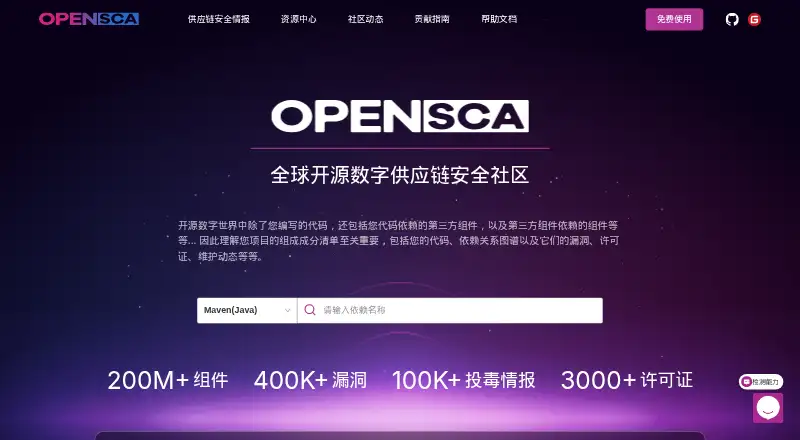
What OpenSCA is
OpenSCA analyzes software components and dependencies to find vulnerabilities and open-source license risks. It can be used from an IDE, command line, or cloud platform, with online and offline use stated. Its command-line tool runs on Windows, Linux, and macOS and supports documented ecosystems including Maven and Gradle, npm, Composer, Ruby gems, Go modules, pip, Cargo, and Rebar. OpenSCA generates SBOMs in DSDX, SPDX, CycloneDX, and SWID formats; it can also accept an SBOM to produce a vulnerability report or change its format. CLI reports can be saved as JSON, XML, HTML, SQLite, CSV, or SARIF. The CLI documentation describes a cloud vulnerability database covering CVE, CWE, NVD, CNVD, and CNNVD, alongside configurable local databases and private package repositories. Xcheck plugins are documented for IntelliJ IDEA and VS Code, and pull request scanning is supported. The free plan costs nothing. Parsing requirements.txt and requirements.in requires a pipenv environment and an internet connection.
Who it suits
OpenSCA suits organizations, enterprises, and individual users who need to review software components, dependencies, vulnerabilities, or open-source license risks. It also fits teams that work with the documented package ecosystems and want SBOM generation or reporting.
What it does well
- Free plan at no cost.
- Generates SBOMs in four listed formats.
- Supports CLI reports in six listed formats.
- Documented plugins for IntelliJ IDEA and VS Code.
- Configurable local vulnerability databases and private repositories.
What to know first
- Parsing two requirements files needs pipenv and internet.
- Scan time depends on package size, network, and language.
Limits
Parsing requirements.txt and requirements.in requires a pipenv environment and an internet connection. The maker says scan time depends on package size, network conditions, and programming language.
Plans
| Plan | Billed and limits | Price |
|---|---|---|
| OpenSCA | Online and offline use stated; no other plan limits stated | Free |
As opensca.xmirror.cn lists them, read 5 Oct 2026. The maker's own page has the final word.
Getting started
- Visit the OpenSCA website.
- Choose an IDE plugin, command-line interface, or cloud platform.
- For command-line use, select the Windows, Linux, or macOS version.
- Configure a vulnerability database or private package repository if needed.
- Scan supported package ecosystems and generate an SBOM or report.
Verdict
OpenSCA combines dependency risk analysis with SBOM generation, multiple report formats, and several ways to run it. Python requirements-file parsing has a stated environment and connectivity requirement.
Questions
How much does OpenSCA cost?
The OpenSCA plan is free. Online and offline use are stated.
Which operating systems does the command line support?
The CLI is available for Windows, Linux, and macOS.
What SBOM formats can it generate?
OpenSCA generates SBOMs in DSDX, SPDX, CycloneDX, and SWID formats.
Can OpenSCA scan Python requirements files?
Parsing requirements.txt and requirements.in requires a pipenv environment and an internet connection.
What vulnerability data does its cloud database cover?
The CLI documentation lists CVE, CWE, NVD, CNVD, and CNNVD coverage. A configurable local vulnerability database is also supported.
Facts from OpenSCA's own pages
- Custom databases
- The product documentation says users can configure vulnerability databases and private package repositories. · opensca.xmirror.cn, 5 Oct 2026
- Founded
- 2014 · opensca.xmirror.cn, 28 Sept 2026
- IDE integrations
- The documentation provides OpenSCA Xcheck plugins for IntelliJ IDEA and VS Code. · opensca.xmirror.cn, 5 Oct 2026
- Intended users
- The maker describes the solution as serving enterprises, organizations, and individual users. · opensca.xmirror.cn, 5 Oct 2026
- Interfaces
- The maker describes use through an IDE, command line, or cloud platform, with online and offline scenarios. · opensca.xmirror.cn, 5 Oct 2026
- Language coverage
- The documented package ecosystems include Maven and Gradle for Java, npm, Composer, Ruby gems, Go modules, pip, Cargo, and Rebar. · opensca.xmirror.cn, 5 Oct 2026
- License
- The OpenSCA-cli repository identifies its license as Apache-2.0. · github.com, 5 Oct 2026
- Operating systems
- The CLI is available for Windows, Linux, and macOS. · github.com, 5 Oct 2026
- Purpose
- OpenSCA analyzes software components and dependencies to identify vulnerabilities and open-source license risks. · opensca.xmirror.cn, 5 Oct 2026
- Report formats
- The CLI supports JSON, XML, HTML, SQLite, CSV, and SARIF reports, alongside several SBOM formats. · github.com, 5 Oct 2026
- SBOM
- It generates SBOMs in DSDX, SPDX, CycloneDX, and SWID formats, and can take an SBOM as input to produce a vulnerability report or convert it to another format. · opensca.xmirror.cn, 5 Oct 2026
- Scanning limitation
- Parsing requirements.txt and requirements.in requires a pipenv environment and an internet connection, according to the language support page. · opensca.xmirror.cn, 5 Oct 2026
- Scan-time factors
- The maker says scanning time depends on package size, network conditions, and programming language. · github.com, 5 Oct 2026
- Support
- The project invites issues and lists [email protected] and QQ group 832039395 for contact. · github.com, 5 Oct 2026
- Vulnerability data
- The CLI documentation says its cloud vulnerability database covers CVE, CWE, NVD, CNVD, and CNNVD, and it also supports a configurable local vulnerability database. · github.com, 5 Oct 2026