Freedom251 › Nonprofit Text Messaging Software
OpenFn
by OpenFn
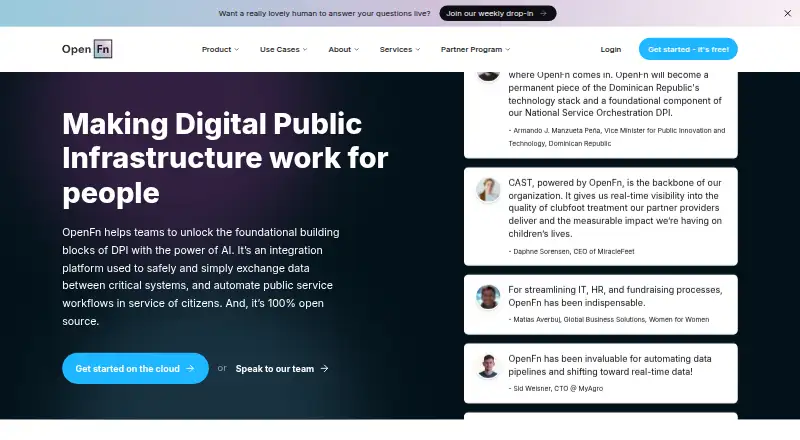
What OpenFn is
OpenFn is a web-based service for orchestrating workflows, transforming data, and syncing information in real time. It also supports connections to on-premises systems. The free plan is listed as free forever and includes one workflow, 100 runs per month, a 60-second limit per run, one user, and 500K AI Assistant tokens. Core costs $49 a month, billed monthly, and allows two workflows, 2,000 runs per month, a five-minute run limit, two users, and 1.5M AI Assistant tokens. Growth costs $199 a month, billed monthly, with 10 workflows, 5,000 monthly runs, a 20-minute run limit, five users, and 5M AI Assistant tokens. Scale costs $499 a month, billed monthly, and includes 20 workflows, 10,000 runs per month, a 30-minute limit per run, 10 users, and 10M AI Assistant tokens. The listed plan limits distinguish each tier by workflow count, monthly run allowance, runtime, user count, and AI Assistant tokens. OpenFn was founded in 2014.
Who it suits
OpenFn may suit teams that need to coordinate workflows, transform data, or sync information in real time, including from on-premises systems. The plan limits can help users assess how many workflows, runs, users, and tokens they need.
What it does well
- Supports workflow orchestration and data transformation.
- Offers real-time sync.
- Supports on-premises connectors.
- Free plan includes one workflow and 100 monthly runs.
What to know first
- Free plan limits each run to 60 seconds.
- Free plan allows one user.
- Core includes only two workflows.
- Paid plans start at $49 a month.
Limits
The Free plan includes one workflow, 100 runs per month, a 60-second limit per run, one user and a maximum history retention of seven days. Core, the cheapest paid plan, costs $49/month billed annually at $588 and allows two workflows, 2,000 runs per month, five minutes per run and two users.
Plans
| Plan | Billed and limits | Price |
|---|---|---|
| Free | Billed annually at $0 · 1 workflow · 100 runs/month · 60 sec limit/run · 1 user · 500k AI Assistant Tokens · community support | Free |
| Core | Billed annually at $588 · 2 workflows · 2,000 runs/month · 5 min limit/run · 2 users · 1.5M AI Assistant Tokens · email support | $49 a month |
| Growth | Billed annually at $2,388 · 10 workflows · 5,000 runs/month · 20 min limit/run · 5 users · 5M AI Assistant Tokens · email support | $199 a month |
| Scale | Billed annually at $5,988 · 20 workflows · 10,000 runs/month · 30 min limit/run · 10 users · 10M AI Assistant Tokens · dedicated support | $499 a month |
| Enterprise | Custom pricing · Volume discounts · dedicated support · country-specific rates · implementation services · private cloud or on-prem deployment · training packages | On request |
As openfn.org lists them, read 5 Oct 2026. The maker's own page has the final word.
Getting started
- Visit the OpenFn website.
- Choose the free plan or a paid plan.
- Build a workflow by point and click or with AI assistance.
- Refine, test and deploy the workflow visually, or use the IDE and CLI.
- Choose hosted SaaS or deploy on your servers, cloud or local infrastructure.
OpenFn is an integration platform for teams automating workflows across public-service systems. It best suits governments, NGOs, and impact organizations that need configurable interoperability between critical systems. Its range of deployment options and developer tools is a strong fit for complex integrations, though small quotas make the free plan better for evaluation than sustained use.
Overview
OpenFn combines workflow orchestration, data transformation, and real-time sync across web APIs, databases, SFTP servers, and raw file exports. Its 70-plus open-source adaptors include DHIS2, CommCare, KoboToolbox, HL7 FHIR, PostgreSQL, and Google Sheets, making it relevant to organizations connecting health, humanitarian, and government systems. The platform originated in 2014.
Teams can build workflows by point and click or with AI assistance, then refine, test, and deploy them visually. A smart IDE and CLI support more technical workflow development, while activity history helps teams monitor jobs, troubleshoot and retry failures, and audit configuration changes. OpenFn runs as hosted SaaS or on customer servers, cloud, or local infrastructure; that flexibility suits organizations with deployment requirements, but self-hosting brings infrastructure responsibility.
Key features
- Workflow authoring: Visual building and AI assistance offer an approachable starting point, while the IDE and CLI give technical teams tools to build and test workflows more directly.
- Adaptors and data exchange: More than 70 open-source adaptors span APIs, databases, SFTP, and file exports. The named options include public-service and health systems as well as PostgreSQL and Google Sheets, useful for varied interoperability projects.
- Operations and security: Activity history supports monitoring, retries, troubleshooting, and configuration audits. OpenFn says its hosted service uses Google Cloud Platform, TLS connections, SSL database connections, and 256-bit encryption at rest. Independent checks monitor message persistence, triggers, and job runners every 60 seconds, with availability and processing times posted to a status site.
- Deployment and compliance: Hosted service and deployment on customer infrastructure provide a choice between managed operation and greater environmental control. OpenFn says it supports GDPR, HIPAA, and FHIR compliance alongside flexible configuration and zero persistence.
Pricing
OpenFn has a free plan and three fixed-price paid plans, with annual billing terms. Each step up increases workflow, run, runtime, user, and AI Assistant token allowances; readers should compare those caps with their expected workload rather than price alone.
| Plan | Price and billing | Included limits and support |
|---|---|---|
| Free | free; billed annually at $0 | 1 workflow, 100 runs/month, 60-second limit/run, 1 user, 500k AI Assistant Tokens, community support; history retained for up to seven days |
| Core | $49 a month; billed annually at $588 | 2 workflows, 2,000 runs/month, 5-minute limit/run, 2 users, 1.5M AI Assistant Tokens, email support |
| Growth | $199 a month; billed annually at $2,388 | 10 workflows, 5,000 runs/month, 20-minute limit/run, 5 users, 5M AI Assistant Tokens, email support |
| Scale | $499 a month; billed annually at $5,988 | 20 workflows, 10,000 runs/month, 30-minute limit/run, 10 users, 10M AI Assistant Tokens, dedicated support |
| Enterprise | Custom pricing | Volume discounts, dedicated support, country-specific rates, implementation services, private cloud or on-premises deployment, and training packages |
Free is useful for a small proof of concept, but one workflow, one user, 100 monthly runs, a 60-second runtime, and seven-day maximum history leave little room for a live team or long-running jobs. Core is the entry point for modest recurring work, adding a second user and 2,000 runs monthly, but still caps workflows at two and jobs at five minutes. Growth gives teams more room for parallel workflows and longer jobs; Scale doubles Growth's run allowance and adds dedicated support, at a substantial price increase. Enterprise is the fit for organizations needing volume discounts, implementation help, training, or private deployment, with custom pricing.
Community support is included on Free; email support starts with Core and Growth, while Scale and Enterprise include dedicated support. Optional expert assistance and training are also offered.
Platforms
OpenFn supports web and API use, as well as self-hosted deployment. Its on-premises and local infrastructure options matter to teams that need to control where integrations run; they are less compelling for buyers seeking only a conventional hosted web app.
Who it's for
OpenFn is aimed at governments, NGOs, and impact organizations coordinating data across digital systems. It is a particularly strong candidate when a project needs public-service adaptors, workflow history, or a choice of hosted and customer-managed deployment. A small team with few runs may start on Free, while larger operational workloads should match the paid plan's workflow, runtime, and user limits to expected demand.
Pros and cons
- Pro: More than 70 open-source adaptors, including DHIS2, CommCare, KoboToolbox, and HL7 FHIR, give interoperability projects relevant starting points.
- Pro: Visual authoring, AI assistance, an IDE, and a CLI accommodate both less technical workflow builders and developer-led teams.
- Pro: Hosted and self-managed deployment options support organizations with different infrastructure needs.
- Con: Free allows only one workflow, one user, and 100 monthly runs, with a 60-second job limit and up to seven days of history; that is restrictive for sustained operations.
- Con: Paid plans impose workflow, run, runtime, and user ceilings, so teams with growing workloads may need to move up tiers or seek custom pricing.
Alternatives
For organizations shopping specifically for nonprofit messaging rather than systems integration, Nonprofit Text Messaging Software is a more focused category. For a broader search for integration platforms, compare options in Integration Platform as a Service Software.
CallHub is a messaging-oriented alternative with a free plan and trial, and supports Android, iOS, MacOS, web, Windows, and API platforms. Text-Em-All (formerly Call-Em-All) offers a free start with 25 voice-broadcast testing credits and test texting to your own number; mass texting requires an upgrade. KindEngage has a free plan and trial and is web-based. Flocknote is another web-based freemium option, free for life for 0–40 members, with monthly pricing varying by church size beyond that.
Ascend uses custom subscription and messaging fees tied to account usage, so it is worth considering when that usage-based pricing model fits. Donr offers text giving for £5 a month, with a 5% plus VAT fee per donation. mCommons ties pricing to results and asks buyers to contact it for plans. momoGood provides a custom-quoted platform with managed event services.
Verdict
OpenFn is the right choice for public-service and impact organizations that need to connect critical systems through configurable workflows, especially when developer tooling and deployment control matter. Its broad adaptor set and deployment choices are the main reasons to choose it; look elsewhere if your priority is nonprofit messaging, or if your expected workload cannot fit its per-plan workflow, run, runtime, and user caps.
Verdict
OpenFn covers workflow orchestration, data transformation, and real-time sync, with on-premises connectors also listed. Its plans have explicit workflow, run, runtime, user, and token limits to weigh against expected use.
Questions
Is OpenFn free?
Yes. The Free plan is billed annually at $0. It includes one workflow, 100 runs per month, one user and a 60-second run limit.
How much does OpenFn cost?
Core costs $49/month, billed annually at $588. Growth is $199/month billed annually at $2,388, and Scale is $499/month billed annually at $5,988. Enterprise has custom pricing.
Can OpenFn be self-hosted?
Yes. It can be deployed on customer servers, cloud infrastructure or local infrastructure, as well as used as hosted SaaS.
What integrations does OpenFn offer?
OpenFn says it has more than 70 open-source adaptors. Examples include DHIS2, CommCare, KoboToolbox, HL7 FHIR, PostgreSQL and Google Sheets.
What platforms does OpenFn support?
The listed platforms are API, self-hosted and web.
Who makes OpenFn?
OpenFn is made by OpenFn. It was founded in 2014.
Facts from OpenFn's own pages
- Availability monitoring
- The trust page says independent infrastructure checks message persistence, triggers, and job runners every 60 seconds, with availability and processing times posted to a status site. · openfn.org, 5 Oct 2026
- Compliance
- The homepage says OpenFn supports compliance with GDPR, HIPAA, and FHIR, alongside flexible configuration, zero persistence, and deployment anywhere. · openfn.org, 5 Oct 2026
- Data transformation
- Yes · openfn.org, 22 Sept 2026
- Deployment
- OpenFn can run as hosted SaaS or be deployed on customer servers, cloud, or local infrastructure. · openfn.org, 5 Oct 2026
- Developer tools
- OpenFn provides a smart IDE, a CLI for building and testing workflows, documentation, and a community. · openfn.org, 5 Oct 2026
- Example integrations
- The adaptor directory lists integrations including DHIS2, CommCare, KoboToolbox, HL7 FHIR, PostgreSQL, and Google Sheets. · openfn.org, 5 Oct 2026
- Founded
- 2014 · openfn.org, 28 Sept 2026
- Free plan
- Yes · openfn.org, 22 Sept 2026
- Integrations
- OpenFn says it offers 70+ open source adaptors for web APIs, databases, SFTP servers, and raw file exports. · openfn.org, 5 Oct 2026
- Monitoring and audit
- OpenFn provides workflow activity history for monitoring, troubleshooting, retrying failures, and auditing project configuration changes. · openfn.org, 5 Oct 2026
- Notable limits
- The Free plan includes 1 workflow, 100 runs per month, a 60-second run limit, one user, and a maximum history retention of seven days. · openfn.org, 5 Oct 2026
- On-premises connectors
- Yes · openfn.org, 22 Sept 2026
- Origin
- The founder says OpenFn's automated workflow and interoperability layer was born in mid-2014. · openfn.org, 5 Oct 2026
- Real-time sync
- Yes · openfn.org, 22 Sept 2026
- Security
- OpenFn says its hosted service runs on Google Cloud Platform and uses TLS connections, SSL database connections, and 256-bit encryption at rest. · openfn.org, 5 Oct 2026
- Paid from
- 49 · openfn.org, 22 Sept 2026
- Support
- OpenFn offers community support, email support on paid plans, dedicated support on Scale, and optional expert assistance and training. · openfn.org, 5 Oct 2026
- What it does
- OpenFn is an open source integration platform for safely exchanging data between critical systems and automating public service workflows. · openfn.org, 5 Oct 2026
- Who it is for
- OpenFn describes its audience as governments, NGOs, and impact organizations seeking automation and interoperability across digital systems. · openfn.org, 5 Oct 2026
- Workflow building
- Users can build workflows by point and click or with AI assistance, then refine, test, and deploy them visually. · openfn.org, 5 Oct 2026
- Workflow orchestration
- Yes · openfn.org, 22 Sept 2026
Where OpenFn stands on Freedom251
- Nonprofit Text Messaging Software#3 of 27
- Integration Platform as a Service Software#25 of 113
- Workflow Integration#8 of 29