Freedom251 › Plumbing Software
OpenFieldPro
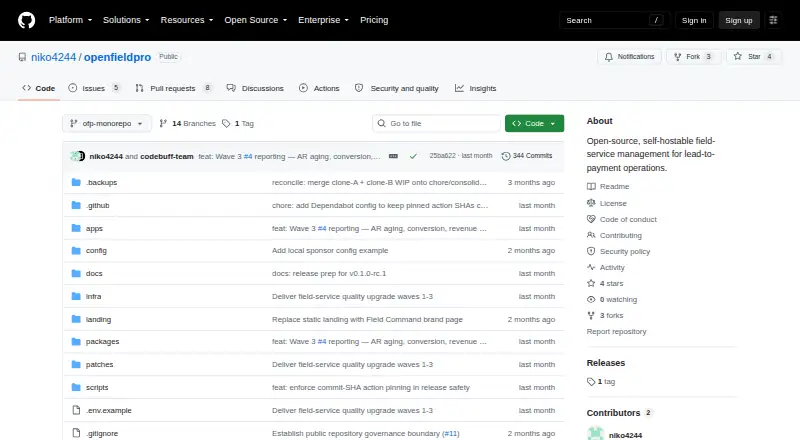
What OpenFieldPro is
OpenFieldPro is open-source field-service management software for operations from lead through payment. Its workflows include CRM, customer and property records, equipment history, scheduling, dispatch, work orders, estimates, invoicing, payments, documents, service plans, reviews and reporting. Technician mobile workflows have offline foundations. Payment capabilities include line-item estimates, invoices, offline payments, optional Stripe checkout and Stripe webhook processing. The integration surface includes a plugin registry, scoped API tokens and outbound events. The project can be self-hosted and includes helpers for installation, updates, backups and restoration. Its listed stack comprises a Next.js web frontend, Fastify API, React Native Expo mobile app and PostgreSQL database. The README says production startup rejects default or short JWT secrets and missing or wildcard production CORS configuration; it also applies bounded route-level rate limits to selected areas. The project describes having no telemetry or phone-home licensing, with optional entitlements verified locally. The AGPL version 3 core costs nothing and has no stated limits on users, technicians, customers, jobs, invoices, locations or core operational features. The project is undergoing release-candidate hardening, and production release still requires its checklist gates.
Who it suits
It suits field-service teams seeking a self-hosted system for managing work from lead through payment. The listed mobile workflows may also suit technicians who need offline foundations.
What it does well
- Covers scheduling, dispatch, work orders and invoicing.
- Technician mobile workflows have offline foundations.
- Includes helpers for installation, updates, backups and restoration.
- Core has no stated limits on users or jobs.
- No telemetry or phone-home licensing is described.
What to know first
- The project is undergoing release-candidate hardening.
- Production release still requires checklist gates.
- Self-hosting requires managing installation and updates.
Limits
The Self-hosted AGPL core costs nothing and has no limits on users, technicians, customers, jobs, invoices, locations or core operational features.
Plans
| Plan | Billed and limits | Price |
|---|---|---|
| Self-hosted AGPL core | No limits on users, technicians, customers, jobs, invoices, locations, or core operational features | Free |
As github.com lists them, read 2 Oct 2026. The maker's own page has the final word.
Getting started
- Open the OpenFieldPro GitHub repository.
- Use the repository's self-hosting installation helpers.
- Choose the web, API, Android or iOS platform that fits your workflow.
- Use the included update, backup and restore helpers as needed.
OpenFieldPro is an open-source field-service management system that connects customer records, scheduling, jobs and payment in a self-hosted package. It is most suitable for service businesses with technical capacity to run their own infrastructure and tailor integrations. The unlimited, no-cost core is attractive, while its release-candidate hardening makes production risk a central buying consideration.
Overview
The system follows a lead-to-payment workflow: CRM records and property details feed scheduling and dispatch, then work orders, estimates, invoices and payments. Equipment history, service plans, documents, reviews and reporting extend it beyond basic job tracking. That breadth can consolidate office operations, but teams wanting a turnkey vendor-operated service will find self-hosting responsibilities and the stated release status significant drawbacks.
OpenFieldPro is licensed under GNU Affero General Public License version 3. Its repository includes helpers for installation, updates, backups and restores, which reduces the routine work of operating a private deployment without removing the need for someone to own that work.
Key features
CRM, customer and property records, equipment history, scheduling, dispatch, work orders, estimates, invoicing, documents, service plans, reviews and reporting cover the main administrative cycle. A dispatch board, online booking, estimate builder and invoice payments are explicitly included, making the core relevant to plumbers and other appointment-based contractors.
Technician mobile workflows have offline foundations, useful when crews work beyond reliable connectivity. Estimates handle line items, and payment workflows include offline payments, optional Stripe checkout and Stripe webhook processing. These options cover common quote-to-cash paths, though the product does not promise every payment provider or method.
A plugin registry, scoped API tokens and outbound events provide an integration surface for teams that need to connect other systems. The listed architecture—Next.js web frontend, Fastify API, React Native Expo mobile app and PostgreSQL—will be most approachable to organizations comfortable maintaining a modern JavaScript and database stack.
Security safeguards include rejecting default or short JWT secrets and wildcard or missing production CORS settings at startup. Bounded route-level rate limits apply to authentication, public booking, uploads and checkout. The project describes no telemetry or phone-home licensing, with optional entitlements verified locally, a meaningful advantage for privacy-conscious operators.
Pricing
| Plan | Price | Includes |
|---|---|---|
| Self-hosted AGPL core | free | No limits on users, technicians, customers, jobs, invoices, locations or core operational features |
The free plan is genuinely unrestricted on the listed operational records, so it fits growing teams that can supply hosting and administration. There is no paid tier described to provide managed hosting or vendor support. Support is handled through GitHub Issues for bugs and feature requests and GitHub Discussions for questions and ideas, which suits community-oriented teams more than organizations requiring a formal service desk.
Platforms
OpenFieldPro provides web, API, Android and iOS access, alongside self-hosted deployment. The combination supports office staff, integrations and technicians without requiring a single device ecosystem.
Who it's for
Choose it for a field-service company that wants ownership of data and deployment, unlimited core usage and the ability to integrate or modify an open-source system. It is a weaker fit for teams without server administration skills, businesses that need a mature production release immediately, or buyers seeking contractual vendor support.
Pros and cons
Pros
- Unlimited users, technicians and core records at no cost, removing growth-based seat and job charges.
- One workflow spans CRM, dispatch, work orders, estimates, invoicing and payments.
- Offline-oriented mobile foundations help technicians working with intermittent connectivity.
- Self-hosting tools, local entitlement checks and no telemetry support deployment and privacy control.
- Scoped tokens, plugins and outbound events offer practical integration points.
Cons
- Release-candidate hardening is still in progress, so production adoption carries software-maturity risk.
- Self-hosting, backups, updates and security configuration remain the customer's responsibility.
- Support is routed through public GitHub Issues and Discussions rather than a stated paid support channel.
- Payment coverage centers on offline payments and Stripe options; broader provider coverage is not established.
Alternatives
Plumbing Software is a useful category starting point when you want to compare plumbing-focused tools.
Pick Opsler instead if a hosted freemium product with Android, iOS, macOS, web and Windows apps suits a small operation; its free Budding plan is limited to two seats and 50 jobs per month.
FieldBench is preferable when you want a conventional freemium service with a one-user, 20-jobs-per-month free tier and a paid Starter option.
Choose ServiceM8 for a freemium mobile-first option whose free plan covers one user and 30 jobs per month, with SMS and AI-use charges.
Contractor+ fits buyers seeking a free-forever plan with basic CRM, up to 250 leads and clients, and five estimates or invoices monthly.
Consider BigChange when you want paid plans with support, live tracking, scheduling, mobile tools, quotes, invoices and business intelligence priced by request.
ServiceWorks is a paid alternative with a Bronze plan at $150 a month and an included API-credit allowance.
Commusoft offers paid, modular plans covering job tracking, forms, contracts, scheduling and online booking, with custom pricing.
Fieldpoint is another paid, self-hostable option with pricing supplied by request.
Verdict
OpenFieldPro is the right choice for technically capable service businesses that want an open-source, self-hosted lead-to-payment platform with unlimited core usage and strong deployment control. Look elsewhere if production maturity, managed hosting or formal support matters more than ownership and zero license cost.
Verdict
OpenFieldPro brings field-service operations and payment workflows into a self-hostable system with web, API and mobile components. Its release-candidate status is a key consideration for prospective production users.
Questions
How much does OpenFieldPro cost?
The Self-hosted AGPL core is free.
Is OpenFieldPro open source?
Yes. The repository uses the GNU Affero General Public License version 3.
Which platforms does it support?
The listed platforms are Android, API, iOS, self-hosted and web.
Can technicians use it offline?
Its technician mobile workflows have offline foundations.
Can it process payments?
The project describes offline payments, optional Stripe checkout and Stripe webhook processing.
Where can users get support?
The support guide directs bug reports and feature requests to GitHub Issues, and questions and ideas to GitHub Discussions.
Facts from OpenFieldPro's own pages
- Core workflows
- It provides CRM, customer and property records, equipment history, scheduling, dispatch, work orders, estimates, invoicing, payments, documents, service plans, reviews, reporting, and technician mobile workflows. · github.com, 2 Oct 2026
- Integrations
- The project describes a plugin registry, scoped API tokens, outbound events, and an integration surface. · github.com, 2 Oct 2026
- License
- The repository license is GNU Affero General Public License version 3. · github.com, 2 Oct 2026
- Payments
- The project describes estimates, line items, invoices, offline payments, optional Stripe checkout, and Stripe webhook processing. · github.com, 2 Oct 2026
- Privacy
- The README describes the project as having no telemetry or phone-home licensing and says optional entitlements are verified locally. · github.com, 2 Oct 2026
- Product
- OpenFieldPro is open-source, self-hostable field-service management software for lead-to-payment operations. · github.com, 2 Oct 2026
- Release status
- The README describes the project as undergoing release-candidate hardening and says production release still requires its release checklist gates. · github.com, 2 Oct 2026
- Security
- The README says production startup rejects default or short JWT secrets and wildcard or missing production CORS configuration, and applies bounded route-level rate limits to authentication, public booking, uploads, and checkout. · github.com, 2 Oct 2026
- Self-hosting
- The repository includes self-hosting install, update, backup, and restore helpers. · github.com, 2 Oct 2026
- Support
- The support guide directs users to GitHub Issues for bugs and feature requests and GitHub Discussions for questions and ideas. · github.com, 2 Oct 2026
- Technician workflows
- The technician mobile workflows have offline foundations. · github.com, 2 Oct 2026
- Technology
- The listed stack includes a Next.js web frontend, Fastify API, React Native Expo mobile app, and PostgreSQL database. · github.com, 2 Oct 2026
Where OpenFieldPro stands on Freedom251
- Plumbing Software#3 of 33