Freedom251 › ACH Payment Processing Software
OpenACH
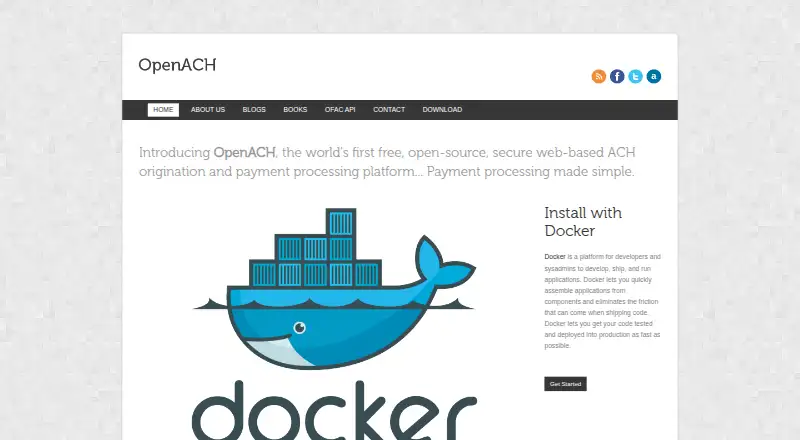
What OpenACH is
OpenACH is an open-source, web-based platform for originating and processing ACH payments. Businesses can use a bring-your-own-bank model, and OpenACH says it can work with any major bank. Its mobile-enabled web interface lets users schedule transactions, while recurring ACH payments and ACH credits are supported. A REST/JSON API connects business software to ACH processing, and the core NACHA libraries convert data into NACHA files for use with existing applications.
OpenACH can be downloaded as a Docker image or as source code for installation on an existing web application server. It is written in PHP and uses PostgreSQL. The free open-source plan is licensed under GPL v3.0 for open-source applications distributed under GPL v3.0. OEMs, ISVs and VARs distributing OpenACH with products without GPL source distribution have a separate commercial license option.
The site reports completed OpenACH integration testing by U.S. Bank and describes a bank plugin for transferring files and handling returns and changes. Docker setup generates an encryption key for data; the configuration file that contains the key should be protected. The maker describes the platform for businesses that need ACH processing, organizations connecting existing payment systems, and developers or system integrators. It invites users to contact its team with simple or technical questions.
Who it suits
OpenACH suits businesses that need ACH processing through their own bank, and organizations integrating payment processing into existing software. Developers and system integrators can use its API, NACHA libraries, Docker image or source installation.
What it does well
- Open-source software is available under GPL v3.0.
- Supports recurring ACH payments and ACH credits.
- REST/JSON API connects business software to ACH processing.
- NACHA libraries convert data into NACHA files.
- Can be installed from a Docker image or source.
- Mobile-enabled web interface schedules transactions.
What to know first
- Free GPL plan requires open-source applications distributed under GPL v3.0.
- Distributors that do not distribute GPL source need a separate commercial license.
- Docker setup requires protecting the configuration file containing the encryption key.
Limits
The free plan is for open-source applications distributed under GPL v3.0. OEMs, ISVs and VARs distributing OpenACH with products without distributing source under GPL v3.0 need a separate commercial license.
Plans
| Plan | Billed and limits | Price |
|---|---|---|
| OpenACH open-source software | Free under GPL v3.0 for GPL-licensed open-source applications · Source-distribution copyleft requirements · self-hosted deployment | Free |
| OEM Commercial License | Contact OpenACH for pricing · For OEMs, ISVs and VARs distributing OpenACH without GPLv3 source distribution | On request |
As openach.com lists them, read 15 Oct 2026. The maker's own page has the final word.
Getting started
- Visit the OpenACH website.
- Choose the Docker image or source code for an existing web application server.
- Install OpenACH using the selected route.
- For Docker setup, protect the configuration file containing the generated encryption key.
- Connect business software through the REST/JSON API or use the web interface to schedule transactions.
OpenACH is a web-based, open-source platform for ACH origination and payment processing, best suited to businesses and integrators able to manage their own deployment and bank connection. Its free GPL edition combines a REST/JSON API with NACHA libraries; the trade-off is that this is a build-and-integrate choice, not a turnkey hosted service.
Overview
OpenACH lets organizations bring a bank of their choice, and says it can process payments through any major bank. That flexibility can be valuable when a business wants ACH processing connected to its existing systems, but it also puts bank setup and deployment on the organization. U.S. Bank completed integration testing, and a bank plugin transfers files and handles returns and changes. This is a useful integration example, though it does not establish that every bank connection will be as direct.
The platform combines a mobile-enabled web interface for scheduling transactions with recurring ACH payments, ACH credit support, and API access. It is written in PHP and uses PostgreSQL, and can be installed from a Docker image or source on an existing web application server. Those options suit technical teams; buyers seeking a managed service should look elsewhere.
Key features
- REST/JSON API: Integrate business software with ACH processing. This is a strong fit for developers building payment workflows into an existing application, but requires integration work rather than a ready-made connection to every system.
- NACHA libraries: The core libraries transform data into NACHA files for use with existing software. Organizations that need file generation without relying on the web interface may find this especially useful.
- Mobile-enabled scheduling: The web front end supports scheduling transactions from mobile devices, giving users a browser-based workflow alongside the API and libraries.
- Bank integration: The platform supports a bring-your-own-bank approach and describes a plugin for file transfers, returns, and changes. The completed U.S. Bank integration testing is a concrete example, not a promise of identical implementation effort with other banks.
- Self-hosted deployment: Docker and source installation let organizations run the software on their own infrastructure. Docker setup generates an encryption key for data; the configuration file containing it must be protected.
- GPL v3.0 licensing: The open-source edition is free under GPL v3.0. Distributors incorporating OpenACH into products without distributing source under GPL need the separate commercial license.
Pricing
OpenACH open-source software — free. This plan is free under GPL v3.0 for open-source applications distributed under GPL. It is the natural starting point for businesses, developers, and integrators able to self-host and accept those terms. The license condition matters: it does not fit distributors who need to keep their product source closed.
OEM Commercial License — custom pricing. This is for OEMs, ISVs, and VARs distributing OpenACH with products without distributing source under GPL v3.0. It addresses the key licensing constraint of the free plan, though the price is custom rather than a published fixed fee.
Platforms
OpenACH supports web, API, self-hosted, Android, and iOS. The web interface is mobile-enabled, while the API provides an integration route for business software. Self-hosting is supported through Docker or source installation; the platform's PHP and PostgreSQL stack makes technical deployment capability important.
Who it's for
OpenACH is aimed at businesses seeking ACH processing, organizations connecting existing payment systems, and developers or system integrators. It is most compelling when a team wants bank choice, NACHA file generation, and an API and can own installation and integration. It is a weaker fit for organizations that want a hosted, ready-to-use service or for commercial distributors unwilling to meet GPL source-distribution terms and not prepared to obtain the commercial license.
Pros and cons
- Pro: No software charge for qualifying use. The open-source plan costs nothing for applications distributed under GPL v3.0.
- Pro: Several integration paths. An API, NACHA libraries, and a bank plugin support different ways to connect ACH processing with existing systems.
- Pro: Deployment choice. Docker or source installation can accommodate organizations running their own web application infrastructure.
- Con: Implementation rests with the adopter. Self-hosting and bank integration call for technical work, making OpenACH less suitable for teams wanting a managed, turnkey service.
- Con: GPL terms constrain some distributions. OEMs, ISVs, and VARs that do not distribute source under GPL v3.0 need the separately priced commercial license.
- Con: Protecting the encryption key is an operational responsibility. The Docker setup places the key in a configuration file that must be secured.
Alternatives
ACH Payment Processing Software is a broader category to explore when comparing ACH tools beyond OpenACH.
- Nickel is worth considering for teams that want a web-based freemium option: Nickel Core is free with three active users, a $25,000 transaction limit, one payment page, and unlimited bills per month.
- ACH Processing Company is a paid API- and web-based alternative.
- ACHPAY.AI may suit buyers looking for a paid API or web option with a free trial; its ACH processing plan is priced on request, up to $5.00 per transaction.
- Paymentus is another option for organizations seeking an enterprise billing and payment platform across Android, API, iOS, and web; pricing is custom.
- ACH Payments is a paid API and web alternative with a ChurchSquare special pricing plan at $0.35 a month, billed $20.00 monthly for three accounts plus reporting and 800# support; ACH transaction fees are .35 each, plus a .01 gateway fee per transaction and $2.50 per ret.
- First ACH API may fit those seeking a paid API or web service with a free trial; custom API integration, programming, or customization requires a proposal.
- GoACH is a paid API and web alternative with custom pricing based on industry, processing volume, and risk profile.
- GoCardless Bank Account Data is a paid API and web alternative.
Verdict
Choose OpenACH if you need ACH processing with bank choice, an API or NACHA libraries, and the ability to self-host under GPL v3.0. Its strongest case is the combination of free qualifying use and flexible integration routes. Look elsewhere if you need a managed service, or obtain the commercial license if you distribute a product without GPL source distribution.
Verdict
Choose OpenACH if you need ACH processing with a bring-your-own-bank setup and want an API, NACHA libraries or self-hosted deployment. Organizations distributing it with products without GPL source distribution should consider the separate commercial license.
Questions
Is OpenACH free?
The open-source software plan is free under GPL v3.0 for open-source applications distributed under GPL v3.0.
What license does OpenACH use?
OpenACH is offered under GPL v3.0. A separate commercial license is available for certain distributors.
How can I install OpenACH?
It can be downloaded as a Docker image or as source for installation on an existing web application server.
Can OpenACH work with my bank?
OpenACH supports a bring-your-own-bank model and says it can use any major bank to process payments.
Does OpenACH provide an API?
Yes. It offers a REST/JSON API for integrating business software with ACH processing.
What is the commercial license for?
It is for OEMs, ISVs and VARs distributing OpenACH with products without distributing source under GPL v3.0.
Facts from OpenACH's own pages
- API
- OpenACH offers a REST/JSON API for integrating business software with ACH payment processing. · openach.com, 4 Oct 2026
- Audience
- The maker describes OpenACH for businesses seeking ACH processing, organizations integrating existing payment systems, and developers or system integrators. · openach.com, 4 Oct 2026
- Bank choice
- The platform supports a bring-your-own-bank model and says it can use any major bank to process payments. · openach.com, 4 Oct 2026
- Bank plugins
- The CLI supports bank-plugin registration and configuration, with documented Manual, U.S. Bank, Wells Fargo and SagePay plugin classes. · openach.com, 15 Oct 2026
- CLI administration
- The command-line tool handles administration tasks such as users, payment profiles, schedulers, bank plugins, migrations and OFAC updates. · openach.com, 15 Oct 2026
- Company headquarters
- EasyOFAC, described on its site as an OpenACH company, lists 401 E 8th St, Suite 214-694, Sioux Falls, South Dakota 57103. · easyofac.com, 15 Oct 2026
- Company registration
- A Sioux Falls business-entity directory lists OPENACH, INC. among active entities. · city-data.com, 15 Oct 2026
- Compliance API detail
- EasyOFAC documents a quota endpoint showing remaining searches, overage counts, monitored-entity counts and billing-cycle dates. · easyofac.com, 15 Oct 2026
- Credit and debit ACH
- Payment types can represent credits deposited into external accounts or debits withdrawn from them. · openach.com, 15 Oct 2026
- Deployment
- OpenACH can be downloaded as a Docker image or as source for installation on an existing web application server. · openach.com, 4 Oct 2026
- Documentation scope
- The developer guide covers application structure, code organization, extension points, SDK integration and database relationships. · openach.com, 15 Oct 2026
- External identifiers
- Payment profiles can be linked to a customer system through an external ID. · openach.com, 15 Oct 2026
- Independent registry capabilities
- The IDB description attributes automated ACH processing, batch processing, user management, reporting and audit functions to OpenACH. · knowledge.iadb.org, 15 Oct 2026
- Independent registry description
- The Inter-American Development Bank registry lists OpenACH as a JavaScript API tool under GPLv3, version 1.9.4. · knowledge.iadb.org, 15 Oct 2026
- Independent repository activity
- GitHub shows the public repository with 131 stars, 56 forks, zero listed issues and two pull requests when viewed in October 2026. · github.com, 15 Oct 2026
- Integrations
- The site reports that U.S. Bank completed OpenACH integration testing and describes a bank plugin for transferring files and handling returns and changes. · openach.com, 4 Oct 2026
- Language extensibility
- Because endpoints accept REST/JSON calls, developers can access them from any language capable of those requests and port the SDK. · openach.com, 15 Oct 2026
- Legacy installation prerequisites
- The installation guide lists Apache 2.2+, PostgreSQL 9.1+, PHP 5.3+, Yii 1.1.14+, PostgreSQL, mcrypt, cURL and DoubleMetaphone modules. · openach.com, 15 Oct 2026
- License
- The repository license identifies the OpenACH Community License as GNU GPL version 3. · github.com, 15 Oct 2026
- Limit: deployment complexity
- The source-install route is described as more involved than Docker and requires web-server, database, permissions and encryption-key configuration. · openach.com, 15 Oct 2026
- Limit: Linux skills
- The CLI guide says administrators need to be comfortable with Linux command-line basics because the CLI is the primary administration interface. · openach.com, 15 Oct 2026
- Limit: payment-type editing
- Payment types can only be modified through the OpenACH web interface; the API exposes them for reference when schedules are created. · openach.com, 15 Oct 2026
- Limit: web interface role
- The CLI documentation says the web interface is mainly for reference and that most work is expected to happen through API integration. · openach.com, 15 Oct 2026
- Mobile access
- The interface is described as mobile-enabled for managing ACH processing from different locations. · openach.com, 15 Oct 2026
Where OpenACH stands on Freedom251
- ACH Payment Processing Software#1 of 21