Freedom251 › Cloud Access Security Broker Software
Octelium
What Octelium is
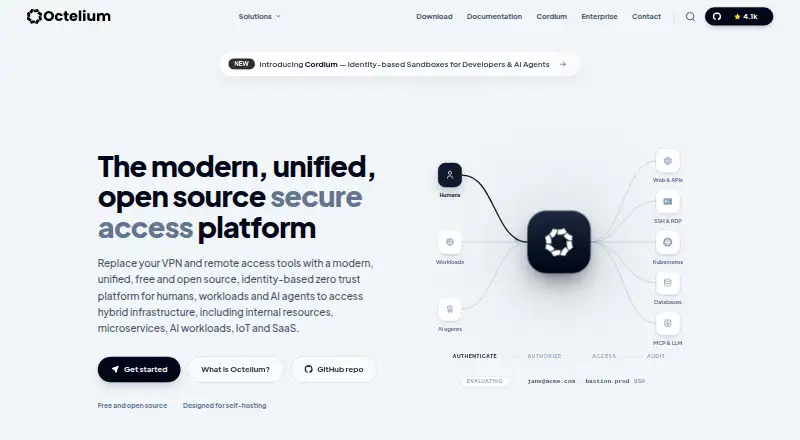
Octelium is an open-source, self-hosted access platform for people, workloads, and AI agents connecting to infrastructure, SaaS, and applications across hybrid environments. It runs on Kubernetes and places protected resources behind identity-aware proxies, where policies authorize requests at the application layer. Its listed protocols and services include HTTP, gRPC, web applications, SSH, Kubernetes, PostgreSQL, MySQL, RDP, DNS, SOCKS5, TCP, UDP, MCP, and LLM modes.
Upstream credentials can be held as Cluster Secrets and injected after authorization, so users and workloads do not need to carry them. Human identity integrations include OIDC and SAML 2.0 providers such as Okta, Microsoft Entra ID, Google Workspace, Keycloak, and Auth0, plus GitHub OAuth2. Native authentication options include FIDO2 and WebAuthn passkeys, TPM 2.0, and TOTP.
The MCP gateway can authorize tool calls and arguments. The LLM gateway can apply model and token limits and record token usage. Octelium describes OpenTelemetry-based, layer-7-aware logs and metrics covering request details, database queries, Kubernetes operations, and SSH session recordings. A quick installer can provision a single-node Cluster on a fresh Linux VM or server; larger deployments can use managed or on-premises multi-node Kubernetes.
Who it suits
Octelium suits teams that need self-hosted, policy-based access to hybrid infrastructure, SaaS, and applications for people, workloads, or AI agents. Its listed protocols, identity options, and Kubernetes deployment choices are relevant to organizations managing varied services and access paths.
What it does well
- Open-source and self-hosted, with a free forever plan for personal and evaluation use.
- Supports a broad set of protocols, including SSH, databases, Kubernetes, MCP, and LLM modes.
- Can inject stored upstream credentials after authorization.
- Offers passkeys, TPM 2.0, and TOTP authentication options.
- Provides request, database, Kubernetes, and SSH activity telemetry.
- Quick installer provisions a single-node Cluster on a fresh Linux VM or server.
What to know first
- The free plan is limited to personal and evaluation use.
- Octelium runs on Kubernetes.
- Commercial licensing and premium support are in the Enterprise package.
Limits
The free and open-source plan is self-hosted and free forever for personal and evaluation use. The Enterprise package lists commercial licensing, premium support, and enterprise features, with pricing available by contacting Octelium.
Plans
| Plan | Billed and limits | Price |
|---|---|---|
| Free and open source | Self-hosted; free forever for personal and evaluation use | Free |
| Enterprise package | Contact Octelium · Commercial license; premium support; enterprise features | On request |
As octelium.com lists them, read 8 Oct 2026. The maker's own page has the final word.
Getting started
- Visit the Octelium website.
- Choose the free and open-source plan for personal or evaluation use, or contact Octelium about the Enterprise package.
- Prepare a fresh Linux VM or server for a single-node Cluster, or use managed or on-premises multi-node Kubernetes for a larger deployment.
- Use the quick installer to provision a single-node Cluster, or deploy on Kubernetes.
- Connect identity providers and configure access policies for protected resources.
Octelium is an open-source, self-hosted access platform for people, workloads, and AI agents working across applications and hybrid infrastructure. It suits Kubernetes operators who need application-level access policies across varied services. Its breadth is a strong reason to consider it; the requirement to run Kubernetes is a substantial operational commitment.
Overview
Octelium puts protected resources behind identity-aware proxies and evaluates requests with policies at the application layer. That gives teams a way to govern access across SaaS, applications, and hybrid infrastructure in one platform. It reaches beyond conventional remote network access, which makes it a better fit for organizations with varied services and identities than for teams seeking only a straightforward business VPN.
Deployment runs on Kubernetes. A quick installer can provision a single-node Cluster on a fresh Linux server or VM, while larger deployments can use managed or on-premises multi-node Kubernetes. The installer provides a practical route to evaluation, but production use still calls for Kubernetes operations.
Key features
The protocol range includes HTTP, gRPC, web applications, SSH, Kubernetes, PostgreSQL, MySQL, RDP, DNS, SOCKS5, TCP, UDP, MCP, and LLM modes. That coverage can bring application, database, infrastructure, and AI access into a shared policy model. Organizations with a narrow access need may find the breadth unnecessary relative to the work of running the platform.
Human identity integrations support OIDC and SAML 2.0 providers including Okta, Microsoft Entra ID, Google Workspace, Keycloak, and Auth0, as well as GitHub OAuth2. Native authentication includes FIDO2 and WebAuthn passkeys, TPM 2.0, and TOTP. This mix gives teams several ways to connect existing identity systems and authenticate users.
Octelium stores upstream credentials as Cluster Secrets and injects them after authorization. Users and workloads therefore do not need to carry those credentials, a useful separation for access to protected services.
Its MCP gateway can authorize tool calls and their arguments, while the LLM gateway can enforce model and token limits and record token usage. These controls make Octelium relevant to teams governing AI access alongside conventional services, rather than adding a separate policy layer only for AI tools.
OpenTelemetry-based, layer-7-aware logs and metrics can capture request details, database queries, Kubernetes operations, and SSH session recordings. Enterprise telemetry integrations include Datadog, Splunk, Elastic, Grafana, ClickHouse, Kafka, Prometheus, Azure Monitor, and Logz.io. Octelium says its identity-aware application auditing can provide access evidence for SOC 2, ISO/IEC 27001, and internal security controls; that evidence can support compliance work, though it does not itself establish compliance.
Pricing
Free and open source: free, self-hosted, and free forever for personal and evaluation use. This is the route for individuals and teams assessing the platform. Its stated use is personal and evaluation, so organizations needing commercial rights should consider the Enterprise package.
Enterprise package: custom pricing, billed by contacting Octelium. It includes a commercial license, premium support, and enterprise features: a web console, SCIM 2.0 provisioning, encrypted Secret management, just-in-time access, multi-region Clusters, and managed upgrades. This package is aimed at organizations that need those capabilities and commercial licensing; it carries a quote-based buying process.
Platforms
Octelium supports API, Linux, web, and self-hosted deployments, with a hybrid deployment model and both inline and API-based controls. Kubernetes is the runtime foundation: a single-node Cluster can run on a fresh Linux VM or server, while larger installations can use managed or on-premises multi-node Kubernetes. Teams without Kubernetes capacity should weigh that requirement before choosing it.
Who it's for
Octelium is a strong candidate for Kubernetes-running organizations that need policy-based access for people, workloads, and AI agents across multiple protocols. Its secret injection, identity options, and detailed access telemetry are especially relevant where teams need to control credentials and understand activity at the application layer.
It is less compelling for a small team with a single, conventional remote-access requirement or for an organization unable to operate Kubernetes. The free plan supports personal and evaluation use; teams moving into commercial use should account for the Enterprise package.
Pros and cons
- Broad service coverage: Support for web, databases, infrastructure protocols, and MCP/LLM modes can reduce the need for separate access policy layers.
- Credentials stay out of users' hands: Cluster Secrets are injected after authorization, so users and workloads need not hold upstream credentials.
- Detailed activity visibility: Layer-7 logs and metrics include database, Kubernetes, and SSH activity, with integrations for a range of telemetry platforms.
- Kubernetes is required: Even the single-node installer provisions a Kubernetes Cluster, adding an operational prerequisite that may rule it out for some teams.
- Commercial use requires Enterprise: The free plan is for personal and evaluation use; commercial licensing and premium support are in the custom-priced package.
Alternatives
Cloudflare Access is a practical alternative for organizations wanting a freemium option with a free plan under 50 users and a listed Pay-as-you-go plan at $7 a month. Its broader platform support also spans mobile and desktop operating systems, while Octelium centers on self-hosted Kubernetes access and a wide protocol set.
Dope Security CASB Neural may suit teams prioritizing a paid secure web gateway with on-device SSL inspection, URL filtering, cloud app controls, anti-malware, and Shadow IT discovery for Mac and Windows. Octelium is the more relevant fit when the goal is identity-aware access to infrastructure and applications across many protocols.
Airtel Business Connect is another paid option to compare for business connectivity. Netskope One CASB and Versa Cloud Access Security Broker are paid CASB alternatives. Check Point Harmony SASE offers a 30-day trial before a license is required. Fortra ZTNA is a paid option with demo and quote requests. Netskope One Private Access is a paid enterprise product with a free trial. These are alternatives to compare when their product category or platform coverage better matches a team's requirements.
Readers comparing the broader categories can also browse Cloud Access Security Broker Software and Business VPN Software.
Verdict
Choose Octelium if your organization already runs Kubernetes and needs one application-layer policy platform for human, workload, and AI access across varied services. Its strongest case is the combination of protocol breadth, secret injection, and detailed auditing. Look elsewhere if Kubernetes is outside your operating model, or if you need a commercial license and support without moving to a custom-priced Enterprise package.
Verdict
Choose Octelium if you need an open-source, self-hosted access platform with application-layer policies and support for a wide range of services. Its free plan is for personal and evaluation use; teams seeking commercial licensing, premium support, or listed enterprise features should look at the Enterprise package.
Questions
Is Octelium free?
Its Free and open source plan costs nothing and is free forever for personal and evaluation use.
Is Octelium open source?
Yes. The listed Free and open source plan is self-hosted.
What platforms does Octelium support?
Its listed platforms are API, Linux, self-hosted, and web. It runs on Kubernetes.
What identity providers and authentication methods are listed?
Human identity support includes OIDC and SAML 2.0 providers such as Okta, Microsoft Entra ID, Google Workspace, Keycloak, and Auth0; GitHub OAuth2 is also listed. Native options include FIDO2 and WebAuthn passkeys, TPM 2.0, and TOTP.
What does the Enterprise package include?
It lists a web console, SCIM 2.0 provisioning, encrypted Secret management, just-in-time access, multi-region Clusters, managed upgrades, premium support, and commercial licensing.
How do I get started with a single-node deployment?
Octelium's quick installer can provision a single-node Cluster on a fresh Linux VM or server.
Facts from Octelium's own pages
- Access model
- It places protected resources behind identity-aware proxies and authorizes requests at the application layer using policies. · octelium.com, 8 Oct 2026
- AI gateway
- Its MCP gateway can authorize tool calls and arguments, while its LLM gateway can apply model and token limits and record token usage. · octelium.com, 8 Oct 2026
- Authentication
- Native authentication options include FIDO2 and WebAuthn passkeys, TPM 2.0, and TOTP. · octelium.com, 8 Oct 2026
- Company history
- Octelium says development began in 2020 and Octelium Labs, LLC was established in January 2025. · octelium.com, 8 Oct 2026
- Deployment
- Octelium runs on Kubernetes; its quick installer can provision a single-node Cluster on a fresh Linux VM or server, and larger deployments can use managed or on-premises multi-node Kubernetes. · octelium.com, 8 Oct 2026
- Enterprise features
- The enterprise package lists a web console, SCIM 2.0 provisioning, encrypted Secret management, just-in-time access, multi-region Clusters, managed upgrades, premium support, and commercial licensing. · octelium.com, 8 Oct 2026
- Free plan
- Yes · octelium.com, 20 Sept 2026
- Identity integrations
- Human identity support includes OIDC and SAML 2.0 providers such as Okta, Microsoft Entra ID, Google Workspace, Keycloak, and Auth0; GitHub OAuth2 is also listed. · octelium.com, 8 Oct 2026
- Secretless access
- Upstream credentials are stored as Cluster Secrets and injected after authorization so users and workloads do not need to hold them. · octelium.com, 8 Oct 2026
- Security evidence
- Octelium says its identity-aware, application-level auditing can provide access evidence for SOC 2, ISO/IEC 27001, and internal security controls. · octelium.com, 8 Oct 2026
- SIEM integrations
- The enterprise page lists telemetry integrations including Datadog, Splunk, Elastic, Grafana, ClickHouse, Kafka, Prometheus, Azure Monitor, and Logz.io. · octelium.com, 8 Oct 2026
- Supported protocols
- The product lists HTTP, gRPC, web applications, SSH, Kubernetes, PostgreSQL, MySQL, RDP, DNS, SOCKS5, TCP, UDP, MCP, and LLM modes. · octelium.com, 8 Oct 2026
- Visibility and auditing
- The platform describes OpenTelemetry-based, layer-7-aware logs and metrics, including request details, database queries, Kubernetes operations, and SSH session recordings. · octelium.com, 8 Oct 2026
- What it does
- Octelium is an open-source, self-hosted secure access platform for humans, workloads, and AI agents accessing hybrid infrastructure, SaaS, and applications. · octelium.com, 8 Oct 2026
Where Octelium stands on Freedom251
- Cloud Access Security Broker Software#1 of 27
- Business VPN Software#16 of 94
- SSH Server Software#8 of 34
- Zero Trust Platforms#8 of 23