Freedom251 › Game Boy Emulators
Ocelot
What Ocelot is
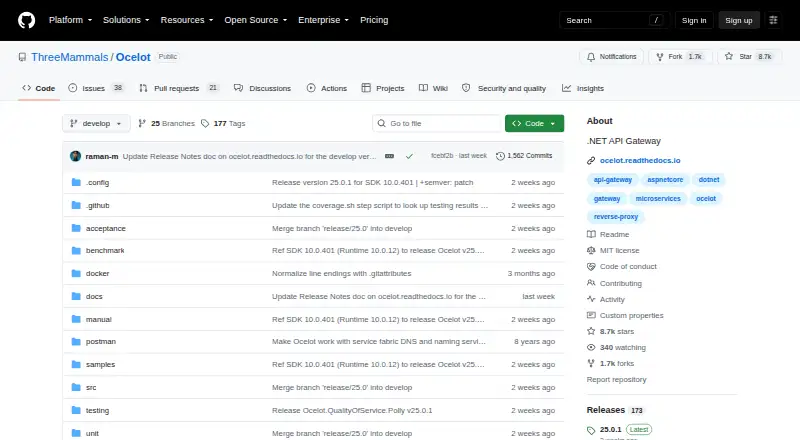
Ocelot is an open-source .NET API gateway for microservices that need a shared entry point for HTTP and HTTPS services. It runs as an ASP.NET Core application and supports platforms supported by ASP.NET Core. Developers install it as a NuGet package, then configure static or dynamic routes. Gateway capabilities include caching, request aggregation, authentication, load balancing, rate limiting, logging, and request and response transformations. It also supports WebSocket and secure WebSocket connections, plus service discovery through Consul, Kubernetes, Eureka, and Azure Service Fabric. Routes can use registered ASP.NET Core authentication schemes, including JWT bearer tokens, and restrict access by scope. Its documentation includes examples for Auth0 and Okta and describes IdentityServer bearer tokens. Ocelot targets .NET 8, .NET 9, and .NET 10. It is self-hosted, MIT-licensed, and priced at $0. The project does not directly support GraphQL; it points developers to GraphQL for .NET as an integration option.
Who it suits
Ocelot suits teams building microservices on ASP.NET Core that want to route service traffic through a configurable gateway. It is a fit for developers who can install and operate a self-hosted .NET application and need gateway features such as authentication, service discovery, or rate limiting.
What it does well
- Free and MIT-licensed.
- Supports static and dynamic routes.
- Includes caching, load balancing, and rate limiting.
- Service discovery supports Consul, Kubernetes, Eureka, and Azure Service Fabric.
- Supports WebSocket and secure WebSocket connections.
What to know first
- Does not directly support GraphQL.
- Requires deployment as an ASP.NET Core application.
Plans
| Plan | Billed and limits | Price |
|---|---|---|
| Ocelot | MIT-licensed open-source .NET API gateway | Free |
As github.com lists them, read 9 Oct 2026. The maker's own page has the final word.
Getting started
- Open the Ocelot project website on GitHub.
- Create an ASP.NET Core project targeting .NET 8, .NET 9, or .NET 10.
- Install Ocelot as a NuGet package.
- Configure routes and any required gateway features.
- Deploy the configured ASP.NET Core application.
Verdict
Choose Ocelot if you need a free, self-hosted gateway for HTTP(S) microservices built on ASP.NET Core, with routing, authentication, and service discovery options. Look elsewhere if direct GraphQL support is required; the project points to GraphQL for .NET for integration.
Questions
How much does Ocelot cost?
The Ocelot plan is free. The project is open source under the MIT license.
Where does Ocelot run?
Ocelot is deployed as a self-hosted ASP.NET Core application. It targets .NET 8, .NET 9, and .NET 10.
What protocols does Ocelot support?
It supports HTTP, HTTPS, WebSocket, and secure WebSocket (WSS) services on platforms supported by ASP.NET Core.
Which authentication methods can routes use?
Routes can use registered ASP.NET Core authentication schemes, including JWT bearer tokens and IdentityServer bearer tokens, and can restrict access by scope.
Does Ocelot support GraphQL?
It does not directly support GraphQL. The project points developers to GraphQL for .NET for integration.
Which service discovery providers are documented?
Ocelot documents Consul, Kubernetes, Eureka, and Azure Service Fabric providers.
Facts from Ocelot's own pages
- Authentication
- Routes can use registered authentication schemes, including JWT bearer schemes, and can restrict access by scopes. · ocelot.readthedocs.io, 9 Oct 2026
- Deployment
- Ocelot is configured and deployed as an ASP.NET Core application, and the documentation includes multiple-instance, Consul, and Service Fabric configurations. · ocelot.readthedocs.io, 9 Oct 2026
- Gateway features
- Listed features include caching, request aggregation, authentication, load balancing, rate limiting, logging, and request and response transformations. · github.com, 9 Oct 2026
- GraphQL limit
- The project says it does not directly support GraphQL and points developers to the GraphQL for .NET library for integration. · github.com, 9 Oct 2026
- HTTP support
- It works with HTTP(S) services on platforms supported by ASP.NET Core. · ocelot.readthedocs.io, 9 Oct 2026
- Integrations
- The authentication documentation includes examples for Auth0 and Okta, and describes using IdentityServer bearer tokens. · ocelot.readthedocs.io, 9 Oct 2026
- License
- The GitHub repository identifies the project license as MIT. · github.com, 9 Oct 2026
- Purpose
- Ocelot is a .NET API gateway for microservices architectures that need a unified point of entry. · ocelot.readthedocs.io, 9 Oct 2026
- Routing
- Its primary features include configuration and routing, with support for static and dynamic routes. · ocelot.readthedocs.io, 9 Oct 2026
- Runtime
- Ocelot targets .NET 8, .NET 9, and .NET 10 and is installed as a NuGet package in an ASP.NET Core project. · ocelot.readthedocs.io, 9 Oct 2026
- Security policy
- The GitHub repository reports that it has not set up a SECURITY.md file and has no published security advisories. · github.com, 9 Oct 2026
- Service discovery
- Documented service discovery providers include Consul, Kubernetes, Eureka, and Azure Service Fabric. · github.com, 9 Oct 2026
- WebSockets
- The documentation lists WebSockets, including secure WebSockets, as supported features. · ocelot.readthedocs.io, 9 Oct 2026
Where Ocelot stands on Freedom251
- Game Boy Emulators#12 of 23
- API Gateway Software#16 of 29