Freedom251 › Database Replication Software

NineData
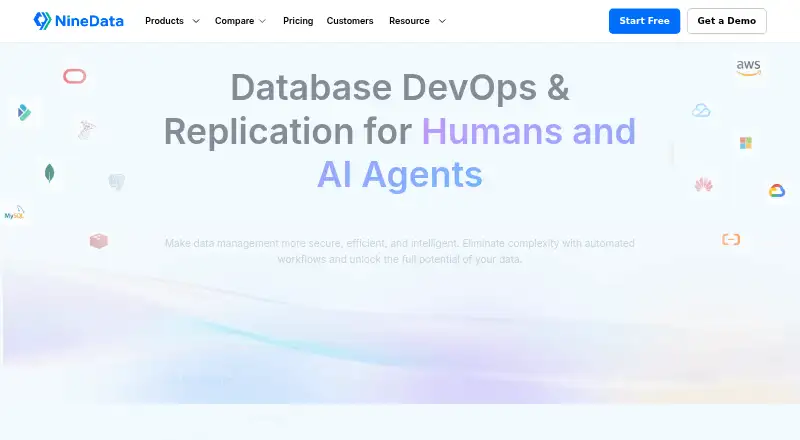
What NineData is
NineData is a platform for database DevOps, replication, comparison, and AI-assisted data management. Its DevOps tools cover SQL standards review, approval workflows, automated release and rollback, archiving, and change tracking. Replication supports similar or different source types, cross-region synchronization, and migration across clouds and environments. Data Comparison offers full, sampling-based, feature-column, and incremental checks, with generated repair SQL and DDL scripts. AI functions include slow SQL optimization and natural-language SQL generation, with support for multiple large language models. The platform lists relational and NoSQL databases, warehouses, and analytical systems, alongside cloud vendors including AWS, Azure, Alibaba Cloud, Tencent Cloud, and Google Cloud. Community runs on-premise in a single-node Docker deployment; SaaS is managed in the cloud, while Enterprise can run in private environments. Community is free and limited to 10 data sources and 10 replication tasks. SaaS Data Replication starts at $30 a month, billed according to task volume and specifications.
Who it suits
NineData may suit teams managing database changes, moving or comparing data across different systems, or using AI-assisted SQL tools. Community fits users who can work within its 10-source and 10-task limits; organizations needing managed or private deployments can consider its other editions.
What it does well
- Automates SQL review, approval, release, and rollback workflows.
- Replication supports cross-region and cross-cloud movement.
- Comparison can generate repair SQL and DDL scripts.
- Community is free with on-premise deployment.
- Supports relational, NoSQL, warehouse, and analytical databases.
What to know first
- Community is limited to 10 data sources.
- Community is limited to 10 replication tasks.
- SaaS replication starts at $30 a month.
- Enterprise pricing is custom and not listed.
Limits
Community includes up to 10 data sources and 10 replication tasks. The SaaS free tier supports up to 10 data sources with no time limit; paid SaaS plans are billed by task volume and specifications.
Plans
| Plan | Billed and limits | Price |
|---|---|---|
| Community | Free / forever · on-premise · up to 10 data sources · up to 10 replication tasks · single-node Docker · community support | Free |
| SaaS Data DevOps | from $1000 / mo; billed by task volume and specifications · 10 data sources included · high availability · private network connectivity · dedicated enterprise support for paid customers | $1,000 a month |
| SaaS Data Replication | from $30 / mo; billed by task volume and specifications · 10 data sources included · high availability · private network connectivity · dedicated enterprise support for paid customers | $30 a month |
| Enterprise | Custom; contact us · on-premise · on-demand data sources and replication tasks · HA cluster architecture · advanced governance and security · dedicated enterprise support | On request |
As ninedataglobal.com lists them, read 15 Oct 2026. The maker's own page has the final word.
Getting started
- Visit the NineData website.
- Choose Community for on-premise deployment, SaaS, or Enterprise for a private environment.
- For Community, use the single-node Docker deployment.
- For SaaS, select Data Replication or Data DevOps and review its task-volume and specification pricing.
- Connect supported data sources and cloud vendors for the database workflows you need.
- Use the documented OpenAPI endpoint to execute SQL through the SQL Console execution flow.
NineData brings database change governance, data movement, comparison, and AI-assisted SQL into one platform. It is a strong fit for teams working across database types or cloud environments that need several of those jobs under one roof. Teams focused only on replication may find its broader scope—and the paid SaaS plans’ task-based pricing—harder to justify.
Overview
The platform spans SQL change workflows, replication, data comparison, and AI-assisted SQL tasks. That combination is most useful when database teams need to manage changes as well as move or reconcile data; it is less compelling if the requirement is a single, narrow data-movement function.
NineData supports relational databases including MySQL, PostgreSQL, Oracle, and SQL Server; NoSQL systems such as MongoDB, Redis, and Milvus; and analytical platforms including ClickHouse, Doris, StarRocks, Hive, and MaxCompute. Its cloud integrations include Alibaba Cloud, Tencent Cloud, Huawei Cloud, AWS, Mobile Cloud, Baidu Cloud, Google Cloud, and Azure. That range makes it relevant to mixed estates, though buyers should still confirm their particular source and target combination.
Key features
Database DevOps and governance
SQL standards review, approval workflows, automated release and rollback, archiving, and change tracking give teams a defined path for database changes. RBAC, enterprise SSO, sensitive-data masking, and syntax review address access control and review needs that matter in governed environments. Smaller teams without formal change processes may not benefit enough to make these capabilities central to their choice.
Replication and comparison
Replication handles homogeneous and heterogeneous sources, two-way movement, cross-region synchronization, and cross-cloud or cross-environment migration. Change data capture and transformations extend its role beyond straightforward copies. Comparison can run as a full, sampling-based, feature-column, or incremental check, then generate repair SQL and DDL scripts. Those options suit teams reconciling large or varied data sets, while teams needing only a simple one-way feed may prefer a narrower tool.
AI-assisted SQL
NineData describes slow-SQL optimization, natural-language SQL generation, and support for multiple large language models. These functions may help teams that want SQL assistance alongside database operations, but the platform's broader governance and replication capabilities remain the more substantial reasons to consider it.
Pricing
The Community plan is free, billed Free / forever. It provides on-premise deployment, single-node Docker deployment, community support, up to 10 data sources, and up to 10 replication tasks. This is the clearest starting point for a small deployment or evaluation, but the task ceiling and single-node architecture limit its fit for larger or high-availability needs.
SaaS Data Replication costs $30 a month, billed from $30 / mo, with charges based on task volume and specifications. It includes 10 data sources, high availability, private network connectivity, and dedicated enterprise support for paid customers. It is the lower-cost paid route for teams primarily moving data, but the starting price is not a fixed total when usage and specifications determine the bill.
SaaS Data DevOps costs $1,000 a month, billed from $1000 / mo, also based on task volume and specifications. It includes 10 data sources, high availability, private network connectivity, and dedicated enterprise support for paid customers. This is aimed at teams that need the DevOps offering in a managed-cloud deployment; its substantially higher starting price makes it difficult to justify for replication-only needs.
Enterprise uses custom pricing. It offers on-premise deployment, data sources and replication tasks purchased on demand, high-availability cluster architecture, advanced governance and security features, and dedicated enterprise support. It suits organizations requiring private deployment or capacity beyond Community's caps, but requires a custom quote.
Platforms
NineData offers a web platform and API, alongside self-hosted deployment. Community runs on-premise as a single-node Docker deployment, SaaS is fully managed cloud, and Enterprise is available for private environments. Windows documentation covers accessing a self-built MySQL data source through an SSH tunnel. The documented OpenAPI endpoint executes SQL through the SQL Console flow, a focused integration point rather than a claim of broad API coverage.
The homepage lists AWS FTR, ISO 27001, ISO 27017, ISO 9001, and ISO 20000 certifications. These are relevant credentials for organizations evaluating security and operational controls, alongside the product's access-management features.
Who it's for
NineData is best for database teams whose work spans change control, replication, and comparison across multiple systems or cloud vendors. Community offers a bounded on-premise entry point; paid SaaS adds high availability and private-network connectivity, while Enterprise provides private deployment and configurable capacity. It is a weaker fit for a team that needs only basic replication or cannot predict task-based SaaS costs.
Pros and cons
- Pros: Combines SQL governance, replication, comparison, and AI-assisted SQL, which can consolidate several database workflows.
- Pros: Supports two-way replication, change data capture, transformations, and cross-region movement across a broad set of database and cloud types.
- Pros: Offers deployment choices from free single-node Docker to managed SaaS and private Enterprise environments.
- Cons: Community is capped at 10 data sources and 10 replication tasks, and its single-node setup does not provide the high-availability architecture of paid offerings.
- Cons: SaaS charges vary with task volume and specifications, so the starting prices do not establish a predictable final cost.
- Cons: SaaS Data DevOps starts at $1,000 a month, a substantial commitment for teams that do not need its DevOps scope.
Alternatives
Database Replication Software is a useful category starting point if you want to compare replication tools more broadly.
- SymmetricDS is worth considering if its free, AGPL v3 Community plan and broad platform coverage suit your deployment needs.
- DBConvert Streams may fit users who want its free IDE, browser viewers, and editor extensions, with federated queries over two sources.
- dsync is an option for small projects and testing where a free, open-source plan with best-effort support is sufficient.
- Debezium is a free, Apache License 2.0 change data capture platform for teams seeking that focused capability.
- Artie may suit teams whose pipeline needs fit its free tier of up to 1M billable rows per month and two active pipelines.
- Bucardo is a free, open-source BSD-licensed alternative for Linux, macOS, or self-hosted use.
- DBSync offers a free Developer plan capped at two connectors, 10,000 records, and three objects; its Professional plan starts at $999 a month.
- Google Cloud Datastream may be a fit for eligible AlloyDB and Spanner sources to BigQuery, with 100 GiB of CDC data per month per billing account in its free tier.
Verdict
Choose NineData if your team needs database governance alongside replication and comparison across a varied estate, and values having self-hosted, managed-cloud, and private-environment deployment options. Its strongest case is the breadth of related workflows in one platform. Look elsewhere if you need only a focused replication tool, or if task-based SaaS pricing and the high starting price of Data DevOps do not match your budget.
Verdict
NineData covers database change management, replication, comparison, and AI-assisted SQL work in multiple deployment models. Community has explicit source and task limits, while paid SaaS costs depend on task volume and specifications.
Questions
Is NineData free?
Yes. Community costs nothing and is billed free forever. The SaaS free tier supports up to 10 data sources with no time limit.
How much do the paid plans cost?
SaaS Data Replication is $30 a month, billed from $30 / mo. SaaS Data DevOps is $1,000 a month, billed from $1000 / mo; both are billed by task volume and specifications. Enterprise is custom priced.
Which deployment options does NineData offer?
Community is on-premise with single-node Docker deployment, SaaS is fully managed cloud, and Enterprise is available for private environments.
Which databases and clouds does it support?
Listed sources include MySQL, PostgreSQL, Oracle, SQL Server, MongoDB, Redis, Milvus, ClickHouse, Doris, StarRocks, Hive, and MaxCompute, among others. Listed cloud vendors include Alibaba Cloud, Tencent Cloud, Huawei Cloud, AWS, Mobile Cloud, Baidu Cloud, Google Cloud, and Azure.
What security and access controls are listed?
NineData lists AWS FTR, ISO 27001, ISO 27017, ISO 9001, and ISO 20000 certifications. Database DevOps lists RBAC, enterprise SSO integration, sensitive data masking, and syntax and standards review.
Can I use its API?
Yes. NineData documents an OpenAPI endpoint for executing SQL through the SQL Console execution flow.
Facts from NineData's own pages
- Access controls
- Database DevOps lists RBAC, enterprise SSO integration, sensitive data masking, and syntax and standards review. · ninedataglobal.com, 29 Sept 2026
- AI
- The platform describes AI features including slow SQL optimization, natural-language SQL generation, and support for multiple large language models. · ninedataglobal.com, 29 Sept 2026
- AI agents
- Community Edition includes ChatDBA, SQL diagnosis, SQL optimization and migration assessment capabilities. · docs.ninedataglobal.com, 15 Oct 2026
- Air-gapped deployment
- The pricing FAQ says Community and Enterprise can run fully offline in air-gapped or isolated networks. · ninedataglobal.com, 15 Oct 2026
- API
- NineData documents an OpenAPI endpoint for executing SQL through the SQL Console execution flow. · docs.ninedataglobal.com, 29 Sept 2026
- API authentication
- OpenAPI requests use AccessKey ID, SecretKey-derived SHA-256 signatures and UTC timestamps rejected when more than ten minutes from server time. · docs.ninedataglobal.com, 15 Oct 2026
- API examples
- The developer documentation provides Bash and Java examples plus curl calls for listing, creating, updating and deleting data sources. · docs.ninedataglobal.com, 15 Oct 2026
- Backup and restore
- The documentation includes backup policies, backup sets and restore workflows for supported sources. · docs.ninedataglobal.com, 15 Oct 2026
- Cloud integrations
- The documentation lists Alibaba Cloud, Tencent Cloud, Huawei Cloud, AWS, Mobile Cloud, Baidu Cloud, Google Cloud, and Azure as supported cloud vendors. · docs.ninedataglobal.com, 29 Sept 2026
- Community limits
- Community Edition is limited to ten data sources, ten replication tasks including two incremental tasks, and ten comparison tasks. · docs.ninedataglobal.com, 15 Oct 2026
- Community support
- Community support is documentation plus a WeChat group, while Enterprise offers dedicated 7x24 support and SLA service. · docs.ninedataglobal.com, 15 Oct 2026
- Company legal name
- The privacy policy identifies the provider as Jiuzhang Arithmetic (Zhejiang) Technology Co., Ltd. · docs.ninedataglobal.com, 15 Oct 2026
- Comparison
- Data Comparison supports full, sampling-based, feature-column, and incremental comparisons, and can generate repair SQL and DDL scripts. · ninedataglobal.com, 29 Sept 2026
- Database comparison
- Comparison checks schemas and data between sources and can generate SQL to remediate differences. · docs.ninedataglobal.com, 15 Oct 2026
- Database DevOps
- The platform provides browser SQL work, querying, SQL standards, review, approvals, controlled releases and audit trails. · docs.ninedataglobal.com, 15 Oct 2026
- Database integrations
- Supported data sources include relational databases such as MySQL, PostgreSQL, Oracle, and SQL Server; NoSQL databases such as MongoDB, Redis, and Milvus; and warehouses including ClickHouse, Doris, StarRocks, Hive, and MaxCompute. · docs.ninedataglobal.com, 29 Sept 2026
- Data replication
- Replication supports schema, full and incremental synchronization, including one-way and bidirectional workflows. · docs.ninedataglobal.com, 15 Oct 2026
- Deployment
- NineData describes Community as on-premise and single-node Docker deployed, SaaS as fully managed cloud, and Enterprise as available for private environments. · ninedataglobal.com, 29 Sept 2026
- Docker adoption signal
- The official Docker Hub image showed about 8.4K pulls or stars? on the opened page, with the page displaying 8.4K beside the image metadata. · hub.docker.com, 15 Oct 2026
- Documentation depth
- Documentation is divided into task guides, field-level reference pages, developer API material and resources, with explicit prerequisites and limits. · docs.ninedataglobal.com, 15 Oct 2026
- Headquarters
- The privacy policy gives the registered address as 11th Floor, Building 3, Haizhi Centre, Cangqian Street, Yuhang District, Hangzhou, Zhejiang, China. · docs.ninedataglobal.com, 15 Oct 2026
- Identity controls
- Organization administration documents SSO, MFA, roles, permissions, audit logs, IP allowlists and data watermarks. · docs.ninedataglobal.com, 15 Oct 2026
- Independent pricing listing
- Capterra lists Community Edition at $0.00 and SaaS and Enterprise entries at $58.00 usage-based per month. · capterra.com, 15 Oct 2026
- Installation
- Docker Hub documents a single docker run command, automatic initialization in roughly five to ten minutes and browser access on port 9999. · hub.docker.com, 15 Oct 2026
Where NineData stands on Freedom251
- Database Replication Software#8 of 32