
Neon
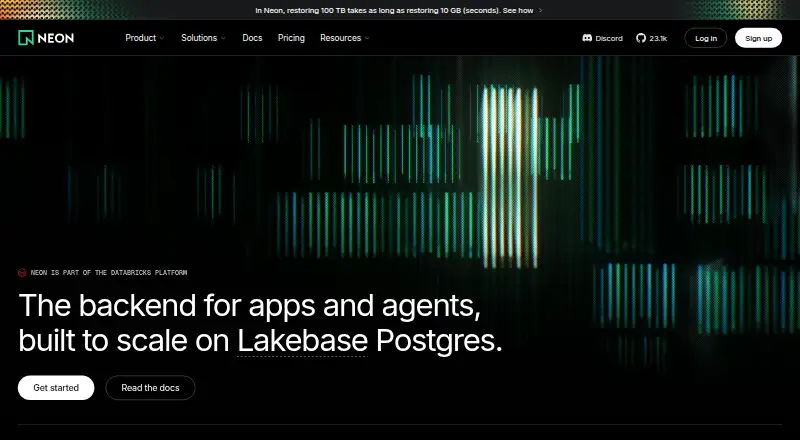
What Neon is
Neon is a managed PostgreSQL service hosted in the cloud for relational data. It adjusts compute resources to workload and can suspend them during inactivity, restarting when database activity resumes. Database branches are isolated, can be created in about a second, and share data through copy-on-write storage. Neon also supports PgBouncer connection pooling, read replicas, high availability, point-in-time recovery, JSON data, and seven-day backup retention. Its API manages projects and databases, and documented integrations and workflows include Vercel, Prisma, Drizzle ORM, GitHub Actions, and its CLI. The Free plan costs nothing and includes 10 projects, 50 CU-hours per month per project, 0.5 GB storage per project, 10 branches per project, and 5 GB monthly egress. Launch is listed at $0.11 a month, with usage-based billing and no monthly minimum. Scale is listed at $0.22 a month, also with usage-based billing and no monthly minimum. Neon states that data is encrypted at rest with AES-256 and in transit with TLS 1.2 or higher.
Who it suits
Neon suits developers and teams building relational applications who want managed PostgreSQL with workload-based compute and database branching. Its Scale plan is intended for production workloads requiring advanced security, availability, and compliance features.
What it does well
- Compute adjusts to workload and can scale to zero.
- Isolated branches share data through copy-on-write storage.
- Supports high availability and point-in-time recovery.
- Provides an API and documented integration workflows.
- Free plan includes 10 projects.
What to know first
- Free plan storage is 0.5 GB per project.
- Free plan egress is limited to 5 GB monthly.
- Free plan allows 10 branches per project.
- Launch and Scale usage is billed by consumption.
Limits
The Free plan includes 10 projects, 50 CU-hours per month per project, 0.5 GB storage per project, 10 branches per project, and 5 GB monthly egress. Launch includes 10 branches per project and autoscaling up to 16 CU; additional branches cost $0.002 per branch-hour. Scale includes 25 branches per project and a 30-day Instant Restore window.
Plans
| Plan | Billed and limits | Price |
|---|---|---|
| Free | Free · 10 projects · 50 CU-hours/month per project · 0.5 GB storage per project · 10 branches/project · 5 GB/month egress | Free |
| Launch | $0.106 per CU-hour; $0.35 per GB-month storage · Usage-based with no monthly minimum · 10 branches/project included, then $0.002 per branch-hour · autoscaling up to 16 CU · 100 GB/month egress | $0.11 a month |
| Scale | $0.222 per CU-hour; usage-based with no monthly minimum · 1,000 projects · 99.95% SLA-backed uptime · private networking and IP allow lists · 25 branches/project included · 30-day Instant Restore window | $0.22 a month |
As neon.com lists them, read 30 Sept 2026. The maker's own page has the final word.
Getting started
- Open neon.com.
- Choose the Free, Launch, or Scale plan.
- Use the API or CLI to manage projects and databases programmatically.
- Connect a documented workflow such as Vercel, Prisma, Drizzle ORM, or GitHub Actions.
Neon is a managed, cloud-hosted PostgreSQL service for teams that need elastic database compute and fast isolated branches. It suits growing applications with uneven demand especially well; organizations requiring production-grade availability and compliance should consider the higher Scale tier and its usage charges carefully.
Overview
Neon is a relational database service with JSON support, high availability, read replicas and point-in-time recovery. Its compute can autoscale with workload and suspend after inactivity, then resume when activity returns. That model can reduce always-on resource use for intermittent applications, while cloud-only deployment rules out teams that must host the database on their own infrastructure.
Neon says it joined Databricks in May 2025 and is now part of the Databricks Platform. Data at rest is encrypted with AES-256, and data in transit uses TLS 1.2 or higher. Neon undergoes annual SOC 2 Type II, ISO/IEC 27001:2022 and ISO/IEC 27701:2019 audits and states that it has achieved HIPAA compliance.
Key features
Elastic compute
Autoscaling adjusts database compute to demand, while scale-to-zero suspends compute during inactivity and restarts it when activity resumes. This is a strong fit for development environments, prototypes and workloads with quiet periods. The free allowance still limits sustained use to 50 CU-hours per month per project, so consistently busy services will move quickly into paid consumption.
Branching and pooling
Isolated database branches can be created in about a second and share data through copy-on-write storage. That combination supports separate development or testing environments without duplicating all underlying data. Neon also supports PgBouncer connection pooling, useful when applications open many short-lived connections.
Management and integrations
An API manages projects and databases programmatically. Neon documents workflows with Vercel, Prisma, Drizzle ORM, GitHub Actions and its CLI, giving teams established integration paths for application deployment and automation. Support is directed through Neon's Discord community.
Pricing
Free
The Free plan costs nothing and includes 10 projects, 50 CU-hours per month per project, 0.5 GB storage per project, 10 branches per project and 5 GB monthly egress. It is appropriate for learning, prototypes and small low-traffic applications. The per-project compute and storage ceilings make it unsuitable for a production workload with sustained activity or larger datasets.
Launch
Launch is priced at $0.11 a month, billed at $0.106 per CU-hour and $0.35 per GB-month of storage, with usage-based billing and no monthly minimum. It includes 10 branches per project, autoscaling up to 16 CU and 100 GB monthly egress; branches beyond the included amount cost $0.002 per branch-hour. Neon describes this tier for growing projects and early startups. Compared with Free, it removes the small fixed allowances in favor of metered capacity, so costs track usage but require monitoring.
Scale
Scale is priced at $0.22 a month, billed at $0.222 per CU-hour with usage-based billing and no monthly minimum. It supports up to 1,000 projects, includes a 99.95% SLA-backed uptime commitment, private networking, IP allow lists, 25 branches per project and a 30-day Instant Restore window. It is intended for production workloads that need stronger security, availability and compliance controls. The higher CU rate makes it harder to justify for small or experimental deployments.
Platforms
Neon is offered through api, Linux, macOS, web and Windows platforms. The deployment model is cloud and the service is managed, rather than self-hosted.
Who it's for
Choose Neon for a startup or application team that wants PostgreSQL with autoscaling, scale-to-zero behavior, programmatic administration and rapid database branches. It is particularly well suited to variable workloads and development workflows that benefit from isolated environments. Scale is the relevant option for production teams needing private networking, IP allow lists, an uptime SLA and a longer restore window.
Look elsewhere if self-hosting is mandatory, if predictable flat pricing is more important than consumption billing, or if the Free plan's project, storage, compute and egress caps cannot support your workload.
Pros and cons
- Pros: Autoscaling and suspend-on-idle behavior accommodate uneven demand.
- Pros: Fast copy-on-write branching creates isolated database environments without full data duplication.
- Pros: API access, PgBouncer pooling and documented Vercel, Prisma, Drizzle ORM, GitHub Actions and CLI workflows support automation.
- Pros: Scale adds a 99.95% SLA, private networking, IP allow lists and a 30-day Instant Restore window.
- Cons: Free limits are tight at 50 CU-hours and 0.5 GB storage per project, with 5 GB monthly egress.
- Cons: Launch and Scale use consumption billing, making monthly spend less predictable as compute, storage or branch use grows.
- Cons: Cloud-only deployment cannot meet an on-premises or self-hosted requirement.
Alternatives
For a broader directory of Relational Databases, compare other relational services when Neon’s cloud-only, usage-based model does not fit. The Data Version Control Tools list is more appropriate when versioning datasets, rather than running a managed PostgreSQL database, is the central need.
git-annex is free software for managing large files without storing their contents in Git, so choose it for file-oriented versioning instead of a relational database. Weights & Biases fits machine-learning experiment tracking, with a free tier offering five model seats, 5 GB monthly storage and 1 GB monthly Weave ingestion. Apache Iceberg is a free Apache-licensed table format for data-lake workloads. Apache Paimon is a free open-source data-lake platform with selectable connectors and storage plugins.
ClearML is an alternative for teams seeking an open-source self-hosted machine-learning platform. Dolt is a free, open-source database with Git-like versioning, while its DoltHub Pro plan costs $5 a month for private data. Nile runs entirely on a machine without a cloud account, making it preferable for local data version control. DataChain offers local open-source compute for a single developer and cloud-storage backends, with a Teams plan for collaborative use.
Verdict
Neon is a strong choice for teams building cloud applications that need PostgreSQL, elastic compute and near-instant isolated branches. Its main reason to choose is the combination of scale-to-zero behavior, branching and automation-friendly management. Look elsewhere when self-hosting or fixed, predictable costs are essential, or when the Free plan’s low storage and compute allowances cannot cover real usage.
Verdict
Neon combines managed PostgreSQL with compute that can pause during inactivity, database branching, and programmatic management. Its free tier has stated project, storage, compute, branch, and egress limits; paid plans use consumption-based billing.
Questions
Does Neon have a free plan?
Yes. The Free plan costs nothing and includes 10 projects, 50 CU-hours per month per project, 0.5 GB storage per project, 10 branches per project, and 5 GB monthly egress.
How are Launch and Scale priced?
Launch is $0.11 a month, billed at $0.106 per CU-hour. Scale is $0.22 a month, billed at $0.222 per CU-hour; both are usage-based with no monthly minimum.
Which platforms does Neon support?
The listed platforms are API, Linux, macOS, web, and Windows.
What integrations does Neon document?
Neon documents workflows involving Vercel, Prisma, Drizzle ORM, GitHub Actions, and its CLI.
What security and compliance does Neon state?
Neon says stored data uses AES-256 encryption and data in transit uses TLS 1.2 or higher. It reports annual SOC 2 Type II, ISO/IEC 27001:2022, and ISO/IEC 27701:2019 audits and says it has achieved HIPAA compliance.
Facts from Neon's own pages
- API
- Neon provides an API for managing projects and databases programmatically. · neon.com, 30 Sept 2026
- Autoscaling
- Neon automatically adjusts database compute resources based on workload. · neon.com, 30 Sept 2026
- Branching
- Neon database branches are isolated, can be created in about a second, and share data through copy-on-write storage. · neon.com, 30 Sept 2026
- Company
- Neon says it joined Databricks in May 2025 and is now part of the Databricks Platform. · neon.com, 30 Sept 2026
- Compliance
- Neon states it undergoes annual SOC 2 Type II, ISO/IEC 27001:2022, and ISO/IEC 27701:2019 audits, and has achieved HIPAA compliance. · neon.com, 30 Sept 2026
- Connection pooling
- Neon supports connection pooling using PgBouncer. · neon.com, 30 Sept 2026
- Integrations
- Neon documents integrations and workflows involving Vercel, Prisma, Drizzle ORM, GitHub Actions, and its CLI. · neon.com, 30 Sept 2026
- Product
- Neon describes itself as a serverless, cloud-hosted PostgreSQL database service. · neon.com, 30 Sept 2026
- Scale to zero
- Neon can suspend compute after inactivity and restart it when database activity resumes. · neon.com, 30 Sept 2026
- Security
- Neon states that stored data is encrypted with AES-256 and data in transit uses TLS 1.2 or higher. · neon.com, 30 Sept 2026
- Support
- Neon directs customers to its Discord community for questions and discussion. · neon.com, 30 Sept 2026
- Use cases
- Neon describes its Launch plan as suited to growing projects and early startups, and Scale as intended for production workloads requiring advanced security, availability, and compliance features. · neon.com, 30 Sept 2026
Where Neon stands on Freedom251
- Ai Databases#6 of 40
- Data Version Control Tools#15 of 36
- Databases And Backend#14 of 33
- Relational Databases#17 of 38
- Transaction Data Store Software#17 of 29