Freedom251 › Data Version Control Tools

Apache Paimon
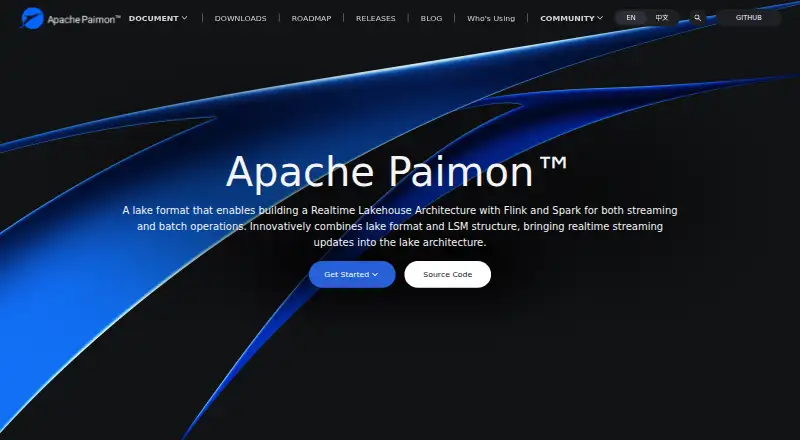
What Apache Paimon is
Apache Paimon is a free, open-source lake format for building realtime lakehouse architectures with streaming and batch operations through Flink and Spark. Primary-key tables support large-scale updates using configurable merge engines for deduplication, partial updates, aggregation or first-row updates. Append tables support batch and streaming processing, with automatic small-file merging and compaction using Z-order sorting. Paimon also provides ACID transactions, time travel, schema evolution and metadata for petabyte-scale datasets and many partitions. Listed engine integrations include Flink, Spark, Hive, Trino, Presto, StarRocks and Doris, though available operations vary by engine and version. Documented CDC pipelines cover MySQL, PostgreSQL, Kafka, MongoDB and Pulsar. The project also describes blob tables, vector and full-text search, and a Python SDK with Ray, PyTorch and Pandas integrations. PyPaimon provides catalog, table, Arrow and pandas APIs, and core table reads and writes do not require a JVM or running Flink or Spark cluster. Users choose connectors and storage plugins for their environment; distributed clusters need shared storage available to participating processes.
Who it suits
Paimon suits teams building lakehouse systems that need both streaming and batch data operations. Python users can access core table reads and writes without a JVM or an active Flink or Spark cluster.
What it does well
- Supports ACID transactions and time travel.
- Handles primary-key updates and append processing.
- Documents CDC pipelines for five listed systems.
- Core Python table reads and writes need no JVM.
What to know first
- Supported operations vary by engine and version.
- Engine integrations require matching connectors or built-in integrations.
- Distributed clusters need shared storage.
- Users must choose connectors and storage plugins.
Plans
| Plan | Billed and limits | Price |
|---|---|---|
| Apache Paimon | Open-source data lake platform; choose connectors and storage plugins for your environment | Free |
As paimon.apache.org lists them, read 4 Oct 2026. The maker's own page has the final word.
Getting started
- Visit the Apache Paimon website.
- Choose the engine JARs, filesystem plugins, or Java API bundle for your environment.
- Select a documented storage option and configure catalog and warehouse access.
- For an engine integration, use a matching connector or built-in integration.
- For distributed clusters, make shared storage available to participating processes.
Overview
Apache Paimon is an open-source lake format for teams building lakehouses around streaming and batch data. It is best suited to data engineers who can assemble a stack from supported engines, catalogs, and storage; the trade-off is that Paimon is a table-management layer, not a complete hosted data platform.
Key features
Mutable and append-focused tables
Primary-key tables support large-scale updates with merge strategies for deduplication, partial updates, aggregation, and first-row updates. Their LSM structure and changelog producers suit streaming change-data workflows. Append tables instead target large batch and streaming loads, with automatic small-file merging and compaction that can use Z-order sorting. This division gives teams useful choices for different write patterns, but it also makes table design an early architectural decision.
History and large-scale management
ACID transactions, schema evolution, time travel, table-level snapshots, branching, and point-in-time rollback support governed changes to datasets over time. The project also targets petabyte-scale tables and many partitions, with fast scan planning and incremental clustering for analytics. These capabilities are valuable in large lakehouse deployments, though they do not replace the work of operating the surrounding compute and storage.
Integrations and deployment
Documented engine integrations include Flink, Spark, Hive, Trino, Presto, StarRocks, and Doris, while CDC pipelines cover MySQL, PostgreSQL, Kafka, MongoDB, and Pulsar. Supported reads, writes, and table operations vary by engine and version, so teams should verify that their required operations align with the compatibility matrix before committing.
PyPaimon provides catalog, table, Arrow, and pandas APIs plus a command-line tool. Core reads and writes do not require a JVM or a running Flink or Spark cluster, which gives Python users a more direct route to table data. The broader project also describes blob tables, vector and full-text search, and integrations with Ray, PyTorch, and Pandas for multimodal and AI workloads.
Deployment remains an engineering responsibility: engine use requires the matching connector or built-in integration and access to the catalog and warehouse storage, while distributed clusters need shared storage accessible to participating processes. Filesystem options include local files, HDFS, and several cloud object stores. Authorization generally belongs to the surrounding catalog, engine, service, operator configuration, and storage permissions rather than to one central Paimon security layer.
Pricing
Apache Paimon is free and open source. Its Apache Paimon plan costs nothing and includes an open-source data lake platform; users choose the connectors and storage plugins for their environment. There are no paid tiers to unlock, but the plan does not include a hosted service: teams must provide and operate the required engines, catalog, and storage. Storage is bring-your-own.
Platforms
Paimon supports API, Linux, macOS, Windows, and self-hosted deployments. Its Java API bundle can be embedded in Java applications, and PyPaimon offers Python access. Practical compatibility depends on selecting the appropriate engine integration, connector, and storage backend.
Who it's for
Paimon is a strong fit for data engineering teams that need transactional lake tables for both streaming updates and batch processing, especially when they already operate compatible engines and shared storage. Python users who need table APIs without running a Flink or Spark cluster may also find PyPaimon useful. It is a weaker fit for buyers seeking a turnkey managed service or a single product that owns authorization and the full compute stack.
Pros and cons
- Pros: Separate primary-key and append table patterns accommodate changing records and high-volume append workflows.
- Pros: Transactions, schema evolution, snapshots, rollback, and branching support data lifecycle management.
- Pros: Broad engine and CDC integrations, plus a Python client that can read and write without a JVM or running Flink or Spark cluster.
- Cons: Engine support differs by version and operation, so compatibility checks are necessary before deployment.
- Cons: Teams must assemble connectors, catalog, and storage, and distributed deployments require shared storage.
- Cons: Authorization depends largely on the surrounding systems, which means security configuration spans the stack.
Alternatives
For a comparable free lakehouse table format, consider Apache Iceberg. Paimon can publish Iceberg metadata so applications can read existing Paimon data files through Iceberg connectors, while writes and maintenance remain in Paimon.
For large-file management without storing file contents in Git, git-annex is a free alternative. For model and experiment workflows, Weights & Biases offers a free tier with 5 model seats, 5 GB monthly storage, and 1 GB monthly Weave data ingestion.
ClearML is another option, with a self-hosted version described as fully open source. For versioned data with a database-oriented approach, Dolt has a free open-source plan with an approximately 100 MB program. Neon may suit readers looking for a hosted database platform with a free tier that includes 10 projects, 10 branches per project, and defined compute, storage, and egress allowances.
Nile offers a free local option that runs on the user's machine without a cloud account. DataChain is an alternative for local data work, with a free single-developer plan supporting millions of records and S3, GCS, or Azure storage. Browse the Data Version Control Tools directory for more options.
Verdict
Choose Apache Paimon if you need a free, open-source table layer for streaming and batch lakehouse workloads and are prepared to run its compatible engines, catalog, and storage. Its range of table operations and integrations is the central reason to choose it; the main reason to look elsewhere is the operational burden of building and securing the surrounding stack.
Verdict
Paimon provides table management for streaming and batch lakehouse workloads, with integrations spanning several engines and data sources. Check engine compatibility and storage requirements for the intended deployment.
Questions
How much does Apache Paimon cost?
The listed plan is free. It is an open-source data lake platform.
Is there a free plan or trial?
There is a free plan. The facts do not list a free trial.
Which engines integrate with Paimon?
The ecosystem lists Flink, Spark, Hive, Trino, Presto, StarRocks, and Doris. Supported operations vary by engine and version.
What storage can Paimon use?
Documented options include local files, HDFS, Aliyun OSS, S3, Tencent COS, Azure Storage, Huawei OBS, and Google Cloud Storage.
Can Paimon publish Iceberg metadata?
Yes. Applications can use Iceberg connectors to read Paimon's existing data files; writing and maintenance remain in Paimon.
What support and security reporting routes does the project provide?
The project directs users to its mailing list and GitHub issue tracker for help and issue reporting. Possible vulnerabilities should be reported privately to [email protected] before public disclosure.
Facts from Apache Paimon's own pages
- Analytics
- The project describes petabyte-scale tables with time travel, fast scan planning, schema evolution, and incremental clustering. · paimon.apache.org, 4 Oct 2026
- Append processing
- Append tables support large-scale batch and streaming processing, automatic small-file merging, and data compaction with Z-order sorting. · paimon.apache.org, 4 Oct 2026
- CDC
- The documentation lists CDC pipelines for MySQL, PostgreSQL, Kafka, MongoDB, and Pulsar. · paimon.apache.org, 4 Oct 2026
- CDC ingestion
- The project homepage lists CDC pipelines for MySQL, PostgreSQL, Kafka, MongoDB, and Pulsar. · paimon.apache.org, 4 Oct 2026
- Compute integrations
- The ecosystem compatibility page lists integrations for Flink, Spark, Hive, Trino, Presto, StarRocks, and Doris, with supported operations varying by engine. · paimon.apache.org, 4 Oct 2026
- Data management
- Paimon supports ACID transactions, time travel, schema evolution, and metadata for petabyte-scale datasets and many partitions. · paimon.apache.org, 4 Oct 2026
- Data security
- The filesystems guide documents OSS server-side encryption headers and configuration for AES256, KMS, or SM4. · paimon.apache.org, 4 Oct 2026
- Deployment model
- The download guide offers engine JARs, filesystem plugins, and a Java API bundle to run Paimon with query engines or embed it in a Java application. · paimon.apache.org, 4 Oct 2026
- Deployment requirement
- Engine integrations require a matching connector or built-in integration and access to the catalog and warehouse storage; distributed clusters need shared storage available to participating processes. · paimon.apache.org, 4 Oct 2026
- Iceberg access
- Paimon can publish Iceberg metadata so applications can read its existing data files through Iceberg connectors; writers and maintenance remain in Paimon. · paimon.apache.org, 4 Oct 2026
- Integration limits
- The compatibility matrix lists engine version ranges and shows that supported read, write, and table operations vary by engine. · paimon.apache.org, 4 Oct 2026
- Multimodal and Python
- The homepage describes vector search, full-text search, blob tables, and a Python SDK with integrations including Ray, PyTorch, and Pandas. · paimon.apache.org, 4 Oct 2026
- Multimodal data
- The project lists blob storage, vector storage, full-text search, and global indexing capabilities. · paimon.apache.org, 4 Oct 2026
- Purpose
- Apache Paimon is a lake format for unified batch, streaming, and multimodal AI workloads. · paimon.apache.org, 4 Oct 2026
- Python and AI
- PyPaimon is described as a Python SDK with Ray, PyTorch, and Pandas integrations for AI and multimodal workloads. · paimon.apache.org, 4 Oct 2026
- Python client
- PyPaimon provides catalog, table, Arrow, and pandas APIs plus a command-line tool; core table reads and writes do not require a JVM or a running Flink or Spark cluster. · paimon.apache.org, 4 Oct 2026
- Query engines
- The ecosystem documentation lists Flink, Spark, Hive, Trino, Presto, StarRocks, and Doris integrations. · paimon.apache.org, 4 Oct 2026
- Realtime updates
- Primary key tables support large-scale updates and configurable merge engines, including deduplication, partial updates, aggregation, and first-row updates. · paimon.apache.org, 4 Oct 2026
- Security model
- The project says trust and authorization boundaries are generally enforced by the surrounding catalog, engine, service, operator configuration, and storage authorization. · paimon.apache.org, 4 Oct 2026
- Security reporting
- The security page asks users to report vulnerabilities privately to the Apache Security Team at [email protected] before public disclosure. · paimon.apache.org, 4 Oct 2026
- Storage
- Documented filesystem options include local files, HDFS, Aliyun OSS, S3, Tencent COS, Azure Storage, Huawei OBS, and Google Cloud Storage. · paimon.apache.org, 4 Oct 2026
- Streaming
- Primary-key tables support streaming updates using LSM structure, merge engines, and changelog producers. · paimon.apache.org, 4 Oct 2026
- Support
- The project directs users to its user mailing list and GitHub issue tracker for help and issue reporting. · paimon.apache.org, 4 Oct 2026
- Vulnerability reporting
- The project directs users to report possible vulnerabilities privately to [email protected] and not disclose them publicly before the project responds. · paimon.apache.org, 4 Oct 2026
Where Apache Paimon stands on Freedom251
- Data Version Control Tools#3 of 36