Freedom251 › Mutation Testing Tools
Mutant
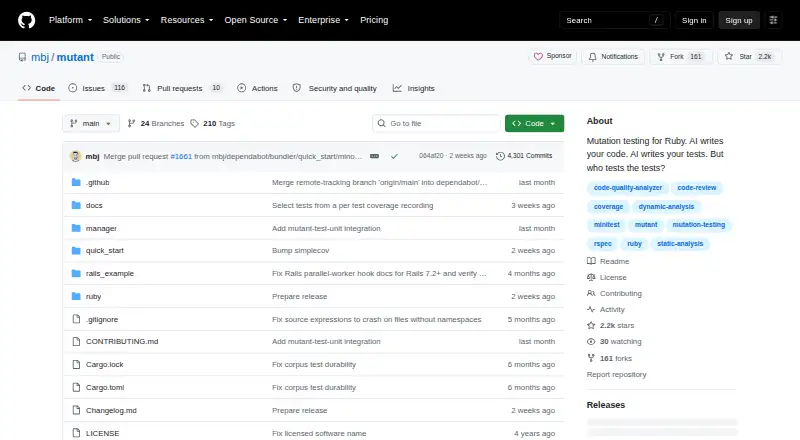
What Mutant is
Mutant is Ruby mutation testing software that checks whether a test suite detects deliberate changes to code. It alters arithmetic, logical and bitwise operators, removes statements, and changes return values, then reports mutations that survive the tests. It works with RSpec, Minitest and Test::Unit, and supports incremental analysis for CI workflows. Mutant supports Ruby 3.2, 3.3, 3.4 and 4.0 for runtime, syntax and mutations. For Rails applications, its integration includes parallel-worker database isolation for PostgreSQL and SQLite and is verified for Rails 7.2, 8.0 and 8.1. Mutant runs on developers’ machines or in CI, with parallel execution and surviving-mutant reports available. It cannot emit mutations for methods defined within closures, including those created with module_eval, class_eval, define_method or define_singleton_method. The open-source plan costs nothing for public repositories with the full feature set. Commercial monthly access is $30 a month per developer, and yearly access is $250 a year per developer; CI use requires no additional subscription. Mutant was created and is developed by Markus Schirp.
Who it suits
Mutant suits Ruby developers who want to assess whether their RSpec, Minitest or Test::Unit suites catch code changes, including teams running incremental mutation analysis in CI. Rails teams can use its integration with supported Rails versions and PostgreSQL or SQLite worker isolation.
What it does well
- Works with RSpec, Minitest and Test::Unit.
- Supports Ruby 3.2, 3.3, 3.4 and 4.0.
- Incremental mode supports CI workflows.
- Rails integration isolates parallel workers with PostgreSQL and SQLite.
- Free plan includes the full feature set for public repositories.
What to know first
- Cannot emit mutations for methods defined within closures.
- Commercial code requires a subscription per developer.
- Runs only on developers’ machines or in CI.
Limits
The free open-source plan is for public repositories. Commercial subscriptions are billed per developer; CI execution requires no additional subscription.
Plans
| Plan | Billed and limits | Price |
|---|---|---|
| Open source | public repositories · full feature set | Free |
| Commercial yearly | per developer · any number of repositories · CI use requires no additional subscriptions | $250 a year |
| Commercial monthly | per developer · any number of repositories · CI use requires no additional subscriptions | $30 a month |
| Enterprise | volume subscriptions · custom plans | On request |
As github.com lists them, read 1 Oct 2026. The maker's own page has the final word.
Getting started
- Visit the Mutant website on GitHub.
- Choose the open-source plan for a public repository, or a commercial subscription for commercial code.
- Run Mutant on a developer machine or in CI.
- Integrate it with RSpec, Minitest or Test::Unit.
Mutant is a Ruby mutation-testing tool for teams using RSpec, Minitest, or Test::Unit. Its framework support, incremental CI mode, and Rails database isolation make it a focused option for Ruby projects whose methods fall within its mutation coverage.
Overview
Mutation testing checks whether a test suite catches deliberate changes to code. Mutant alters arithmetic, logical, and bitwise operators, removes statements, and changes return values. Surviving mutations give developers concrete places to examine whether tests protect the intended behavior.
Mutant runs on developers’ machines or in CI. That suits teams who want mutation analysis within their development and build environments; there is no execution outside those settings. Schirp DSO LTD says it does not access customer source code, customer data, or other sensitive material, and that customer information is never shared or sold. Discord, GitHub Issues, and release announcements are its communication channels.
Key features
Ruby frameworks and mutation reports
Support for RSpec, Minitest, and Test::Unit lets teams use Mutant with several established Ruby testing frameworks. It supports Ruby 3.2, 3.3, 3.4, and 4.0 for runtime, syntax, and mutations. Reports of surviving mutants help focus test improvements on code changes the suite did not catch.
Incremental runs and parallel execution
Incremental mode supports mutation testing in CI, which makes it more practical to include analysis in an ongoing build workflow. Parallel execution is also supported. Together, these capabilities suit teams that want mutation analysis as part of regular development rather than only as an occasional manual step.
Rails database isolation
Mutant supports Rails applications with parallel-worker database isolation for PostgreSQL and SQLite. The integration is verified for Rails 7.2, 8.0, and 8.1, making it a more specific fit for teams on those versions and databases. This does not extend the stated database support beyond PostgreSQL and SQLite.
A defined coverage boundary
Mutant cannot emit mutations for methods defined inside closures, including methods created with module_eval, class_eval, define_method, or define_singleton_method. Projects that rely on those patterns will have a gap in mutation coverage, so teams should weigh that limitation against the value of Mutant’s framework and Rails support.
Pricing
The Open source plan costs nothing and includes the full feature set for public repositories. It is the clear fit for public Ruby projects, but it does not cover commercial code.
Commercial monthly costs $30 a month, billed per developer, and covers any number of repositories. Commercial yearly costs $250 a year per developer and also covers any number of repositories. Both commercial plans require a subscription for each developer using Mutant on commercial code; CI use requires no additional subscriptions. Teams should account for developer seats when comparing the monthly and yearly terms.
Enterprise offers volume subscriptions and custom plans at custom pricing. There is no free trial. The free plan is limited to public repositories, while the paid plans suit developers working on commercial code.
Platforms
Mutant supports Linux and macOS. Ruby support covers versions 3.2, 3.3, 3.4, and 4.0 for runtime, syntax, and mutations. Teams on other operating systems or Ruby versions fall outside the stated platform and version support.
Who it's for
Mutant suits Ruby developers who want to assess whether their tests catch meaningful changes and who use RSpec, Minitest, or Test::Unit. Rails teams using PostgreSQL or SQLite on Rails 7.2, 8.0, or 8.1 get the added benefit of parallel-worker database isolation. Public repositories can use every feature at no charge; commercial teams need to budget per developer, with no extra subscription for CI execution.
Pros and cons
Pros
- Integrates with RSpec, Minitest, and Test::Unit, so teams using any of these frameworks can apply mutation testing without changing their test framework.
- Incremental CI mode and parallel execution support recurring analysis in development workflows.
- Public repositories get the full feature set free, and commercial CI execution adds no subscription charge.
- Rails support includes parallel-worker database isolation for PostgreSQL and SQLite on verified Rails versions.
- Execution stays on developer machines or in CI, and the maker says customer data is not accessed, shared, or sold.
Cons
- Closure-defined methods cannot be mutated, leaving a coverage gap for projects built around those definitions.
- Commercial licensing is billed per developer, so costs grow with the number of developers using Mutant on commercial code.
- Execution is limited to developer machines and CI, which rules out teams seeking another execution model.
- Support for Rails database isolation is scoped to PostgreSQL and SQLite and the verified Rails versions.
Alternatives
Mutation Testing Tools is a useful place to compare options across the category.
- ArcMutate is another freemium option for Linux and macOS, with self-hosted and Windows platforms also supported. Its free licenses are for open-source projects, and it offers a free trial.
- MuJava is a free option for Linux, macOS, and Windows, provided as-is under the Apache license.
- Mutatest is a free, MIT-licensed option for Linux, macOS, and Windows.
- go-mutesting is a free MIT-licensed Go mutation-testing framework for Linux and self-hosted environments.
- LittleDarwin is a free Java mutation analysis framework for Linux, supported through donations.
- MutPy is a free option for Linux and self-hosted environments, with no paid plans or usage limits stated.
- pymute is a free Linux option installed with Cargo and requires Rust and Cargo.
- pytest-gremlins is a free, MIT-licensed Linux package that requires Python 3.11 or later.
Verdict
Choose Mutant for Ruby mutation testing when your team uses a supported test framework and Ruby version, particularly if Rails database isolation or incremental CI runs matter. Its full-featured free plan is strong for public repositories, while commercial teams get unlimited repositories under per-developer subscriptions. Look elsewhere if your code depends on closure-defined methods, if you need another operating system or execution setting, or if per-developer commercial licensing does not fit.
Verdict
Choose Mutant if you need Ruby mutation testing with the test frameworks and Ruby versions it supports, or Rails integration with parallel-worker database isolation. Public repositories can use the full feature set at no charge. Look elsewhere if your code relies on methods defined within closures, or if you need execution outside developer machines and CI.
Questions
Is Mutant free?
The open-source plan costs nothing for public repositories and includes the full feature set.
How much do commercial subscriptions cost?
The monthly plan is $30 a month per developer. The yearly plan is $250 a year per developer.
Which Ruby versions does Mutant support?
It supports Ruby 3.2, 3.3, 3.4 and 4.0 for runtime, syntax and mutations.
Which test frameworks does it integrate with?
Mutant integrates with RSpec, Minitest and Test::Unit.
Can Mutant run in CI?
Yes. It supports incremental mode for CI, and CI use requires no additional subscription.
Who develops Mutant?
Mutant was created and is developed by Markus Schirp.
Facts from Mutant's own pages
- CI workflow
- Mutant supports incremental mode for running mutation testing in CI. · github.com, 1 Oct 2026
- Commercial licensing
- Commercial subscriptions are required per developer using Mutant on commercial code, while CI execution requires no additional subscriptions. · github.com, 1 Oct 2026
- Creator
- Mutant was created and is developed by Markus Schirp and is cited as subject of IEEE-published research. · github.com, 1 Oct 2026
- Data sharing
- Customer information is never shared or sold to anyone. · github.com, 1 Oct 2026
- Execution model
- Mutant runs exclusively on developers’ machines or in CI. · github.com, 1 Oct 2026
- Headquarters
- Naxxar, Malta · github.com, 28 Sept 2026
- Mutation operators
- Mutant mutates arithmetic, logical and bitwise operators, removes statements, and modifies return values. · github.com, 1 Oct 2026
- Purpose
- Mutant is mutation testing for Ruby that systematically modifies code and verifies that tests catch each change. · github.com, 1 Oct 2026
- Rails integration
- Mutant supports Rails applications with parallel-worker database isolation for PostgreSQL and SQLite. · github.com, 1 Oct 2026
- Rails versions
- The Rails integration is verified for Rails 7.2, 8.0, and 8.1. · github.com, 1 Oct 2026
- Ruby support
- Mutant supports Ruby versions 3.2, 3.3, 3.4, and 4.0 for runtime, syntax, and mutations. · github.com, 1 Oct 2026
- Source-code privacy
- Schirp DSO LTD states that it does not get access to customers’ source code, customer data, or other sensitive material. · github.com, 1 Oct 2026
- Subject limitation
- Mutant cannot emit mutations for methods defined within closures such as module_eval, class_eval, define_method, or define_singleton_method. · github.com, 1 Oct 2026
- Support channels
- Mutant provides Discord, GitHub Issues, and release announcements as communication channels. · github.com, 1 Oct 2026
- Test integrations
- Mutant integrates with RSpec, Minitest, and Test::Unit. · github.com, 1 Oct 2026
Where Mutant stands on Freedom251
- Mutation Testing Tools#7 of 25